
Best Search API for AI Apps: 4 Web Search APIs vs Google

On this page
If you’re building anything that searches the web (an agent, a RAG pipeline, a research tool), you picked a search API. Brave, Tavily, Exa, Perplexity, one of the others. And you almost certainly picked it assuming that what it returns is basically what Google returns. A ranked list of the best pages on the web. Close enough to Google that the distinction doesn’t matter.
That assumption is worth testing, because the entire “AI search” stack rests on it. So we ran the search API comparison nobody publishes: a measured one instead of a feature-checklist table. We took the four most common independent search APIs and ran the same 500 queries through each of them and through cloro’s live Google SERP, on the same day. The query set was stratified across informational, commercial, transactional, navigational, and local intent. Then we scored how much each one actually agrees with Google, on the exact URLs, on the domains, and on the ranking order.
The answer isn’t “yes” or “no.” It’s a spectrum. Where each API sits on it tells you exactly what you’re buying.
The spectrum: from “Google reordered” to “a different web”
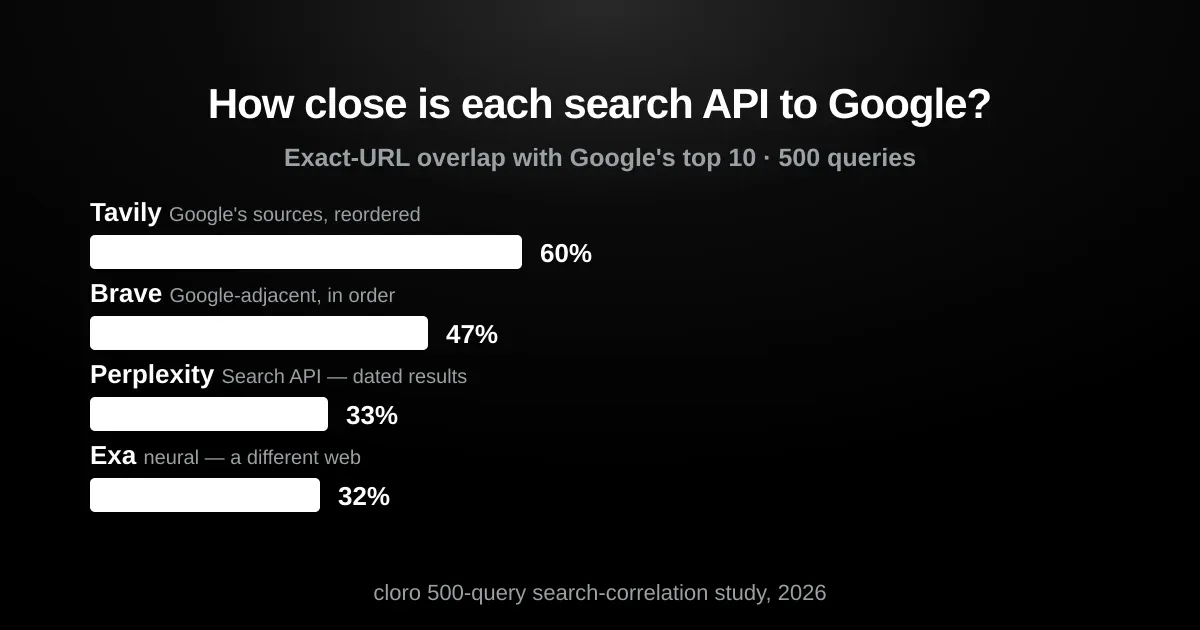
Line the four up by how much of Google’s top 10 they reproduce, and they fall into a clean gradient. This is our 500-query search-correlation study. It puts each vendor’s top 10 against Google’s, on exact URLs and on domains:
| Search API | Exact-URL overlap@10 | Domain Jaccard | Google-domain recall | Its #1 is Google-ranked | Rank ρ | Dates results | Returns an answer |
|---|---|---|---|---|---|---|---|
| Tavily | ~60% | 0.66 | 80% | 78% | 0.03 | 0% | 99.6% |
| Brave | 47% | 0.45 | 65% | 89% | 0.55 | 63% | 0% |
| Perplexity (Search API) | 33% | 0.33 | 49% | 72% | 0.43 | 100% | 0% |
| Exa | 32% | 0.30 | 44% | 68% | 0.27 | 48% | 0% |
Read left to right and the story is a slide from “Google’s page, rearranged” to “a genuinely different web.” But the most important thing in that table is the disagreement between two of its columns. “Google-domain recall” (how many of Google’s domains show up at all) and “rank ρ” (whether they come back in Google’s order) are not the same axis. A vendor can return almost all of Google’s sources in the wrong order, or fewer sources in roughly the right order. That’s the whole shape of the comparison. Here’s each API in its own words.
Tavily: Google’s sources, reordered
Tavily is the most Google-like on sources of anything we tested: its top 10 reproduced about 80% of Google’s top-10 domains and 60% of the exact URLs. If you only looked at which pages come back, you’d call it a near-clone of Google. But its rank correlation with Google was 0.03, statistically no relationship at all. Tavily takes essentially Google’s sources and returns them in an order optimized for LLM consumption, not for Google’s ranking. It’s also the only one of the four that hands back a synthesized answer by default (on 99.6% of queries), which is exactly what you want feeding a model and exactly not what you want if you’re trying to see a ranking. If your agent runs on LangChain or LangGraph, this is very likely the web it sees. We unpack the reordering in detail in Tavily vs Google Search.
Brave: Google-adjacent, and in Google’s order
Brave is the one that best preserves Google’s actual ranking: a Spearman correlation of 0.55, and its #1 result was a domain Google also ranks 89% of the time, the highest first-result agreement of the four. It shares fewer of Google’s total domains than Tavily (65% recall), but the ones it returns come back in something close to Google’s order. Brave runs its own independent index of 30-billion-plus pages, and it’s the engine behind Claude’s web search. A huge share of production “AI search” is quietly Brave search. It also attaches machine-readable dates to 63% of results, which Google’s organic block doesn’t expose, so you can filter or sort by freshness in a way a plain Google SERP won’t let you. Full breakdown in Brave Search API vs Google.
Perplexity Search API: Google-adjacent, and dated
The Perplexity Search API is a raw ranked-results endpoint rather than the Perplexity answer engine users know, and it sits in the middle of the spectrum. It recalled about half of Google’s domains (49%), preserved order moderately well (ρ 0.43), and, in its signature move, returned a machine-readable date on essentially every result (100%), skewing older (median age ~277 days), handy if you need every result timestamped, less so if you were hoping for fresh ones. It’s neither Google nor the Perplexity you see in the app; the three-way distinction is the whole subject of Perplexity Search API vs Google.
Exa: a different web, by design
Exa is the outlier, and it’s supposed to be. It’s a neural search API: it retrieves by embedding similarity, or meaning, rather than keyword-and-link ranking. So it’s the least Google-like of the four (32% URL overlap, 44% domain recall, ρ 0.27), and that’s the point, not a defect. Exa surfaces semantically related pages Google’s ranking would bury, which is a feature for discovery and research and a mismatch if you expected Google’s results. The design tradeoff is the subject of Exa Search vs Google.
What every one of them is missing
Here’s the part that unifies the whole spectrum. For all their differences in how close to Google’s sources they land, the four APIs have one thing in common: none of them returns Google’s actual result page.
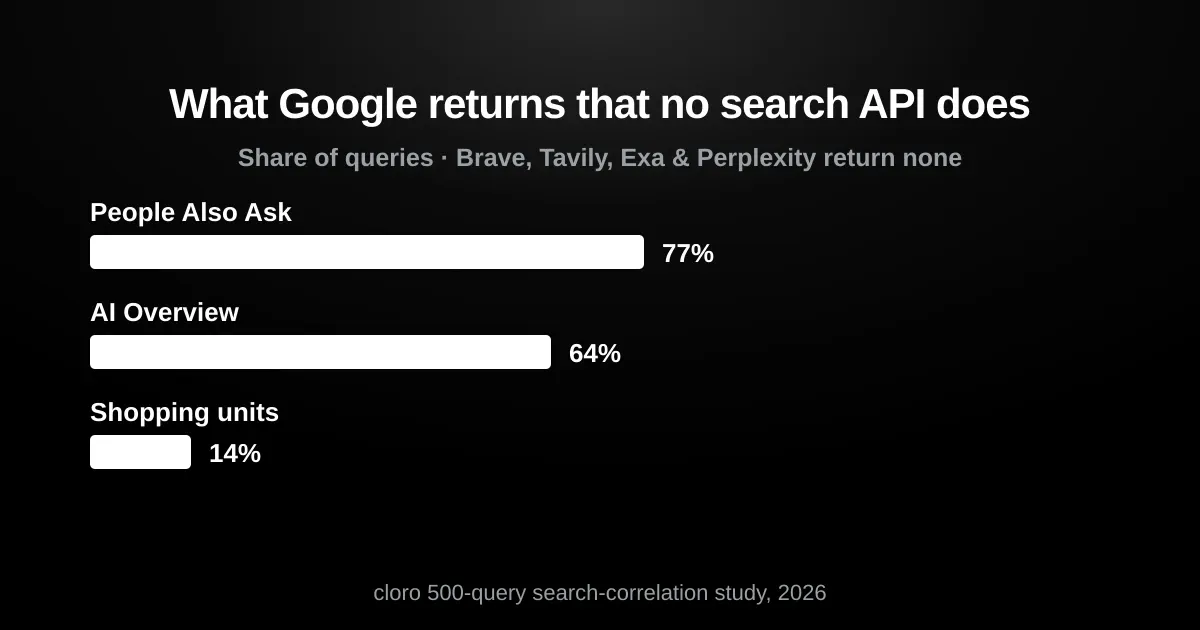
On the same 500 queries, Google rendered a People Also Ask block on 77% of them, an AI Overview on 64%, and shopping units on 14%. Brave, Tavily, Exa, and Perplexity return exactly zero of these. Because each API queries its own index or retrieval model rather than scraping Google, it structurally can’t return the Google-specific features that increasingly are the page. They give you organic links (Google’s, reordered, or a neighboring web) and nothing of the answer layer Google wraps around them.
And that layer isn’t a mirror of the organic results, either. When Google generated an AI Overview, the domains it cited overlapped with Google’s own organic top 10 only 51% of the time. So the AI Overview is pulling from sources that even Google’s organic ranking doesn’t fully surface, let alone an independent API. If AI Overview visibility is what you’re tracking, no web search API can see it, because the feature doesn’t exist outside Google’s page.
This is the bottom line of the comparison. Every independent search API can tell you, to varying degrees, which pages Google would surface. Not one of them can tell you what Google actually shows.
Pricing: the Google SERP API turns out to be the cheapest option
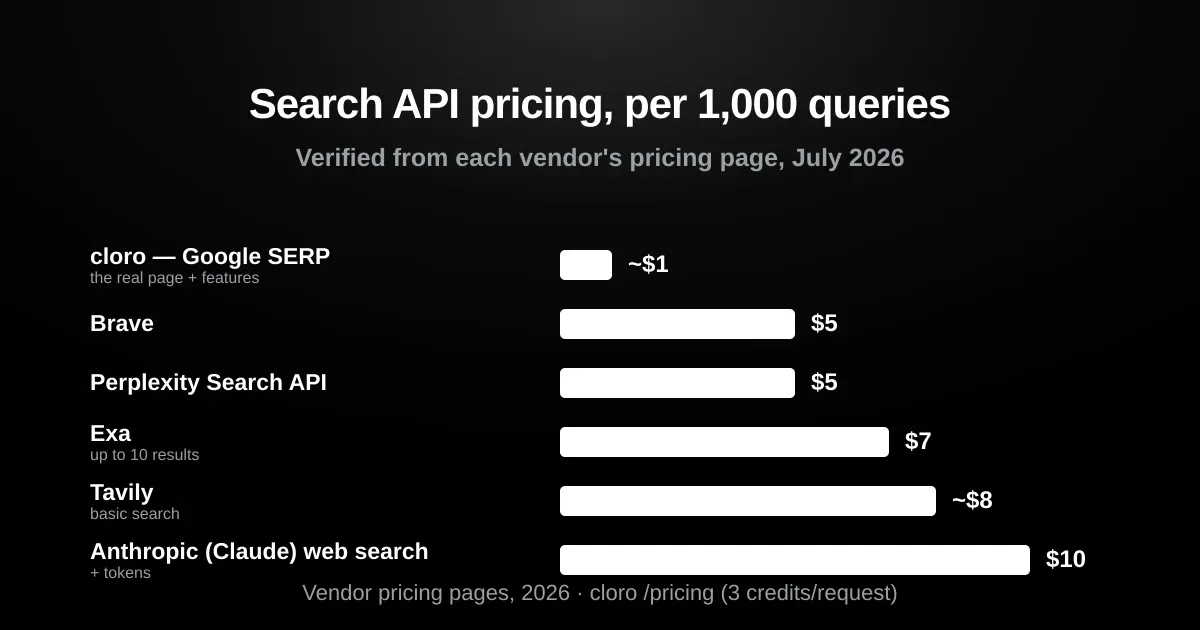
The prices cluster tightly, and the Google SERP API is the cheapest per query, which surprises people. All figures verified from each vendor’s own pricing page in July 2026:
| API | What you get | Price / 1,000 | Free tier |
|---|---|---|---|
| cloro (Google SERP) | The real Google page + AI Overview, PAA, shopping, exact order | ~$0.93–$1.20 | within base plan |
| Geekflare | Web, news and image results, or Google’s first page with serp: true | ~$0.70–$3.80 | 500 credits/mo |
| Brave | Independent index — Google-adjacent sources, in order | $5 | $5 credits/mo |
| Perplexity (Search API) | Ranked results, every one dated | $5 | — |
| Exa | Neural/embedding retrieval — a different web | $7 (≤10 results) | 20,000 req/mo |
| Tavily | ~80% of Google’s sources, reordered, + an answer | ~$8 (basic) | 1,000 credits/mo |
| Anthropic (Claude) web search | The Brave index, read & summarized by Claude | $10 + tokens | — |
The numbers behind that table: Brave’s pricing is $5 per 1,000 requests; the Perplexity Search API is $5 per 1,000; Exa is $7 per 1,000 for up to 10 results (plus $1/1,000 per extra result) with 20,000 free requests a month; Tavily is $0.008 per credit and a basic search is one credit, so about $8 per 1,000 (advanced searches are two credits); and Claude’s web search is $10 per 1,000 plus token costs: the Brave index with a model wrapper at double Brave’s own price. cloro’s pricing includes a Free tier with 500 credits a month, and Hobby is $100/mo for 250,000 credits; a Google Search request is 3 credits, which works out to roughly $0.93 to $1.20 per 1,000 queries.
Parallel, an AI-native retrieval API outside this test, lands in the same band: its Search endpoint is $5 per 1,000 requests with 10 results included. So adding a fifth independent API to the table would not change the pricing picture.
Geekflare’s Search API sits across both sides of this comparison. By default it returns ad-free web, news or image results, can scrape the top pages or add a grounded answer in the same call, and ships an MCP server. With serp: true it returns Google’s first results page instead, with organic results, People Also Ask and related searches, plus city-level targeting. Its SERP documentation lists no AI Overview field, and a request returns one page of about 10 results. Per Geekflare’s pricing, a search costs 2 credits in either mode, which works out to $3.80 per 1,000 on the $19 Starter plan and $0.70 on the $349 Business plan, with 500 free credits a month.
The takeaway: it isn’t that one price wins. The cheapest option isn’t automatically the best search API for your job. Price barely varies, so it shouldn’t drive the decision; what varies is the output. Pay for the one whose output you actually need.
Which is the best search API for your use case?
The spectrum maps cleanly onto use cases, so the best search API is the right tool per job rather than a single winner.
- Grounding an LLM or agent, cheapest sources. Any independent API works, since this is what they’re built for. The best search API here is whichever fits your stack. Brave if you want Google-like ordering and dates (and it’s what Claude uses); Tavily if you want a ready-made answer and the widest slice of Google’s sources; Perplexity if you want everything dated; Geekflare if you want the top pages scraped in the same call.
- Discovery and research: finding pages Google wouldn’t rank. Exa. Its neural retrieval is a feature here rather than a gap; it surfaces semantically related work that keyword ranking buries.
- Reproducing or measuring the Google page. A real Google SERP API like cloro. The moment you need the AI Overview, People Also Ask, shopping units, or the exact organic order (for rank tracking, SEO, AI-Overview monitoring, or SERP scraping), no independent index can help, because none of them is scraping Google.
- You conflated the two. The most common, most expensive mistake: choosing a web search API for a job that actually needs the Google page. If you’re tracking rankings or AI Overview visibility on a Tavily or Brave feed, you’re measuring a different web than the one you’re trying to report on.
If you’re weighing SERP-API vendors specifically (the scraper side of this world, rather than AI web-search APIs), that’s a different comparison. See our rundown of the best SERP APIs.
Which search API works for academic and market research at scale?
The one whose results you can reproduce and whose raw responses you can keep, which puts three requirements ahead of anything on the marketing pages. Reproducibility: research needs a documented, archivable result per query, so favor APIs returning the full structured response (the 500-query methodology below is checkable precisely because every response was archived). Coverage match: if the study is about what people see, you need the consumer surface, Google’s real page or the AI engines’ real answers; if it is about the web as a corpus, an independent index like Exa’s is a feature, exactly as in the discovery row above. Scale mechanics: batch submission, predictable per-request cost, and rate limits that survive a 100,000-query collection week matter more to a research budget than any per-feature difference.
On cost at research volume, the pricing section above already does the arithmetic; the addition for research teams is that success billing (failed requests cost nothing) ties a large collection’s budget to delivered rows. For collections that land in a warehouse for analysis, the BigQuery pipeline is the standard shape.
Methodology and caveats
The data is first-party: cloro’s search-correlation harness (internal ticket MAR-124), one run on 2026-07-08.
- Baseline is cloro’s live Google SERP (
/v1/monitor/google), organic top 10. Overlap is measured on normalized URLs (host + path) and on registrable domains. - Same-hour execution. Every vendor leg and the Google baseline ran within the same hour per query, so they’re compared against the same live SERP rather than a cached or day-shifted one.
- 500 queries, stratified by intent (informational, commercial, transactional, navigational, local) × category (12 verticals from automotive to travel). The query set is versioned, so re-runs are directly comparable.
- Rank ρ is Spearman correlation on the ranks of domains present in both lists, computed only where at least three domains are shared. A near-zero value (Tavily) means “same sources, unrelated order,” not “different sources.”
- Freshness counts only machine-readable dates a vendor returns. Google’s organic block exposes none, so there’s no Google age column. That’s a real asymmetry between the products rather than a hole in the data.
- One snapshot. This is a single point-in-time run. Indexes shift, and a vendor’s numbers can move between runs; treat the spectrum’s shape, the ordering of the four, as the durable finding rather than any single decimal.
The one thing to take away
Any search API comparison ends in the same place: “AI search” is not Google search, and it’s not one thing either. So the best search API is the one whose output matches your job: it’s a spectrum, from Tavily returning Google’s sources in its own order, to Exa retrieving a genuinely different web on purpose, with Brave and Perplexity in between. Which one is right depends entirely on whether you want sources (any of them will do) or Google’s ranking (Brave leads) or a different web (Exa, by design).
But every point on that spectrum shares one limit: none of these APIs returns Google’s result page. The AI Overview that now answers most queries before any link, the People Also Ask block on three-quarters of searches, the shopping units, the exact order: that layer lives only on Google’s page, and only a SERP API returns it.
Need the real Google SERP, features intact? See how cloro’s web search API returns it as structured JSON, or check the pricing. It’s often cheaper per query than the web search API you’d have used instead.

About the author
Ricardo Batista
Founder, cloro
Ricardo is one of the founders and engineers behind its SERP and AI-search scraping infrastructure. Before cloro he scaled a financial comparison site to $7M ARR and ran the full-country operations of a unicorn to $65M ARR, then went back to building. He writes about search engine scraping, generative-engine optimization, and turning live search and AI-answer data into something teams can act on.
Frequently asked questions
What is the best search API for AI applications?
The best search API depends on what 'best' means for your app, because the search APIs behind AI products aren't interchangeable: they sit on a spectrum of how close they are to Google. In a 500-query test against Google's live SERP, Tavily returned the most Google-like sources (about 80% of Google's top-10 domains) but reordered them; Brave best preserved Google's actual ranking (Spearman 0.55) and powers Claude's web search; the Perplexity Search API sat in the middle and dated every result; and Exa, which retrieves by meaning rather than keywords, was the least Google-like by design. For grounding an LLM, any of them works. For the page a human sees on Google (AI Overview, People Also Ask, shopping), none of them does, and you need a real SERP API.
Are web search APIs the same as Google search results?
No. Every independent search API we tested (Brave, Tavily, Exa, Perplexity) runs its own index or retrieval model, not Google's. They share Google's authoritative sources to varying degrees (from ~80% of Google's domains down to ~44%), but none returns Google's actual result page: the AI Overview (on 64% of queries), People Also Ask (77%), and shopping units (14%) are structurally absent, and most also reorder the results. If you need what a user actually sees on Google, an independent search API can't give it to you; you need a Google SERP API that returns the live page.
Which search API is closest to Google?
On sources, Tavily is closest: across 500 queries its top 10 shared about 80% of Google's top-10 domains and 60% of the exact URLs, but its rank correlation with Google was near zero (0.03), so it returns Google's sources in its own order. On ranking, Brave is closest: it preserved Google's ordering best (Spearman 0.55) and its #1 result was a Google-ranked domain 89% of the time. So 'closest to Google' has two different answers depending on whether you care about which pages get returned or the order they come back in.
How much do search APIs cost compared to a Google SERP API?
Per 1,000 queries, verified from each vendor's pricing page: Brave and the Perplexity Search API are $5, Exa is $7 (up to 10 results, with 20,000 free requests a month), Tavily is about $8 for basic searches, and Anthropic's Claude web search, which runs on Brave, is $10 plus token costs. A Google SERP API like cloro is roughly $0.93–$1.20 per 1,000 queries and returns the full Google page with its features. So the SERP API is not only different in output, it's often the cheapest per query.
Why would I use a Google SERP API instead of a cheaper web search API?
Because the independent search APIs return sources, not Google's page. If your job is to ground an agent or feed a RAG pipeline, a web search API is a fine, cheap choice. But if you need to measure or reproduce what appears on Google (the AI Overview answer, People Also Ask questions, shopping units, and the exact organic order), none of the independent APIs return those, because none of them is scraping Google. A SERP API returns the live results page with those features as structured JSON, which is a different product for a different job.
Which search API works for academic and market research at scale?
The one whose results you can reproduce and archive. Research needs the full structured response stored per query, a coverage match (the consumer surface for studies about what people see, an independent index like Exa for web-as-corpus work), and scale mechanics: batch submission, predictable cost, and rate limits that survive a 100,000-query week. Success billing helps a research budget because failed requests cost nothing.
Related reading
Tavily vs Google Search: How Much SERP Do You See?
If your LangChain or LangGraph agent searches the web, it's probably searching with Tavily, not Google. So how close is Tavily to Google? We put the same 500 queries through both. It's the closest of any search API we've measured, but it reranks Google's sources into an order of its own.
Brave Search API vs SERP API: Claude's Search Engine
Anthropic's Claude searches the web with the Brave Search API, not Google. So how close is Brave to Google? We ran 500 identical queries through both indexes. The answer is "closer than the headline number suggests," with one real exception.
Exa Search vs Google: Neural Search vs the Real SERP
Exa searches the web by meaning, not keywords. So how different is it from Google, really? We ran 500 identical queries through Exa and cloro's live Google SERP. The overlap is the lowest of any search API we've measured, and that's exactly the point.