
ChatGPT Shopping: How Product Discovery Works

On this page
ChatGPT Shopping turns product research into a conversation. Instead of scrolling through a page of blue links, a shopper describes the job to be done, laying out budget, constraints, style, use case, and the trade-offs they are willing to accept. The model does the comparison work that a buyer used to do across a dozen open tabs.
The answer it returns is not a classic product grid. It is a buyer’s guide with product cards, pros and cons, reviews, prices, and retailer links, usually ending on one recommended pick. That format changes what “ranking” means, because your catalog has to be machine-readable before it can be recommended at all. OpenAI’s product feed spec requires structured fields like price, availability, and description for a product to be discoverable inside ChatGPT Shopping.
This guide explains how ChatGPT Shopping works, what product data matters, and how to prepare your catalog with schema markup, a compliant feed, and AI visibility tracking. For the paid side of the surface, see the separate ChatGPT ads rollout.
What ChatGPT Shopping actually is
ChatGPT Shopping is the layer of ChatGPT that handles product-intent prompts. When someone asks for the best option in a category, the model stops answering like an encyclopedia and starts answering like a shopping assistant, complete with visual product cards, prices, and buy links.
From product grid to buyer’s guide
A search engine hands you ten results and makes you do the sorting. ChatGPT Shopping does the sorting first and hands you a conclusion. It reads specs, weighs sentiment, checks prices, and then presents a short shortlist with a single highlighted winner and the reasoning behind it.
That shift matters because the reasoning is now visible to the shopper. If the model can explain why a competitor is a better fit for “small apartment” or “sensitive skin,” the buyer never opens your page to find out you would have been the better pick. The explanation is the sale, and it happens before a click.
Search results versus Instant Checkout
There are two distinct ways a product reaches a shopper inside ChatGPT Shopping, and they are worth separating. The first is ordinary web-grounded search, where the model pulls product data from pages it crawls and from reputable third parties. The second is a native commerce path built on OpenAI’s Agentic Commerce Protocol.
The Agentic Commerce Protocol, or ACP, is an open standard that serves as the connective layer between merchants and ChatGPT users. OpenAI built it together with Stripe. The two companies published it as an open standard for programmatic commerce flows between buyers, AI agents, and businesses under an Apache 2.0 license. It lets an approved merchant feed a catalog directly to ChatGPT. With Instant Checkout, a shopper can even complete the purchase without leaving the chat.
The collapsed funnel: no comparison page means no chance to be considered
Traditional e-commerce marketing assumes a linear funnel with four clean stages:
- Discovery: the user sees an ad on Instagram.
- Consideration: the user Googles “Best X vs Y.”
- Decision: the user visits Amazon or your site.
- Purchase: the transaction closes.
In the AI era, this funnel collapses into a single prompt. The user asks ChatGPT Shopping, “Find me the best espresso machine for beginners that heats up fast, and find the best price,” and expects a decision, not a reading list.
In the seconds that follow, the model scans reviews for beginner-friendly sentiment and checks specs for heat-up time. It compares prices across the web and recommends one specific machine.
The discovery, consideration, and decision phases now happen at once, and the shopper sees only the verdict. If your product is not the answer, you lose more than the sale. You lose the chance to even be considered, because there was no comparison page for you to appear on.
How ChatGPT Shopping works, and where your product data has to be strong
We measured what comes out the other end. Across 3,312 product-intent prompts run through six AI engines, ChatGPT returned a structured product card on 87% of them and Google AI Mode on 91%, while Perplexity managed 1% and Gemini none. The named merchants were led by Best Buy at 12% and Walmart at 11%, with Amazon only fourth at 4%. The picks themselves were barely concentrated: 3,481 distinct products appeared, and even the single most-recommended item showed up in about 2% of answers. Sources skewed to third-party review and community sites, with YouTube and Reddit at 19% each and RTINGS at 16%, rather than brand-owned pages. The full AI shopping study has the breakdown.
The takeaway: the shelf is real and wide, so a long tail of products gets named rather than a fixed short list, and the route onto it runs through the review and community layer more than through your own product page.
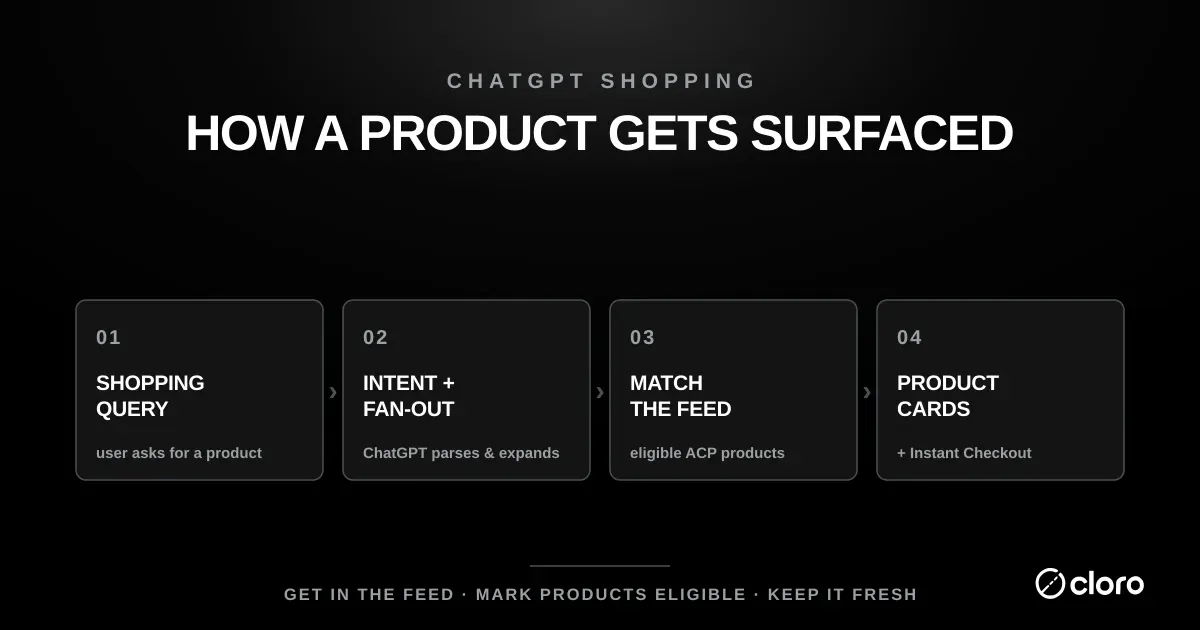
ChatGPT Shopping is a combination of live search and structured reasoning, and it moves through a few predictable stages.
Intent parsing
Before the model can recommend anything, it has to work out what the shopper actually means. It deconstructs a vague request into technical attributes. “Something that won’t make me sweat” becomes a set of filters like material of linen or cotton and high breathability. The clearer your product page is about the jobs it does, the more of these implicit filters you can satisfy.
Fanout search and validation
The model doesn’t take your word for it. It goes and checks. Next it performs query fanout, issuing several derived searches to find products that match the parsed attributes. It then validates candidates against independent sources, cross-referencing Reddit threads and “Best of” lists to confirm the products are actually good rather than merely well-described by their own marketing.
Presentation
Finally, ChatGPT Shopping assembles the buyer’s guide. It returns a curated shortlist, attaches the reasoning (“I chose this because it heats in under a minute”), and surfaces prices and retailer links. This is the layer where product cards, star ratings, and return policies show up, so gaps in your data become gaps in your listing.
From product pages to solution pages
E-commerce SEO has historically been about keyword density, where you stuff “mens linen shirt” into the title five times and hope for the best. ChatGPT Shopping rewards the opposite instinct, so you should optimize for what we call problem density instead.
Write for problem density
Your product detail page should state explicitly what problems the product solves, in the shopper’s own language. That gives the model the reasoning it needs to recommend you.
- Instead of “100% cotton,” say “breathable fabric that stays comfortable in high-humidity climates.”
- Instead of “5000mAh battery,” say “lasts two full days on a single charge.”
- Instead of “ceramic burr grinder,” say “grinds quietly enough to use before the household wakes up.”
Each rewrite hands the model a ready-made justification. When ChatGPT Shopping explains its pick, it is often paraphrasing the clearest problem-solution sentence it found, so the brand that wrote that sentence tends to win the citation.
The product feed behind ChatGPT Shopping
To appear as a native product card rather than a scraped web result, you submit a structured feed through the Agentic Commerce Protocol. OpenAI’s own documentation notes that onboarding product feeds is currently available to approved partners, who apply at chatgpt.com/merchants and then keep their catalog fresh.
Required feed fields
Before the model can rank your product, your feed has to clear a data bar. The feed specification is strict about the fields every product record must carry. Required fields include item_id, title, description, url, brand, image_url, price with an ISO 4217 currency code, and availability drawn from a fixed enum of in_stock, out_of_stock, pre_order, backorder, or unknown. Recommended fields such as gtin, mpn, sale_price, review_count, star_rating, and return_policy give the model the extra signals it uses to rank and describe you.
Sparse feeds get sparse listings. If you omit star_rating and review_count, your card looks thinner than a competitor whose feed carries social proof, and the model has less reason to argue for you.
Search eligibility versus checkout eligibility
Two boolean flags decide how far a product travels inside ChatGPT Shopping. The is_eligible_search field controls whether a product can surface in results at all, while is_eligible_checkout controls whether a shopper can buy it in-chat through Instant Checkout. A product must be search-eligible before it can be checkout-eligible, and enabling checkout also requires seller_privacy_policy and seller_tos links.
Keeping the feed fresh
Prices and stock levels move constantly, so a feed you set and forget goes stale fast. OpenAI recommends providing the entire feed once a day via file upload, then sending incremental updates throughout the day via the API. A stale feed is worse than no feed, because a wrong price surfaced with confidence erodes the trust that makes ChatGPT Shopping useful to buyers in the first place.
Applying as a merchant
The feed program is not yet open to everyone. OpenAI limits it to approved partners, who apply through chatgpt.com/merchants and pass a review before onboarding. Until you are approved, your fastest route into ChatGPT Shopping is the web path: clean schema, honest specs, and third-party coverage. Both routes reward the same discipline, so the work you do on your pages now carries over the day your feed is accepted.
Structured data is how ChatGPT reads your store
Even outside the feed program, structured data is how an AI agent reads your store. If your price is locked inside a complex JavaScript element rather than exposed in markup, the model may never see it. To win at ChatGPT Shopping, your Schema.org markup has to be clean and complete.
Four schema types carry most of the weight:
Product: name, description, and SKU.Offer: price, currency, and availability such as in-stock.MerchantReturnPolicy: AI agents frequently surface “free returns” as a deciding factor.ShippingDetails: delivery speed is a genuine tiebreaker between otherwise equal products.
If your structured data is broken or contradictory, ChatGPT Shopping may hallucinate a wrong price or assume you are out of stock. It will do so with the same confident tone it uses for correct facts. That is the quiet danger of the format. The model does not flag its own uncertainty to the buyer.
Third-party reviews matter as much as your own product page
ChatGPT does not simply trust your description of your product. When it evaluates a candidate, it weighs sentiment from independent sources heavily.
The Reddit test
If you claim your vacuum is “whisper-quiet” but fifty Reddit comments say it “sounds like a jet engine,” ChatGPT Shopping will pass that warning straight to the shopper. Our own analysis of AI product recommendations found the picks were sourced overwhelmingly from Reddit and RTINGS rather than brand pages, so a strong presence in community discussion is now a ranking input, not a vanity metric.
The listicle effect
Being named in a “Top 10” roundup from a reputable publisher such as Wirecutter or TechRadar is a strong authority signal for the model. In that same study, ChatGPT returned a product card on 87% of shopping-intent prompts, and the products it chose leaned on exactly this kind of independent coverage. You cannot optimize only your own site — you have to optimize your reputation across the web that ChatGPT Shopping reads.
Optimizing your catalog for ChatGPT Shopping
Beyond schema and feeds, a few catalog habits make your products easier for ChatGPT Shopping to parse and recommend.
Publish an llms.txt index
Create a simplified, text-only index of your top products so the model can find your best-sellers without wading through heavy HTML. A clean llms.txt file acts as a fast path to the pages you most want surfaced.
Ungate your specs
Do not hide technical specifications behind “click to expand” accordions, tabs, or downloadable PDFs. Put the numbers in plain text on the page, because a spec the model cannot read is a spec it cannot use to argue for you.
Publish comparison tables
Build honest “us versus them” comparison tables directly on your product pages. AI models parse tabular data well, and if you supply the comparison, you shape the narrative that ChatGPT Shopping repeats instead of leaving it to a competitor’s version of the story.
Common ChatGPT Shopping mistakes
A handful of avoidable errors keep good products out of the cards. Each one is a data problem, not a marketing one.
Hiding the price in JavaScript
Many stores render the price only after a script runs, and the model reads the raw page. If the number is not in the markup or the feed, your product shows up without a price, which is usually enough for the model to pass over it. Put the price in plain markup or in your feed instead, so the model never has to guess.
Shipping a stale feed
A feed that updates once a month drifts fast, because stock sells out and prices change daily. When the feed says “in stock” but the page says “sold out,” ChatGPT Shopping stops trusting the rest of your data too. Sync your feed and your live pages on the same cadence, so the two never disagree.
Talking only about yourself
Your own copy is one vote. Reddit, RTINGS, and Wirecutter are the others. A product with glowing self-description and zero third-party mentions rarely wins the recommendation. Earn coverage in those places instead of only polishing your own page, since that is the evidence the model actually weighs.
Ignoring the reviews field
The feed lets you pass review_count and star_rating. Skipping them makes your card look untested next to a competitor’s, and because social proof feeds the ranking, the blank fields cost you.
Tracking your ChatGPT Shopping visibility
Google Analytics cannot tell you whether ChatGPT Shopping is recommending your coffee maker or your competitor’s. The traffic may look like “direct” or “referral” while the actual decision was made off-site, inside a conversation you never saw.
So measure your product share of voice directly. Use cloro’s ChatGPT shopping API to run your transactional prompts on a schedule and capture what the model returns.
- Prompt: “Best coffee maker under $200.”
- Result: Does your brand appear in the product cards, and which features does ChatGPT highlight?
Tracking this over time tells you whether a schema fix, a feed update, or a new wave of Reddit coverage actually moved your standing. Our broader study of the surface found ChatGPT showed a product card on the large majority of shopping prompts, so the shelf space is real and measurable — you just have to look at the response rather than the analytics dashboard.
ChatGPT Shopping is becoming a conversation, not a search bar. The brands that treat their catalog as structured data for a machine, and their reputation as evidence for that machine to cite, are the ones the model will keep recommending.

About the author
Ricardo Batista
Founder, cloro
Ricardo is one of the founders and engineers behind its SERP and AI-search scraping infrastructure. Before cloro he scaled a financial comparison site to $7M ARR and ran the full-country operations of a unicorn to $65M ARR, then went back to building. He writes about search engine scraping, generative-engine optimization, and turning live search and AI-answer data into something teams can act on.
Frequently asked questions
How does ChatGPT Shopping work?
ChatGPT Shopping reads the user's intent, then searches the live web and any onboarded product feeds to assemble a buyer's guide with product cards, prices, and retailer links. It ranks products by how well they match the stated constraints and how strongly third-party sources back them up, then usually names one recommended pick.
How do I get my products into ChatGPT Shopping?
Two paths exist. Product pages with clean `Product` and `Offer` schema, fast load times, and third-party citations can surface through ordinary web search. To appear as a native product card or use Instant Checkout, you submit a structured feed through OpenAI's Agentic Commerce Protocol, which is currently limited to approved partners who apply at chatgpt.com/merchants.
Does ChatGPT take a commission on shopping?
For most product recommendations, ChatGPT behaves like a search engine and sends shoppers to the retailer's own checkout, taking no cut. OpenAI has since added Instant Checkout via the Agentic Commerce Protocol, which lets some purchases complete inside the chat and can carry a merchant fee, so the model is evolving from pure referral toward transactional commerce.
What is the 'collapsed funnel' in ChatGPT Shopping?
The traditional funnel of discovery, consideration, and decision collapses into a single prompt. The user describes a job to be done, and ChatGPT Shopping runs all three stages at once, returning one recommended product instead of a page of options to browse.
Why is structured data so important for ChatGPT Shopping?
AI agents rely on Schema.org markup and structured feeds to parse price, availability, and product attributes. Missing or stale data can lead the model to omit your price, pull an outdated number from a third-party listing, or assume you are out of stock.
How do I track my visibility in ChatGPT Shopping?
The buying decision happens off-site, so it will not show in Google Analytics. Run your transactional prompts through cloro's ChatGPT shopping API to see whether your brand appears in the product cards, which features get highlighted, and which competitors the model picks instead.
Related reading
AI Shopping: What ChatGPT Recommends (Data Study)
ChatGPT returned a product card on 87% of shopping-intent prompts and Google AI Mode on 91%, while Perplexity and Gemini showed almost none. The retailers named are dominated by Best Buy and Walmart, and the picks are sourced overwhelmingly from YouTube, Reddit, and RTINGS, not from brand sites.
ChatGPT Ads Penetration Study: 51% in the US
ChatGPT ads over the last 7 days measure 51.0% of US responses, 53.6% CA, 49.8% AU, and, new since May, 18.8% JP. Everywhere else remains near zero. The surface reverted then re-spiked in June and now looks structural, not transient.

Query Fan Out: How AI Search Expands One Prompt Into Many
Query fan-out turns one AI search prompt into many sub-queries. Learn how ChatGPT and AI Mode retrieve sources and how to optimize for it in 2026.