
How to Make ChatGPT Recommend Website Pages Like Yours

On this page
Fewer than 20% of ChatGPT brand mentions include a website link. The other 4 out of 5 times, a potential customer hears your name with no direct path to your site.
A note on methodology: this figure reflects what cloro observes, not a lab estimate. cloro monitors brand mentions across ChatGPT and other AI engines. For each mention, we record whether ChatGPT attached a clickable source link. The share that carries a link stays below one in five.
That gap is expensive. A brand ChatGPT names but never links loses the click entirely: the potential customer hears you recommended, with no path to your site. The fix is repeatable: you make ChatGPT recommend website links by earning trust the model can verify.
ChatGPT processes over 1 billion queries daily. Capturing even a small share of those as visitors moves the needle.
This guide covers why ChatGPT rarely links websites, how to structure content for AI inclusion, and how to test your progress. You will learn how to make ChatGPT recommend website pages through content, authority, and technical signals. Start by benchmarking your current visibility so you can measure the lift.
Why ChatGPT rarely shows website links
ChatGPT is conservative with link recommendations. It only includes URLs when it’s confident about source quality and relevance.
Authority is the first filter. ChatGPT leans toward sites that turn up in multiple high-quality sources, show clear expertise, cover the whole question rather than a slice of it, and carry real domain authority.
Relevance is the second filter, and it is narrower than people expect. The content has to answer the query directly, come from a site that specializes in the topic, be current and accurate, and match the format the question implies.
Then there are the trust signals, duller but easy to get wrong: a professional site structure, clear contact and about pages, brand presentation that stays consistent across the web, and positive third-party references.
ChatGPT doesn’t use traditional ranking factors like Google. It prioritizes authoritative, thorough content that directly addresses user queries.
Clear the confidence bar on authority, relevance, and trust signals together, and you make ChatGPT recommend website links far more often. Missing any one of the three is usually why a page gets named but never linked.
How ChatGPT decides what to recommend
Before you can make ChatGPT recommend website pages, you need to know where it looks. The model draws on two very different sources. Understanding both tells you where to spend your effort.
We measured where the recommendations actually come from, and the answer is uncomfortable for anyone planning to optimize their own pages. Across 3,312 product-intent prompts run through six engines, our AI shopping study found ChatGPT returned a structured product card on 87% of them, and the picks were sourced overwhelmingly from third-party review and community sites: YouTube (19%), Reddit (19%) and RTINGS (16%), not from brand-owned pages.
So the honest version of “how do I get ChatGPT to recommend my website” is that a large part of the work happens off your website. Earning a place in the sources the model already trusts is doing more here than any on-page change, which reorders the checklist below rather than replacing it.
Training data vs. live web search
The base model learned from a snapshot of the web. That snapshot is frozen at the model’s training cutoff. If your brand was well covered before that date, ChatGPT may already know you.
Live queries behave differently. When ChatGPT search is active, the model fetches fresh web results and cites them. Those citations are the links you actually want to win. Our ChatGPT grounding study breaks down how often each mode fires.
The takeaway is simple. To influence the frozen model, you need broad, lasting coverage. To influence live answers, you need pages that rank and read cleanly right now.
Consensus beats any single page
ChatGPT rarely trusts one source in isolation. It leans toward claims that many independent sites agree on. That is why a single landing page seldom moves the needle.
Third-party mentions carry real weight here. Reviews, listicles, forum threads, and press coverage all reinforce the same signal. Community sources matter too, as our breakdown of Reddit and AI citations shows.
The more places confirm a claim, the more confidently the model repeats it. That agreement is what makes ChatGPT recommend website pages instead of hedging. This is also how LLM citations get earned in practice.
What counts as a “recommendation”
A recommendation is not one fixed thing. It can be a plain name-drop with no link at all. It can be a cited source inside a numbered list. It can be a direct product suggestion in a shopping answer.
Each type needs a slightly different play. The sections below cover all three.
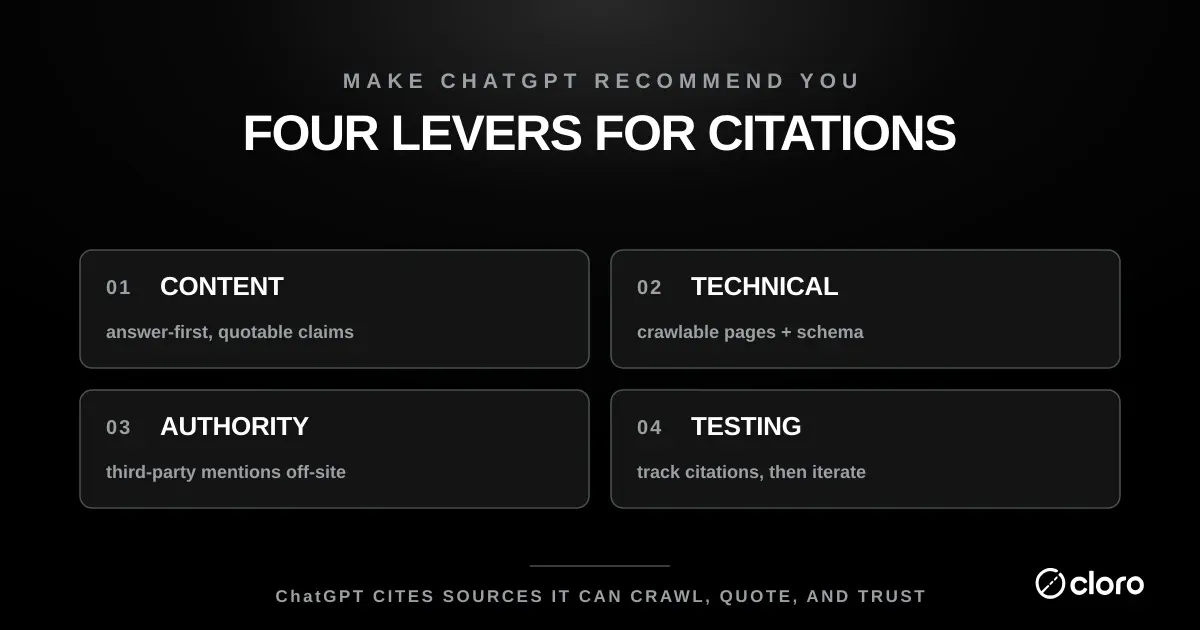
Content optimization for AI inclusion
The goal here is simple. You make ChatGPT recommend website pages by out-teaching every rival resource on the topic.
-
Use clear, descriptive headings. Instead of “Our Solutions”, use “AI Monitoring Tools for Enterprise Companies”. Instead of “Why Choose Us?”, use “Key Benefits of Real-Time LLM Performance Tracking”.
-
Specific, descriptive headings make it easier for the model to match your page to the exact query, which is what decides whether it gets linked at all.
-
Write answers that finish the job. ChatGPT favors content that addresses a topic all the way through, so build pages that answer the related questions too.
-
Documentation that covers everything from basic setup through advanced edge cases in one resource gets mentioned far more often than a page that only covers the basics.
Example structure for a product page:
# [Product Name]: Complete Guide to [Primary Benefit]

## What is [Product Name]?
- Clear definition and primary use case
- Key features and capabilities
- Target audience description

## How [Product Name] Works
- Step-by-step process explanation
- Technical details and requirements
- Integration possibilities

## Benefits of Using [Product Name]
- Specific, measurable benefits
- Use case examples
- Customer success stories

## [Product Name] vs Alternatives
- Direct feature comparisons
- Pricing considerations
- When to choose each option

## Getting Started with [Product Name]
- Implementation timeline
- Required resources
- Next steps
Optimize for question-based queries:
Answer common questions directly. These read close to how people actually phrase prompts to ChatGPT, which raises the odds your page matches the query:
- “What is [your product category]?”
- “How does [your solution] work?”
- “Best [product type] for [specific use case]”
- “How to choose [your product category]”
Include relevant statistics and data:
ChatGPT prioritizes content with specific, credible information:
- Industry statistics
- Performance benchmarks
- User adoption rates
- ROI calculations
Technical website optimization
Clean markup helps ChatGPT recommend website pages it can actually parse. The signals below make your structure legible to a machine reader.
Implement schema markup:
Help AI parse your content structure, so it can quote your name, offerings, and product details correctly instead of guessing.
Organization schema:
{
  "@type": "Organization",
  "name": "Your Company",
  "url": "https://yoursite.com",
  "description": "What your company does",
  "contactPoint": {
    "@type": "ContactPoint",
    "contactType": "customer service",
    "url": "https://yoursite.com/contact"
  }
}
Product schema:
{
  "@type": "Product",
  "name": "Your Product Name",
  "description": "Detailed product description",
  "category": "Product Category",
  "brand": "Your Company"
}
Optimize site architecture:
A structure that’s easy for a crawler to navigate is also the structure ChatGPT’s live search follows when it decides which page on your site to cite.
Clear URL structure:
/products/ai-monitoring-tools//solutions/llm-performance-tracking//resources/ai-monitoring-guide/
Internal linking strategy:
- Link related pages within your content
- Use descriptive anchor text
- Create topic clusters around key themes
Allow the right OpenAI crawlers:
OpenAI uses three crawlers with different jobs, per iConnect’s breakdown: GPTBot collects content that may be used to train models, OAI-SearchBot supports ChatGPT search, and ChatGPT-User handles user-initiated requests. The one that decides live citations is OAI-SearchBot. If it is blocked, ChatGPT usually fails to show your site in search-based results. You can opt out of training and still let ChatGPT recommend website pages from your domain:
User-agent: OAI-SearchBot
Allow: /

User-agent: GPTBot
Disallow: /
Then check your CDN, firewall and bot-protection rules, because robots.txt does not control those layers.
Page speed optimization:
- Achieve Core Web Vitals targets
- Optimize images and resources
- Use efficient hosting infrastructure
- Add an llms.txt file for better crawler access
Authority building for AI recognition
Third-party trust is what makes ChatGPT recommend website content over an unknown brand. Authority is earned off your own domain, so this work happens elsewhere first.
Get mentioned in authoritative sources:
ChatGPT weighs information from trusted publications heavily. Focus on:
Industry publications:
- Trade magazines in your sector
- Industry analyst reports
- Professional association websites
- Academic papers and research
News and media coverage:
- Press releases for significant announcements
- Expert commentary on industry trends
- Case study features
- Awards and recognition coverage
Create linkable assets:
Original research: Publish research that others want to reference:
- Industry surveys and reports
- Performance benchmarks
- Market analysis
- Trend predictions
In-depth guides: Write the definitive resource on topics in your space:
- Implementation guides
- Best-practices documentation
- Troubleshooting resources
- Comparison frameworks
Tools and calculators: Ship tools that demonstrate your expertise:
- ROI calculators
- Assessment tools
- Configuration generators
- Performance analyzers
Getting ChatGPT to recommend your business, brand, or products
Generic advice only goes so far. What you sell changes how you make ChatGPT recommend website pages that convert. Here is how the play shifts by business type.
Local businesses and restaurants
Local recommendations lean heavily on aggregators. ChatGPT often pulls from directories, map listings, and review sites. Your own site is rarely the first thing it reads.
Claim and complete every major profile first. Keep your name, address, and hours identical everywhere. Consistent details help ChatGPT trust that the business is real. Encourage genuine reviews, since both volume and recency help.
Then make your own pages answer local intent directly. A page titled “Best [dish] in [city]” maps neatly to how people ask. That alignment is what makes ChatGPT recommend website content over a bare directory entry.
Ecommerce and product recommendations
Rich product data helps ChatGPT recommend website pages inside shopping answers. Product answers work differently from informational ones. ChatGPT increasingly surfaces specific items inside shopping-style responses. We cover this shift in how ChatGPT recommends products and in our ChatGPT shopping guide.
Structured product data is the foundation. Add Product and Offer schema with clear prices, availability, and review counts. Make sure specs live in text, not only in images. A model cannot quote a spec it cannot read.
Third-party validation closes the loop. Being named in “best [category]” roundups often tips a product into an answer. Earn those placements and keep them current.
SaaS and B2B tools
B2B buyers ask ChatGPT comparison questions constantly. “Best tool for X” and “alternatives to Y” are everyday prompts. To win them, you need pages built for exactly those queries.
Publish honest comparison and alternatives pages. Cover pricing, limits, and ideal use cases in plain language. Balanced, specific pages get cited far more than pure sales copy. This is the surest way to make ChatGPT recommend website pages during a buyer’s research.
Can ChatGPT build a good website for you?
It can build one, which is a separate question from getting one recommended. OpenAI’s Help Center describes ChatGPT Sites, in public beta for workspaces, Plus and Pro accounts: you describe the site, review a private preview, request changes, then publish and share it. OpenAI’s examples are dashboards, project trackers, prototypes, internal portals and reports. A generated site still has to earn the authority and third-party coverage above before ChatGPT will recommend website pages from it.
Testing and tracking your progress
Measure how often you make ChatGPT recommend website links today. That baseline turns every later change into a number you can defend.
Set up a weekly link inclusion test
Test these query types and track link inclusion rates:
Direct queries:
- “What is [your company]?”
- “[Your company] features”
- “[Your company] pricing”
Category queries:
- “Best [product category] tools”
- “Top [industry] software”
- “[Product category] comparison”
Problem-solution queries:
- “How to solve [customer problem]”
- “Tools for [specific use case]”
- “[Problem] solutions”
Create a tracking spreadsheet with these columns:
Date | Query | Brand Mentioned? | Link Included? | Context | Competitors with LinksTrack improvement metrics
| Metric | Baseline | Target | Current |
|---|---|---|---|
| Link inclusion rate | _% | 30%+ | _% |
| Mention frequency | _% | 20%+ | _% |
| Positive context | _% | 80%+ | _% |
The takeaway: for most sites, mention frequency and link inclusion move separately. You’re often already being named; the fixes above are what turn that name-drop into a clickable citation, so fill this table in before you optimize, or you can’t tell which of the two you’re actually short on.
cloro tracks website mentions across ChatGPT and other AI platforms. See ChatGPT visibility tracking for the full feature set.
For comparison with other monitoring tools, our LLM visibility tracking tools guide covers 20+ platforms for tracking brand mentions across major AI systems.
On the monitoring side it records when your website appears in AI responses, tracks link inclusion rates by query type, compares you against competitors, and alerts you in real time when your mention patterns change.
The analytics go a layer deeper: which of your pages get mentioned most often, the context and sentiment of each mention, the query patterns that actually trigger a link, and the same picture across several AI platforms at once. That is what tells you where to push to lift link inclusion rates.
Advanced strategies for link inclusion
These plays help you make ChatGPT recommend website pages for harder, higher-intent queries. Reach for them once the fundamentals above are in place.
Strategy 1: Create AI-optimized landing pages
Build pages specifically for AI recommendations.
Page structure:
- Clear headline stating primary benefit
- Concise description of what you offer
- Bullet-pointed key features
- Social proof elements
- Clear next steps
Content elements that improve AI recognition:
- FAQ sections answering common questions
- Feature comparison tables
- Use case examples with specific details
- Contact information and support options
Strategy 2: Optimize for long-tail queries
ChatGPT is more likely to include links for specific, detailed queries:
Instead of optimizing for: “AI monitoring” Optimize for: “Real-time ChatGPT API performance monitoring tools”
Instead of optimizing for: “Business software” Optimize for: “Multi-LLM response quality comparison platforms”
Strategy 3: Build topic authority clusters
Cluster content around related topics:
Core topic: AI Performance Monitoring Supporting topics:
- LLM response time optimization
- AI API reliability tracking
- Cross-platform AI monitoring
- AI system performance benchmarks
Link these pages together and make sure each one provides unique information that reinforces your expertise.
Strategy 4: Use customer case studies
ChatGPT values real-world examples. Write case studies that show:
- Specific customer challenges
- Your solution implementation
- Measurable results achieved
- Customer quotes and testimonials
Strategy 5: Monitor and replicate successful patterns
When ChatGPT includes your link, analyze:
- What query triggered the inclusion?
- How was your site described?
- What other sites were mentioned?
- What content on your site was most relevant?
Replicate successful patterns:
- Create similar content for related queries
- Use similar language and structure
- Build on topics that already work
- Expand successful content themes
- Apply GEO principles to all new content
Real-world optimization playbook:
Month 1-2: Foundation
- Audit current content structure against the authority, relevance, and trust signals above
- Restructure 5-10 key pages with descriptive headings and fuller answers
- Implement proper schema markup across your site
- Set up tracking with cloro to establish baseline metrics
Month 3-4: Authority Building
- Publish 2-3 in-depth guides targeting your key topics
- Create detailed comparison pages featuring your solutions
- Build relationships with industry publications for backlinks and citations
- Launch original research project to generate unique data
Month 5-6: Optimization
- Analyze which content gets linked most often and replicate successful patterns
- Identify competitor content that outperforms yours and create superior alternatives
- Expand successful content themes into full topic clusters
- Refine and optimize based on real performance data
Companies that followed this playbook report a 15-30% improvement in link inclusion rates by month 1, a 50-80% improvement in mention frequency by month 3, and a 200-400% increase in AI-referred website traffic by month 6.
The competitive window is narrowing. Companies that optimize now will establish AI search positions that become harder to challenge as more businesses pile in.
Getting ChatGPT to show your website comes down to being genuinely useful and authoritative in your space, which is slower than gaming a ranking factor but holds up better. Start with content, build authority through resources worth referencing, and track what moves. Use a ChatGPT visibility tracker to measure improvements and see how AI describes your offerings.
Need help picking a tracking tool? Our LLM visibility tracking tools comparison covers options from $39/month to enterprise.
The teams that make ChatGPT recommend website pages first are hard to dislodge later, because the model keeps repeating whatever the web already agrees on. Wait, and your competitors are the ones defining how AI describes your industry.

About the author
Ricardo Batista
Founder, cloro
Ricardo is one of the founders and engineers behind its SERP and AI-search scraping infrastructure. Before cloro he scaled a financial comparison site to $7M ARR and ran the full-country operations of a unicorn to $65M ARR, then went back to building. He writes about search engine scraping, generative-engine optimization, and turning live search and AI-answer data into something teams can act on.
Frequently asked questions
Why doesn't ChatGPT link to my site?
ChatGPT is conservative with links. It prioritizes high-authority sources and often synthesizes answers without direct attribution unless the source is critical.
How can I increase citation rates?
Publish unique data, original research, and well-structured guides. The more 'quotable' your content is, the more likely the AI is to cite it.
Does robots.txt affect citations?
Yes. OpenAI runs separate crawlers. OAI-SearchBot supports ChatGPT search, so blocking it usually keeps your pages out of search-based answers. GPTBot collects content that may be used to train models, and ChatGPT-User handles user-initiated requests. You can block GPTBot and still allow OAI-SearchBot and ChatGPT-User.
What content authority signals does ChatGPT look for?
ChatGPT values content from websites with strong domain authority, clear expertise, thorough information, and consistent positive third-party references.
How does `llms.txt` help ChatGPT find my site?
`llms.txt` provides AI crawlers with a clean, structured, and machine-readable summary of your website's most important content, improving the chances of accurate citations.
Can ChatGPT create a good website?
ChatGPT can build interactive websites and lightweight apps through ChatGPT Sites, in public beta for workspaces, Plus and Pro accounts. You describe the site, review a preview, ask for changes, and publish. A generated site still needs authority and third-party coverage before ChatGPT will recommend it.
How do I get ChatGPT to recommend my business?
Earn consistent third-party coverage first. Then publish pages that answer the exact questions your buyers ask. When several trusted sources agree, the model repeats your name far more readily. Track the lift with a ChatGPT visibility tracker.
Does ChatGPT recommend specific products?
Yes, and increasingly so in shopping-style answers. Clean product schema and "best of" placements are what surface an item. Our AI shopping guide covers the mechanics in depth.
How long until ChatGPT recommends my website?
Live search answers can shift within days of a strong new page. Deeper, model-level recognition takes months of steady coverage. Most teams see early movement by month two.
Will ChatGPT recommend website links every time it mentions me?
No. A mention and a linked citation are separate outcomes. You often earn the name-drop long before the link. Track both metrics so you know which one is lagging.
Related reading
What is AEO? Answer Engine Optimization Explained (2026)
Master Answer Engine Optimization (AEO) in 2026. Learn how to optimize for ChatGPT, Perplexity, and Google AI Overviews, and how AEO differs from SEO.
Best ChatGPT Scraper 2026: 8 Tools Tested (Web UI)
We tested 8 ChatGPT scrapers against Cloudflare TLS fingerprinting, SSE streaming, and weekly-changing class names to find the best ChatGPT scraper for 2026.
ChatGPT Grounding Study: 86% Commercial, 1% Informational
ChatGPT grounds almost every commercial prompt and almost no informational one. We re-ran our study without forcing web search, across 865 queries and 10 countries, and the split is 86.5% versus 0.9%.