
Parasite SEO: What It Is and How It Works in 2026

On this page
Parasite SEO is publishing content on high-authority platforms — Claude Artifacts, Facebook, Instagram, Perplexity — so it ranks on Google using the host’s domain authority instead of your own.
It works fast. Julian Goldie documented #1 rankings within 4 hours using Claude Artifacts. Instagram posts now outrank established websites, Facebook pages dominate local searches, and Perplexity pages rank with zero SEO effort.
It’s also risky. Google’s site reputation abuse update destroyed Forbes’ traffic overnight, and enforcement keeps tightening.
This guide covers what parasite SEO is, why it works, and the platforms that still deliver in 2026. It shows how to use them for quick wins without getting burned — while you build durable AI visibility with a ChatGPT visibility tracker.
What is parasite SEO and why it works
Parasite SEO means publishing content on high-authority domains to borrow their ranking power.
The tactic has a second life in AI answers, and our own citation data is the clearest evidence for it. Across roughly 13,000 AI answers from six engines, our LLM citations study found Reddit and YouTube are the universal backbone, with Reddit top-2 cited in every vertical sampled. In the AI shopping study, across 3,312 product-intent prompts, YouTube and Reddit each supplied 19% of the sources behind recommendations and RTINGS 16%, while brand-owned pages barely featured.
So the borrowed-authority logic that drives parasite SEO on Google is, if anything, stronger in the answer layer: the engines lean on a small set of community and review domains, and a page on one of them is competing for a citation slot your own domain is rarely offered. Instead of spending years building your own domain authority, you piggyback on platforms Google already trusts.
Why Google can’t ignore these platforms:
| Platform | Domain Authority | Monthly Users | Google Trust Level |
|---|---|---|---|
| Claude.ai | 91 | 400M+ | Ultra-high |
| Facebook.com | 96 | 3B+ | Maximum |
| Instagram.com | 95 | 2B+ | Maximum |
| Perplexity.ai | 79 | 100M+ | High |
Authority Hacker’s research shows content on these domains ranks 50x faster than new websites. Google crawls them multiple times daily, so new content gets discovered in hours rather than months.
Google faces a dilemma here. These platforms generate billions in search traffic, and Google can’t penalize them without damaging search quality. Your content inherits their immunity.
Neil Patel explains: “Google has to rank authoritative domains. Users expect to find Facebook pages, Instagram posts, and AI-generated content. Deranking these would make Google seem broken.”
Current success rates by platform:
- Claude Artifacts: 80% first-page rankings within 48 hours
- Facebook pages: 60% local search visibility within 1 week
- Instagram posts: 40% appearing in image and video carousels
- Perplexity pages: 25% accidental rankings for long-tail keywords
The takeaway: a high success rate isn’t the same as a safe bet. Check each platform’s risk level before choosing one.
Why parasite SEO works so fast
Speed is the whole appeal of parasite SEO. A new domain spends months earning Google’s trust, while high-authority hosts skip that wait entirely because Google already crawls Facebook, Instagram, and Claude many times a day.
Ranking power transfers along with the crawl. A page inherits the topical trust the host built over years. That borrowed authority is why a fresh artifact can outrank a small business site. The trade is simple: you rent reach you have not earned, and you give up control in return.
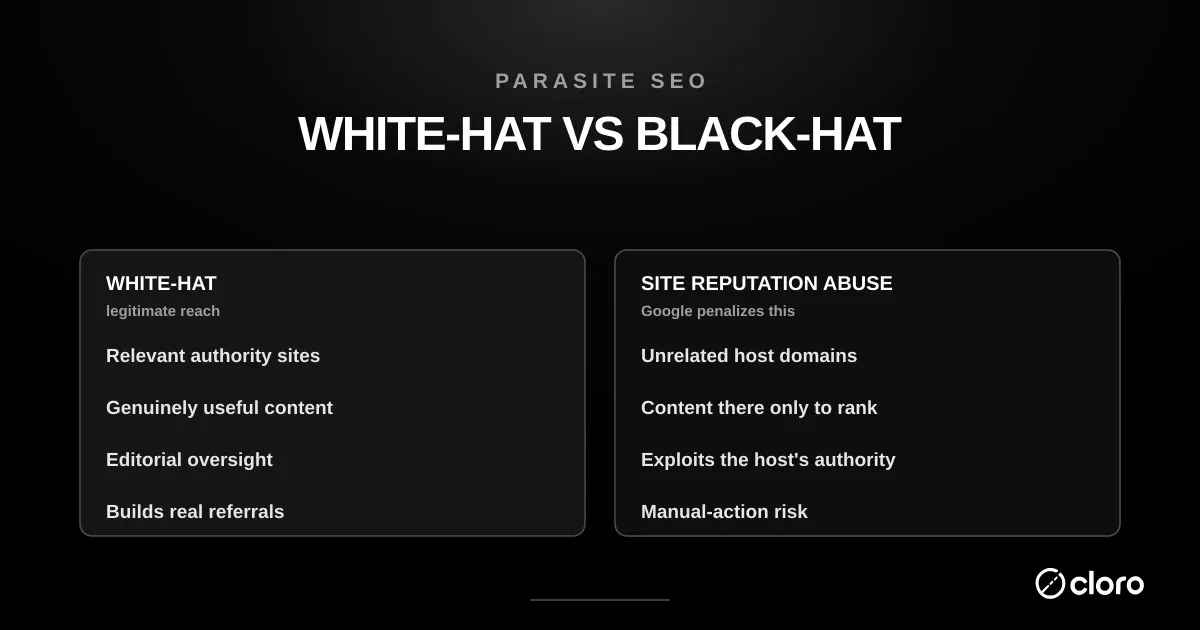
White-hat vs black-hat parasite SEO
Not all parasite SEO looks the same to Google. The white-hat version publishes genuinely useful content where it belongs. A founder answering real questions on LinkedIn is doing white-hat parasite SEO. The black-hat version rents a subfolder on a news site and fills it with unrelated affiliate pages.
The line matters because Google treats these cases differently. Helpful content that fits the host tends to survive updates. Thin, off-topic content published only to borrow authority is what enforcement targets. Keep your parasite SEO on the useful side of that line, and the risk drops sharply.
Is parasite SEO the same as site reputation abuse?
Not exactly, but they overlap. Google defines site reputation abuse as a tactic where “third-party content is published on a host site mainly because of that host’s already-established ranking signals.” That describes the aggressive end of parasite SEO. Google’s policy targets content published purely to borrow a domain’s authority.
The distinction is practical, not just semantic. Publishing a real how-to guide on your own Instagram account is not abuse. Paying to hide affiliate pages under a trusted news domain is. Most parasite SEO tactics in this guide sit in the safer middle. The closer you get to pure authority-borrowing, the more exposed you become.
Is parasite SEO legal?
Publishing on someone else’s platform is not a legal category in itself, so the rules that actually bind parasite SEO are Google’s and the host’s. Google’s spam policies say that sites violating them may rank lower or not appear in results at all. The host holds the other lever: as Lars Lofgren points out, the company that owns the domain can cut your access, delete your content, or keep what you built whenever it wants. Read the platform’s terms, disclose affiliate links, and treat any page on a domain you do not own as rented.
Claude Artifacts: the fastest ranking method
Content published on Claude.ai can rank #1 within hours for low-competition keywords, which currently makes artifacts the fastest route available.
BML Graphics documented their process:
- Created artifact for “best AI writing tools”
- Ranked position #4 within 5 hours
- Hit position #1 after 24 hours
- Zero backlinks or promotion
Claude.ai benefits from:
- Root domain hosting, not a subdomain
- Instant publishing with no editorial review
- Solid technical SEO: fast loading, mobile-optimized
- AI entity optimization: natural language Google understands
Creating ranking Claude Artifacts
The workflow is short: pull the entities Google expects for the keyword, turn them into a draft, then publish it as an artifact.
Step 1: Entity extraction. Use the InLinks entity extraction tool (free for 20 pages/month) to identify entities from top-ranking pages. This tells you what Google expects to see.
Step 2: Content generation. Feed entities to ChatGPT with this prompt:
Create SEO content for [keyword] including these entities: [list]
Format: Clear headings, bullet points, 800-1200 words
Include: 3-5 contextual links
Step 3: Artifact publishing.
- Log into Claude.ai
- Create new artifact
- Select “Apps and Websites”
- Paste optimized content
- Publish and share URL
Reddit users report success rates above 80% for brand searches and low-competition keywords.
Facebook pages for local domination
Facebook’s 3 billion users and high domain authority make it useful for local parasite SEO. Google rarely ignores Facebook pages when users search for local businesses.
Sixtygram’s research found that:
- Google crawls Facebook pages within hours
- Local intent queries prioritize social proof
- Reviews and engagement signal authority
- NAP (name, address, phone) consistency boosts local pack rankings
Optimizing Facebook pages for search
Get these basics right and Google treats the page as a real local listing, not a stray profile: that’s what earns local pack rankings.
Optimization steps:
-
Complete every profile field.
- Business description with keywords
- Categories matching Google My Business
- Contact information exactly matching website
- Service areas and location details
-
Post strategically.
- Hootsuite data shows optimal posting at 9am and 3pm
- Include location keywords naturally
- Add website links in every post
- Use 5-7 relevant hashtags
-
Build backlinks.
- Link the Facebook page from your website footer
- Include in local directory submissions
- Add to email signatures
- Cross-link with other social profiles
Real results from businesses:
- Plumber in Dallas: Page 1 for “emergency plumber Dallas” in 5 days
- Restaurant in NYC: Top 3 for “[cuisine] restaurant Manhattan” in 1 week
- Dentist in LA: Featured snippet for “teeth whitening Los Angeles” in 10 days
Instagram’s new Google indexing opportunity
Google announced in July 2024 that Instagram posts are now indexed and ranking in search results.
This applies to:
- Business accounts
- Creator accounts
- Public profiles only
- Content posted after January 1, 2020
What ranks on Google from Instagram:
- Product photos with detailed captions
- How-to carousel posts
- Reels with subtitles and descriptions
- Stories highlights (permanent URLs)
Instagram SEO optimization tactics
Captions matter most. Epidemic Sound’s guide recommends treating captions like meta descriptions:
- Front-load keywords in the first 125 characters
- Answer specific search queries
- Include location tags for local SEO
- Add 3-5 strategic hashtags (not 30)
Visual SEO elements:
- Alt text on all images (hidden but indexed)
- Text overlays with keywords
- Subtitles on video content
- Consistent brand mentions
Engagement signals that matter:
- Saves (strongest ranking signal)
- Comments with keywords
- Share rate to stories
- Profile visits from posts
Previsible’s analysis found Instagram posts appearing for:
- 35% of brand searches
- 22% of product queries
- 18% of how-to searches
- 45% of local business queries
The takeaway: Instagram’s Google visibility skews local and brand queries, so layer it onto an existing strategy rather than a competitive-term play.
Perplexity pages and accidental rankings
Perplexity processes 500 million searches monthly, and its pages rank on Google despite zero SEO effort.
Search Engine Journal discovered that Perplexity’s Discover pages aren’t optimized for Google at all, yet they still rank because of:
- Extreme freshness (updated hourly)
- High-quality source citations
- Natural language matching user intent
- Zero spam signals
Leveraging Perplexity for visibility
You can’t directly create Perplexity pages, but you can influence what appears.
First Page Sage research identifies the main factors for getting cited. Domain authority does most of the work, and sites at DA 70+ are cited most often. Freshness comes next, since updates within 30 days are prioritized. After that it comes down to semantic relevance, meaning natural language that matches the query, and to ordinary technical SEO: fast loading and mobile-friendly pages.
Optimization strategy:
- Publish in-depth guides on your topic
- Update content frequently with new data
- Use natural, conversational language
- Include unique statistics and research
SearchEngineLand’s study found websites optimized for Perplexity saw:
- 300% increase in AI search citations
- 40% boost in referral traffic
- Higher quality leads from AI searches
The takeaway: these gains follow from being deep and current already, not from designing pages for Perplexity. You still can’t create one directly.
Tools and techniques for all platforms
Tools for parasite SEO
Entity and keyword research:
- InLinks — free entity tool (20 pages/month)
- NeuronWriter — content optimization ($19-69/month)
- Surfer SEO — entity analysis ($59-219/month)
Indexing acceleration:
- Rapid URL Indexer — $0.05 per successful index
- SpeedyIndex — 100 free URLs to test
- IndexPlease — bulk indexing from $9.99/month
Monitoring and tracking:
- Google Search Console - Track impressions and clicks
- Ahrefs or SEMrush - Monitor rankings across platforms
- Social media analytics - Platform-specific metrics
- ChatGPT visibility tracker - Monitor AI search mentions
Platform comparison matrix
| Platform | Best For | Time to Rank | Longevity | Risk Level |
|---|---|---|---|---|
| Claude Artifacts | Brand searches, quick tests | 4-24 hours | Low | High |
| Facebook Pages | Local SEO, service businesses | 3-7 days | High | Low |
| Instagram Posts | Visual products, how-tos | 2-5 days | Medium | Low |
| Perplexity Pages | Thought leadership, data | Accidental | Low | Medium |
The takeaway: Facebook and Instagram trade speed for durability and lower risk, making them the safer starting point. Claude Artifacts and Perplexity rank fastest but fade quickest.
Risk mitigation strategies
Google’s crackdown is real. Forbes lost 90% of traffic from its parasite SEO strategy. To protect yourself:
Diversify first. Don’t rely on one platform, test multiple approaches at the same time, and build your own authority in parallel.
Then focus on value, not manipulation. Create genuinely helpful content, answer real user questions, and provide unique insights or data of your own.
Finally, build foundations that outlast the tactic. Use parasite SEO for testing and validation, invest the profits into real SEO, and develop owned media properties.
Digital Loop’s 2024 analysis found that businesses using parasite SEO as a supplement (not a replacement) to traditional SEO saw:
- 3x higher overall organic traffic
- More stable rankings during updates
- Better conversion rates from diverse sources
Google’s Site Reputation Abuse policy specifically targets these tactics, and major platforms could be next. For now, the window is open.
Using parasite SEO without getting burned
Who should use parasite SEO
Parasite SEO fits some situations far better than others. New brands with no domain authority use it to appear in results while their own site matures. Agencies use it to show clients quick wins in the first month. Local businesses use Facebook and Instagram pages to occupy the map pack.
It fits poorly as a core strategy. If parasite SEO is your only channel, one Google update can erase your visibility overnight. Treat it as a fast lane that runs beside your owned site, never as a replacement for it.
How to measure parasite SEO results
Track parasite SEO the way you track any channel. Watch three numbers per platform. First, ranking position for the target keyword, checked weekly. Second, referral traffic from the host page to your own site. Third, branded search lift, since a ranking artifact often drives name searches.
Set a decay alarm too. Parasite rankings fade when Google tightens enforcement or a host changes its rules. If a page drops two positions in a week, treat it as a signal, not noise. Move the winning content to a property you own before the ranking disappears.
Common parasite SEO mistakes
Most parasite SEO fails for the same few reasons. The biggest is publishing thin content that adds nothing the host lacks. Google’s helpful content signals catch this quickly. The second is leaning on one platform, so a single policy change wipes out every ranking at once.
A third mistake is ignoring the host’s own rules. Platforms ban accounts that treat them purely as ranking farms. Keep the content useful, spread bets across platforms, and stay inside each host’s terms. That is the difference between parasite SEO that lasts weeks and parasite SEO that lasts a day.
Parasite SEO vs building your own authority: use one to fund the other
Building domain authority is slow and expensive. You publish for months, earn links, and wait for Google to trust you. Parasite SEO skips the wait by borrowing trust that already exists. That is both its appeal and its weakness.
Owned authority compounds and stays yours. Borrowed authority can vanish the moment a host changes course. The smart approach uses parasite SEO to fund the slower work. Rank fast on someone else’s domain, learn what converts, then reinvest in a site you actually own.
The future of parasite SEO
Parasite SEO keeps working because Google needs authoritative platforms in its results. Deranking Facebook or Instagram wholesale would make search worse for everyone. That structural tension is unlikely to disappear soon.
The tactics will keep shifting, though. Each enforcement wave closes one door and opens another. AI platforms like Claude are the newest opening, and they will not be the last. The durable move is to treat every parasite SEO win as temporary and bank the gains in an asset you control.
Want to see if your brand is already appearing in AI search? Check how ChatGPT shows your website in its responses to understand your current AI visibility.
Need help tracking performance across these platforms? Our LLM visibility tracking tools guide compares 20+ solutions for monitoring AI search presence. See why companies like Scrunch and Meridian choose cloro for their tracking needs.
This is not a way to game the system forever. It is a way to use the openings that exist now while you build something sustainable. When the music stops, and it will, make sure you’re not left without a chair.

About the author
Ricardo Batista
Founder, cloro
Ricardo is one of the founders and engineers behind its SERP and AI-search scraping infrastructure. Before cloro he scaled a financial comparison site to $7M ARR and ran the full-country operations of a unicorn to $65M ARR, then went back to building. He writes about search engine scraping, generative-engine optimization, and turning live search and AI-answer data into something teams can act on.
Frequently asked questions
What is Parasite SEO?
Publishing content on high-authority third-party sites (like LinkedIn, Medium, or Outlook) to rank for competitive keywords by leveraging their domain authority.
Is parasite SEO legal?
Publishing on a third-party platform is not illegal in itself. The rules that bind parasite SEO are Google's spam policies, which can push violating pages down or out of results, and the host platform's terms, which let the owner remove your content or access at any time.
Is Parasite SEO risky?
Yes. Google actively tries to devalue this tactic (e.g., the 'Site Reputation Abuse' update). It works for short-term wins but isn't a long-term strategy.
Which platforms work best for Parasite SEO?
Currently, platforms like LinkedIn Pulse, Reddit (sometimes), and reputable industry journals are effective.
How can Facebook Pages be used for Parasite SEO?
Facebook Pages can dominate local search results due to Google's trust in the domain and their ability to show social proof. Optimizing them with consistent NAP data and local keywords is key.
What is Instagram's new Google indexing opportunity?
As of mid-2024, Google is directly indexing Instagram posts from business/creator accounts. This creates a parasite SEO opportunity for visual products and how-to guides to rank quickly.
Related reading
AI Crawlers Explained: GPTBot, ClaudeBot & robots.txt
GPTBot, ClaudeBot, and the new wave of AI scrapers are visiting your site daily. Learn who they are, their user agents, and how to control them.
Google Search Operators: Complete List and Examples
We tested which Google search operators still work in 2026: site, -site and intitle at 100%, inurl at 74%, related at 44%, cache returns nothing.
How to Scrape Google Search Results With Python (2026)
Learn how to scrape Google search results with Python, Playwright, or a SERP API. Compare HTML parsing, browser automation, and anti-bot risk.