
What is AEO? Answer Engine Optimization Explained (2026)

On this page
Answer Engine Optimization (AEO) is the practice of structuring content so AI systems like ChatGPT, Perplexity, Gemini, and Google AI Overviews can extract it, trust it, and cite it as a direct answer. Where SEO competes for a position among ten blue links, AEO competes for one slot: the synthesized answer the user actually reads.
That shift matters because search itself is shifting. Gartner predicted in February 2024 that traditional search volume would drop 25% by 2026 as AI chatbots absorb more queries, and Reuters reported in February 2025 that OpenAI had surpassed 400 million weekly active users. The brands that win aren’t the ones with the most pages — they’re the ones whose content is easiest for an AI to parse, attribute, and quote.
This guide covers what AEO is, how it differs from SEO and GEO, and how to optimize, measure, and certify for answer engines.
What does AEO stand for, and what are answer engines?
AEO stands for Answer Engine Optimization. In practice, that means shaping content so systems like ChatGPT, Perplexity, Gemini, Siri, Alexa, and Google AI Overview can identify the best answer on a page, explain why it is credible, and surface it with attribution.
Traditional search engines return a list of documents; answer engines return a response. That response may be summarized from multiple sources into a paragraph, spoken aloud by a voice assistant, or shown as a synthesized panel with citations. Instead of choosing from ten blue links, the user often sees one resolved answer first.
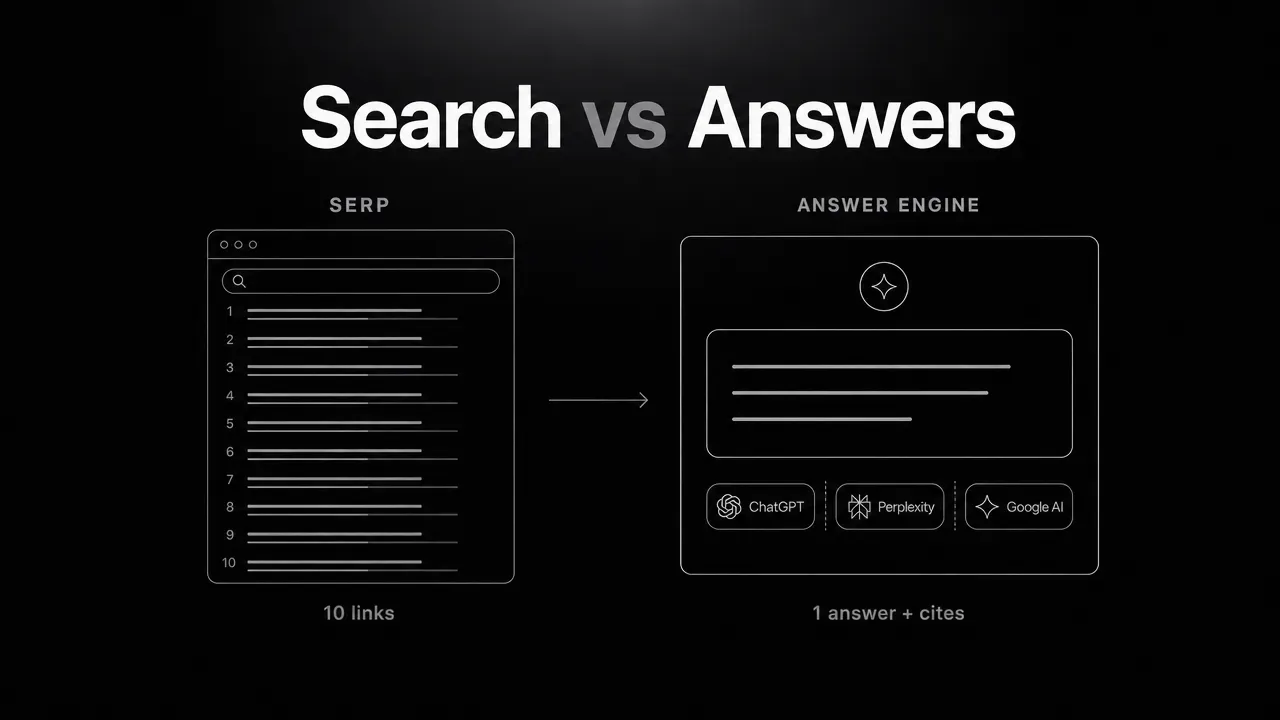
So what is AEO in practice? It is the discipline of making your information extractable, trustworthy, and citable for AI-driven answer systems, sitting at the intersection of content design, SEO, structured data, entity clarity, and brand authority.
When people ask, “What is AEO in AI?” the short answer is the same: it makes your information easy for an AI to interpret, trust, and reuse. Answer engines are not only standalone chatbots — Google AI Overviews, Gemini across Google products, and voice interfaces like Siri and Alexa all behave like answer engines when they produce a direct response instead of a list.
For SEO teams, the implication is clear: a page can be highly relevant yet still lose the answer slot if its meaning is buried, its entities are vague, or its trust signals are weak. AEO removes that friction by favoring explicit definitions, scannable structure, strong authorship, and language that maps cleanly to real questions. So if SEO asks, “How do we rank?” AEO asks, “How do we become the answer?” In 2026, both matter.
AEO vs SEO: how answer engine optimization differs from search engine optimization
SEO and AEO overlap, but they are not the same operating model.
SEO is built to earn visibility in search results pages. It optimizes pages for crawlability, indexing, relevance, authority, and click-through potential. AEO is built to earn inclusion in machine-generated answers. It optimizes content for extractability, citation potential, factual clarity, and answer-level trust.
That distinction changes the target. In SEO, success means ranking well enough to win a click. In AEO, success may mean your content informs the answer even when the user never visits — a citation in ChatGPT, a mention in Perplexity, a surface in Google AI Overviews, or a spoken reply from an assistant.
At the same time, AEO does not erase SEO fundamentals — strong SEO remains the gateway. Bounteous reports that 99% of URLs shown in Google’s AI Mode also appear in the top 20 organic search results, so traditional search strength still shapes whether a source even enters the candidate set for AI synthesis. Bounteous
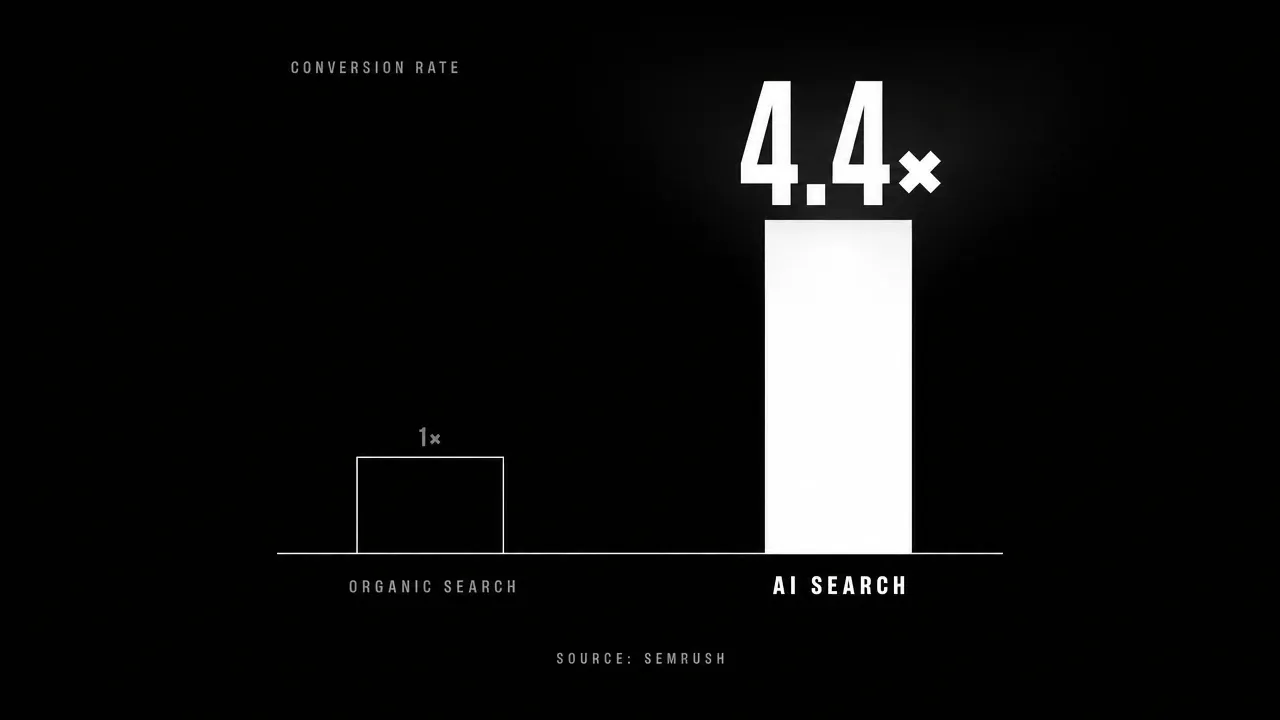
The economic case differs too. AI-referred traffic is usually smaller but often more qualified. Semrush found that visitors arriving through AI search convert at 4.4 times the rate of traditional organic visitors — answer-engine users tend to arrive later in the evaluation process. Semrush
Featured snippets were the bridge between the two worlds, training publishers to think in concise, snippet-friendly answers. AEO extends that logic across AI systems that summarize, compare, and recommend rather than extract one block of text.
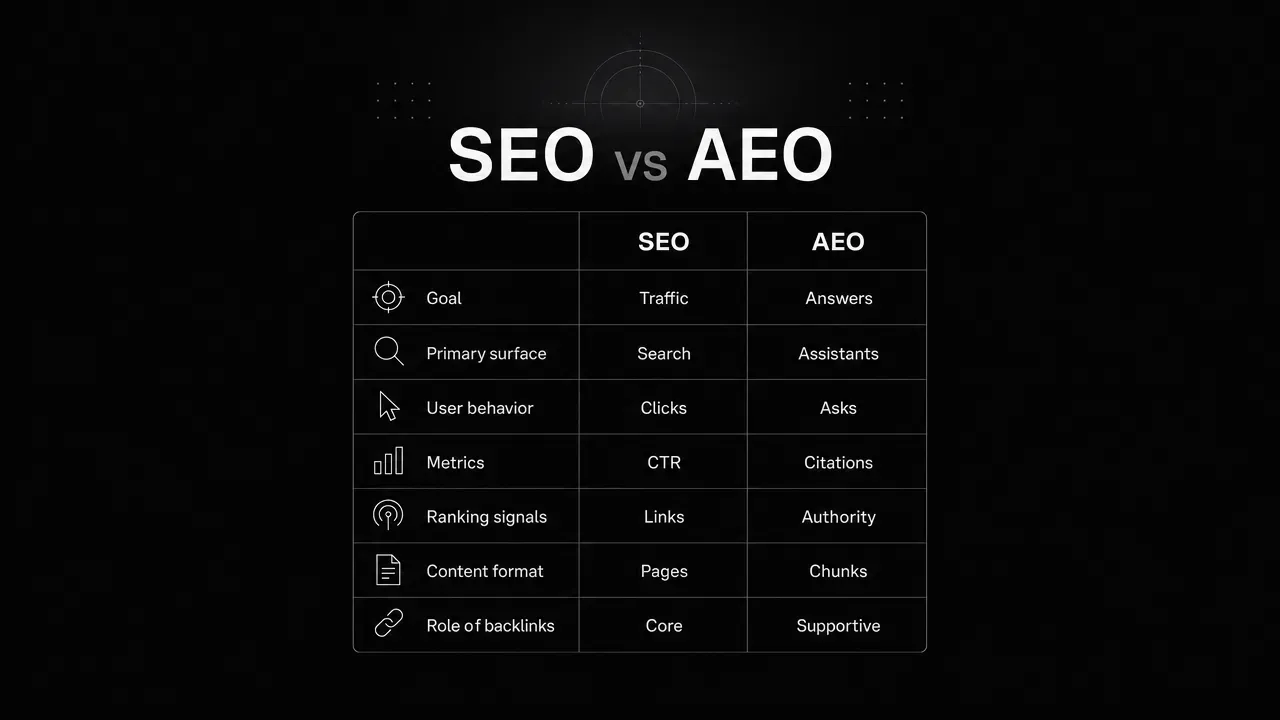
| SEO | AEO | |
|---|---|---|
| Goal | Rank in search results and earn a click | Get selected as the cited answer |
| Optimization focus | Crawlability, relevance, backlinks, authority | Extractability, factual clarity, answer-level trust |
| Success metric | Rankings, impressions, CTR, organic traffic | Citation rate, mention share, share of answer |
| Content unit | The page | The answer block |
| Primary channel | Google, Bing search results | ChatGPT, Perplexity, Gemini, Google AI Overviews |
| Discovery model | User scans a list and chooses | System selects and synthesizes on the user’s behalf |
In short:
- SEO gets your content discovered; AEO gets it selected.
- SEO optimizes pages; AEO optimizes answers.
- SEO measures ranking and traffic; AEO measures mentions, citations, and share of answer.
For teams already doing strong technical SEO, AEO is a refinement, not a reset: tighter answers, clearer information architecture, and better evidence signals. The best programs treat AEO, SEO, and GEO as a connected stack — an extension of AI SEO, not a replacement. Search engines decide what deserves visibility; AI systems decide what deserves to be quoted, synthesized, or recommended.
Goals, metrics, and ranking signals
So what is AEO optimizing for that SEO isn’t? SEO and AEO differ most clearly in their target. SEO aims to improve rankings, clicks, and organic traffic for searchers scanning results pages. AEO aims to increase the likelihood that a page, brand, or statement is used inside an answer for users asking complete questions in conversational environments.
Because of that, the metrics change. SEO teams monitor rankings, impressions, CTR, and revenue. AEO teams add answer-specific indicators such as citation rate, mention share, and answer sentiment.
“Rank #3” is meaningful in SEO. “Mentioned in 28% of tracked prompts on ChatGPT and Perplexity” is more meaningful in AEO.
Ranking signals are interpreted differently too. Backlinks, crawlability, and relevance remain foundational, but AEO weights answer formatting, entity clarity, and verifiable trust markers: author credentials, clear sourcing, and strong E-E-A-T. Schema markup helps machines classify what a page is and how its sections relate — it does not force inclusion, but it reduces ambiguity, like the formats that have long won featured snippets: definitions, comparisons, steps, and summaries.
Will AEO replace SEO?
No. AEO will not replace SEO; it will change what SEO teams consider “complete.”
Gartner predicted that traditional search engine volume would decline 25% by 2026 as users shift more queries to AI chatbots and virtual agents. Gartner That forecast points to channel redistribution, not channel extinction. Search still matters because answer engines need sources, and those sources are still discovered, evaluated, and ranked through search infrastructure.
In practical terms, SEO remains the foundation layer. Google still crawls pages, and answer systems still need authoritative source material — Google AI Overviews sit on top of search indices and search-quality signals. If your technical SEO is weak, your AEO ceiling is lower.
What changes is the visibility model. Instead of asking only “Can we rank?” teams must also ask “Can we be extracted, trusted, and cited?” The winning approach is hybrid: SEO builds crawlable, authoritative pages, and AEO makes them modular, answer-first, and evidence-rich.
GEO, AEO, and GSO: are they actually different?
In 2026, the market still uses several overlapping terms for the same shift. The most common are AEO (Answer Engine Optimization), GEO (Generative Engine Optimization), and GSO (Generative Search Optimization). In day-to-day practice, they are closely related, and many teams use them interchangeably.
The difference is mostly emphasis. AEO focuses on being selected as the direct answer — the clearest label for ChatGPT, Perplexity, Google AI Overviews, or Siri. GEO emphasizes generative systems as the retrieval-and-synthesis layer, centering on how large language models discover and combine sources; for a deeper breakdown, see Generative Engine Optimization (GEO). GSO is the broadest label, framing the shift as generative search across both AI summaries in classical search and standalone assistants.
From an operating perspective, the playbook is similar across all three: create answerable content blocks, strengthen entity clarity, add structured data, improve trust and citation signals, and monitor how platforms represent your brand. That is why many teams roll these efforts into broader AI SEO programs, whether they call the work AEO or GEO.
The more useful distinction is between legacy SEO vocabulary and answer-era vocabulary. SEO was built around rankings, snippets, and clicks; AEO, GEO, and GSO are built around mentions, synthesis, and zero-click influence.
So are they different? Slightly. Separate disciplines? Usually not. The smarter move is to pick one term internally, define it clearly, and execute against the shared mechanics of AI visibility.
Why answer engine optimization matters for the future of search
AEO matters because search behavior is moving from navigation to resolution. Users increasingly ask full questions in ChatGPT, Perplexity, and Google AI Overviews, then act on the answer they receive. It is no longer enough to appear somewhere on a results page — brands need to appear inside the recommendation, comparison, or definition that shapes the decision.
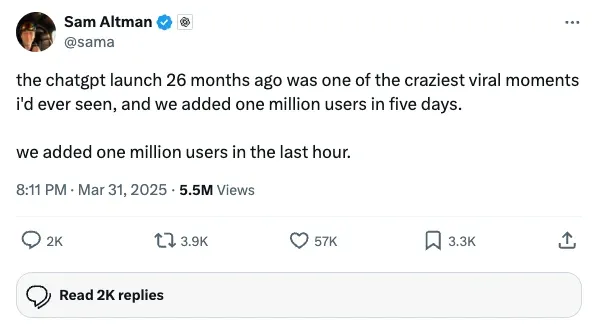
The first consequence is the rise of zero-click behavior. When an answer engine summarizes the market, the user may never open ten tabs — they may shortlist a tool or form a brand impression before any site visit. That makes zero-click search both a measurement problem and a demand-generation problem.
The second consequence is that traffic and value are decoupling. The visitors who do arrive from answer engines tend to be unusually high-intent. HubSpot’s internal data puts the conversion rate at three times that of other channels. HubSpot That fits how answer engines are used: buyers show up after they have already framed the problem and filtered the field.
Buyer behavior reinforces it. HubSpot says 42% of CRM software buyers use AI search in their evaluation. HubSpot For teams in SaaS, finance, health, or complex services, AI visibility is no longer speculative demand capture — it is current-funnel visibility. Each surface behaves differently — ChatGPT shapes early research, Perplexity drives source-linked comparison, Google AI Overviews compress intent inside Google — so brands compete to be cited, not just ranked.
So why is AEO important? Because the future of search is not only about where your page appears. It is about whether your brand survives the synthesis layer.
How to optimize content for answer engines
AEO content works best when it is easy for both humans and machines to parse. A page should answer the primary question quickly, support it with short evidence-rich blocks, and make authorship, freshness, and structure obvious.
The foundational move is simple: build pages around a single explicit question, then answer it near the top. Google’s structured data documentation notes that structured data helps Google understand a page and enable richer search appearances, but does not replace visible, accurate content. Google Search Central The “perfect” AEO format is not standardized, but AgencyAnalytics recommends opening with a concise answer in the 30 to 60 word range, then a few short blocks rather than a long wall of text.
What is AEO used for?
AEO is used for far more than definitions — product comparisons, feature explainers, implementation guides, FAQs, glossaries, and category pages. Any page that answers a concrete question, informational or commercial, can be engineered for answer retrieval.
From a content design perspective, the most reliable page structure looks like this:
- clear H1 aligned to the user question,
- short direct answer,
- trust block with source and author context,
- atomic explanatory paragraphs,
- bullets, steps, or tables for easy extraction,
- schema markup aligned to page type,
- internal links to deepen context.
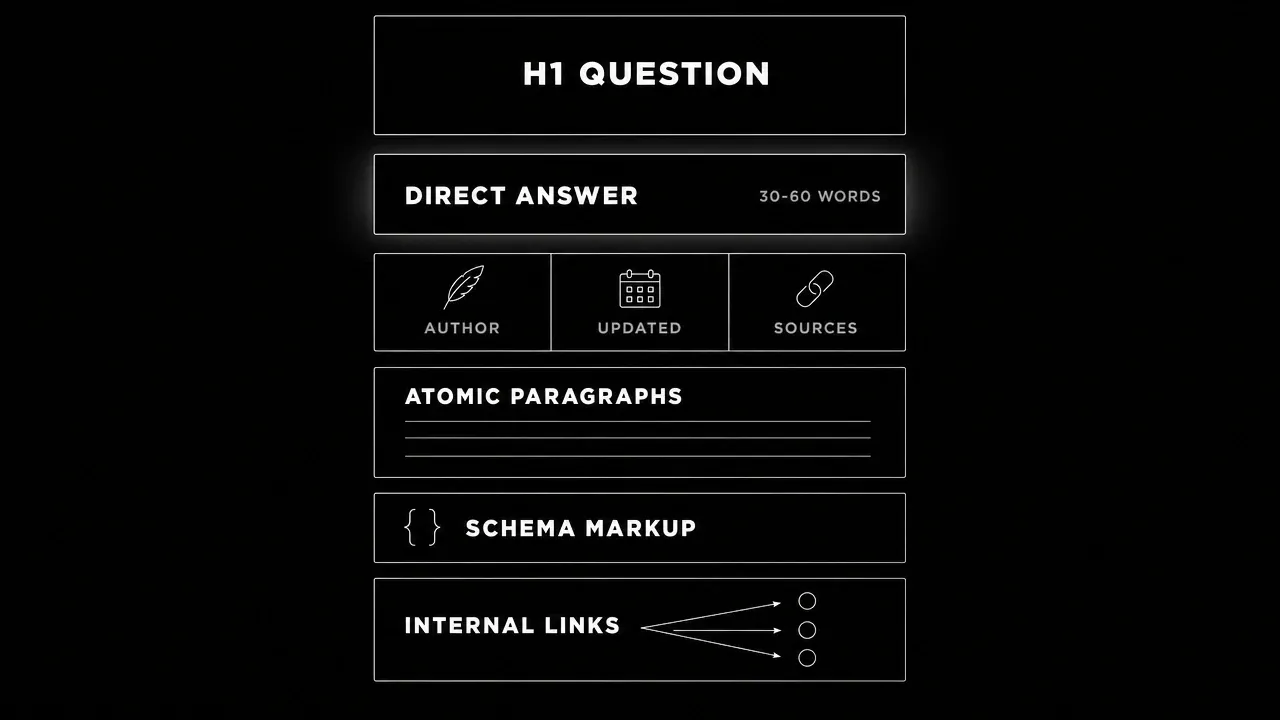
That is the logic behind leading with a direct answer and schema markup that answer engines actually use. AEO is not about writing robotic text. It is about reducing ambiguity.
Lead with a direct answer
The main answer should appear immediately below the page title, not halfway down the page. If the user asks “What is answer engine optimization?”, the page should answer that question in plain language before moving into nuance, examples, or history.
A practical target for that lead answer is about 30 to 60 words — long enough to be useful, short enough to extract cleanly. AgencyAnalytics It should do three things: define the topic, state the distinction or purpose, and avoid throat-clearing. The closer that answer sits to the top, the less work an answer engine does to infer relevance.
Use question-based headings and atomic paragraphs
Question-based headings mirror how people actually search in answer engines. Users type or speak full prompts, not keyword stems, so headings like “Will AEO replace SEO?” or “How do I measure AEO success?” create a tighter match between intent and structure. That is why AEO pages read best as layered Q&A documents rather than essays: each heading resolves a distinct intent, and each answer stands on its own if extracted.
Atomic paragraphs are the writing equivalent of modular code. Keep them short, specific, and focused on one claim. This makes them easier to reuse in summaries, FAQs, and voice responses, and it pairs well with FAQ schema. Human readers scan better too.
A worked example: SEO-style answer vs. AEO-style answer
Take the query “best CRM for small business.” Here’s the same question, answered two ways.
SEO-style answer, written to earn a click:
“Choosing the right CRM for your small business can be a daunting task, given the sheer number of options on the market today. In this guide, we’ll walk you through the key factors to consider, from pricing to scalability, and introduce you to some of the top contenders in the space.”
This paragraph has nothing for a model to extract. No name, no claim, no number — just a promise to deliver value further down the page.
AEO-style answer, written to be lifted and cited:
“The best CRM for small business in 2026 is HubSpot CRM for teams that want a free entry point, Pipedrive for outbound-heavy sales teams, and Zoho CRM for budget-conscious teams already using Zoho’s suite.”
Three named answers, each with a “best for” qualifier, complete in two sentences. A model can quote this block standalone and it still makes sense — that’s the whole test for whether a paragraph is AEO-ready.
Implement schema markup that answer engines actually use
The most useful schema types for AEO are usually Article, FAQPage, and HowTo, depending on page intent. Article helps define authorship, headline, dates, and page type. Google documents that Article structured data can help it better understand article content across Search, Google News, and other properties. Google Search Central
FAQPage and HowTo are still worth using when they accurately reflect the visible page, even though Google reduced their visible rich-result treatment in 2023. Google Search Central Blog You should not use FAQ schema because you expect guaranteed rich results. You should use it when the page genuinely contains question-and-answer content and the markup makes the page easier to interpret.
Best-practice schema stack for most AEO editorial pages:
Articlefor primary page identity,FAQPagefor true FAQ sections,HowTofor step-driven instructional content,BreadcrumbListwhere relevant for hierarchy.
Always keep the markup aligned with visible content. Google’s structured data policies are clear that markup must reflect what users can actually see on the page. Google Search Central
Build trust signals AI systems can verify
Trust signals are where effective AEO starts to resemble classic search quality work. Answer systems favor content that can be attributed and cross-checked: visible author names, last-updated dates, primary-source references, stable entity naming, and claims specific enough to verify. These are practical expressions of E-E-A-T, even when the engine never labels them that way.
Backlinks still matter, but their role shifts. In SEO they are a direct authority signal; in AEO they also act as corroboration. If your brand is consistently cited across trusted third-party sources, answer systems have more evidence your claims are worth repeating.
So trust is both on-page (authorship, sourcing, clarity) and off-page (mentions, links, reviews, third-party validation). AEO rewards content that is easy to verify, not just easy to read.
How to measure and track answer engine optimization success
So what is AEO success, measured honestly? It cannot be captured by rankings alone. A page may rank well and never be cited, or rank modestly and dominate answer-engine mentions because its structure is cleaner. Measurement needs to move from page position to answer visibility.
The first KPI layer is presence: are you mentioned at all in ChatGPT, Perplexity, Google AI Overviews, or voice results? The second is attribution: are you cited or referenced accurately? The third is business impact: does that visibility influence assisted conversions, demos, or pipeline quality?
Expect an iterative timeline, not an instant lift. Practical AEO guides commonly frame early movement within a 30 to 90 day window for high-intent queries once content has been restructured and tracked consistently. AgencyAnalytics A 90-day horizon gives teams enough time to audit priority prompts, ship changes, and observe directional movement.
Reporting is still fragmented: Google Search Console does not yet provide a clean citation report for Google AI Overviews, so third-party tools fill the gap. The most useful model is a tracked prompt set by funnel stage — informational, comparison, vendor/category, brand-plus-competitor, and voice-style questions — monitored weekly alongside traffic and conversion signals.
The KPIs that replace rankings
The most important AEO KPIs are:
- share of answer: how often your brand appears across a tracked prompt set,
- citation rate: how often your domain or page is explicitly cited,
- mention accuracy: whether your brand is described correctly,
- answer sentiment: whether the recommendation is favorable, neutral, or negative,
- AI referral traffic: sessions arriving from AI tools,
- assisted conversions: downstream conversions influenced by answer-engine discovery.
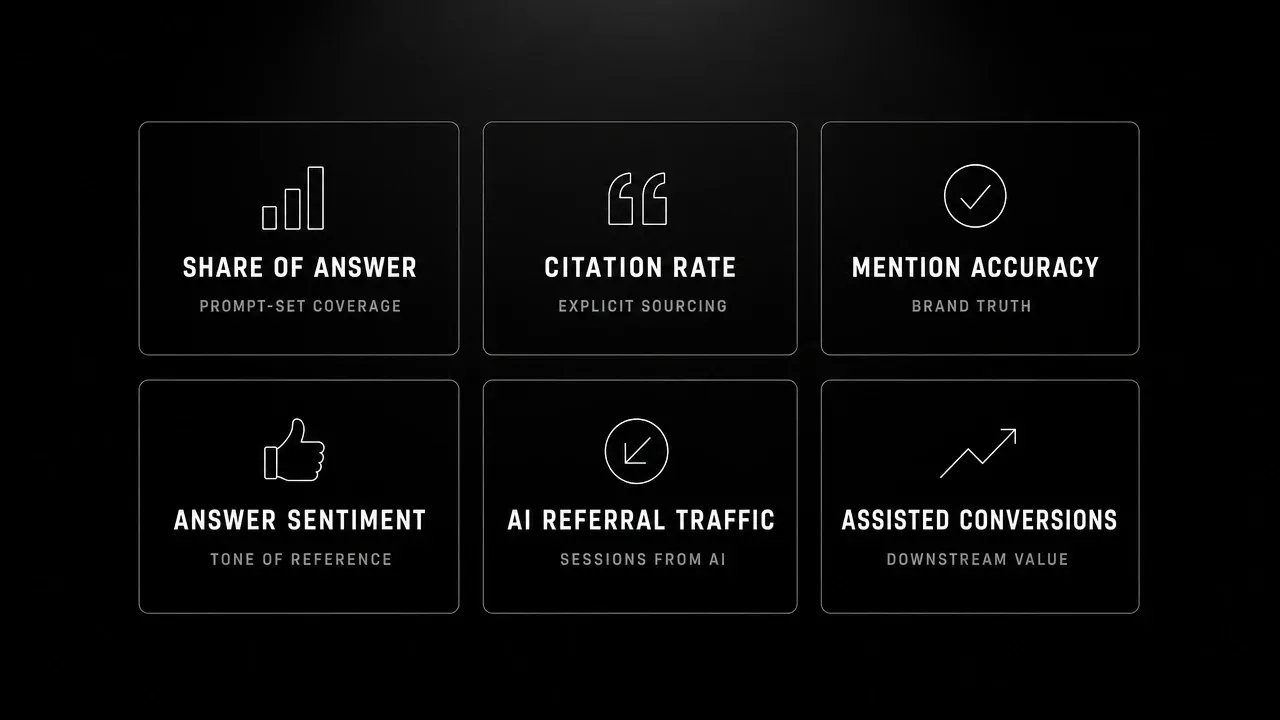
These do not replace traditional SEO metrics, but they do replace rankings as the primary success signal for answer-engine work. Segment by platform too: ChatGPT, Perplexity, Google AI Overviews, and Gemini rarely surface the same sources, so cross-platform visibility matters more than any single screenshot.
Tools and APIs for tracking AI citations
AEO tracking is an emerging category, but the stack is improving — for a hands-on comparison, see our best AEO tools roundup.
HubSpot offers AI Search Grader and broader AEO tooling that shows how a brand appears across answer engines and where visibility gaps exist. HubSpot Semrush provides an AI Visibility Toolkit with visibility scoring, mention analysis, and platform-specific monitoring across ChatGPT, Gemini, and Google AI surfaces. Semrush
Yext also frames AEO in the AI-search context, defining it as optimizing brand content and data so it can be cited as a trusted source by answer engines — a definition that leans heavily on structured, verifiable business data rather than long-form content.
Most of these tools ship as dashboards built for marketers to read a report. cloro takes the opposite approach: a raw API for developers and agencies who want to pull citation, mention, and visibility data directly into their own tools, dashboards, or client-facing reports, instead of logging into someone else’s SaaS to see it.
Benefits and challenges of AEO
So what is AEO worth to a brand? Its biggest benefit is winning visibility where decisions are increasingly made. When ChatGPT, Perplexity, or Google AI Overviews summarize a category or define a concept, the brands included in that answer gain credibility before the click.
That creates several concrete advantages:
- stronger brand recall at the moment of research,
- higher-value visits when clicks do occur,
- better performance on long-tail, question-based demand,
- broader presence across zero-click environments,
- tighter alignment between content and buyer intent.
AEO also improves content quality. Pages that perform well in answer engines are usually clearer, better structured, and easier to maintain, so even modest gains often help SEO, conversions, and UX.
But the challenges are real. Answer systems are volatile: retrieval methods and interfaces change quickly, and what works in ChatGPT may not work in Perplexity. Measurement is imperfect too — there is no universal “answer-engine Search Console” yet.
AEO can also raise visibility without raising traffic, forcing a monetization conversation for some brands. And representation is partly outside your control: answer systems may cite third-party reviews or comparison sites alongside your materials, so reputation work matters as much as on-site optimization. The practical response is adaptation, not resistance — treat AEO as a layer on top of SEO, content, and digital PR, not an isolated experiment.
What is AEO certification, and is it worth it?
AEO certification is usually a training or credentialing program that teaches how answer engines work, how AI visibility differs from traditional SEO, and how to structure content for citations, mentions, and answer inclusion.
The purpose is not to grant official status with ChatGPT, Google, or Perplexity — there is no governing body that certifies a site as “AEO approved.” Certification is an educational signal that helps a team build shared vocabulary and learn practical implementation patterns.
So the value of AEO certification depends on what is actually taught. It is worth it when the program covers answer-engine mechanics, prompt research, content restructuring, schema, E-E-A-T, and measurement — and less valuable when it simply rebrands basic SEO advice with AI language. For in-house teams it works as enablement across content, technical SEO, analytics, and demand gen; for agencies it packages a new service line.
So what is AEO certification actually worth? Sometimes a lot, sometimes nothing. It is worth paying for when it shortens the learning curve and improves execution.
It is not worth paying for if it promises platform favoritism, guaranteed citations, or secret ranking formulas. The real asset is operational competence, not the badge.
A 90-day AEO implementation plan
AEO adoption works best as a phased rollout, not a full-site rewrite: a 90-day window split into three 30-day phases for audit, implementation, and measurement-driven iteration.
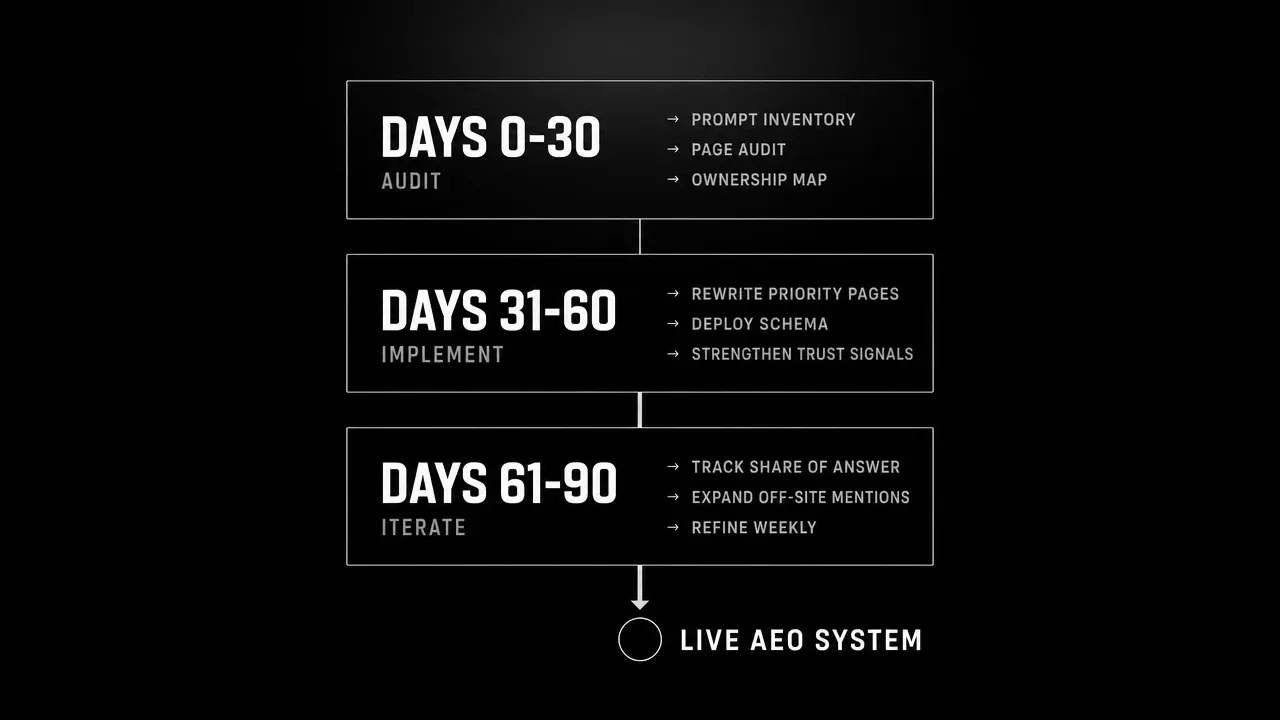
Days 0-30: Audit and prioritization. Pull high-intent informational, comparison, and branded category prompts, review how ChatGPT, Perplexity, and Google answer them today, then map them to existing pages. Audit which pages already rank, already convert, miss direct answers, lack schema, or have weak authorship. Define ownership too: an SEO lead, a content strategist, a developer for schema, an analyst for reporting, and a subject-matter expert for factual review.
Days 31-60: Implementation. Rewrite priority pages into answer-first formats: concise summaries, question-based subheads, atomic paragraphs, and stronger evidence blocks. Add Article markup, plus FAQPage or HowTo where the page genuinely supports it, and refresh bylines, dates, and references. Tighten internal links from supporting pages into core answer pages. To coordinate that work across SEO and AI visibility, cloro should sit close to the reporting loop.
Days 61-90: Distribution, tracking, and iteration. Expand beyond on-page edits: improve third-party mentions, partner citations, and supporting content that answer engines may use to corroborate your brand. Track visibility, share of answer, referral quality, and brand representation across prompt sets and platforms.
The goal by day 90 is not perfection. It is a working AEO system with priority prompts defined, core pages restructured, schema deployed, trust signals strengthened, and a reporting baseline established. Once that system exists, scaling becomes much easier.
So, what is AEO in the end? It is how your brand stays visible when the answer, not the link, becomes the destination. Don’t just rank. Be the answer.

About the author
Ricardo Batista
Founder, cloro
Ricardo is one of the founders and engineers behind its SERP and AI-search scraping infrastructure. Before cloro he scaled a financial comparison site to $7M ARR and ran the full-country operations of a unicorn to $65M ARR, then went back to building. He writes about search engine scraping, generative-engine optimization, and turning live search and AI-answer data into something teams can act on.
Frequently asked questions
What does AEO stand for?+
AEO stands for Answer Engine Optimization. It refers to optimizing content so systems like ChatGPT, Perplexity, Google AI Overviews, Siri, and Alexa can extract and present it as a direct answer.
What is AEO in AI?+
In AI contexts, AEO is the practice of making content easy for answer systems to interpret, trust, and cite. It combines structured writing, clear entities, credible sourcing, and technical signals so AI systems can reuse the information accurately.
What is the purpose of AEO certification?+
AEO certification is mainly for education and team enablement. Its purpose is to teach marketers how answer engines work and how to improve visibility within them. It is not an official approval from AI platforms.
Will AEO replace SEO?+
No. AEO complements SEO rather than replacing it. SEO still helps your pages get discovered and trusted by search systems, while AEO helps those same pages get quoted or cited inside answer experiences.
How long does it take to see AEO results?+
Most teams should think in terms of early directional movement within 30 to 90 days after implementing answer-first rewrites, schema improvements, and trust updates, especially on high-intent pages. Larger gains usually require ongoing iteration.
Which platforms matter most?+
For most brands in 2026, the key answer surfaces are ChatGPT, Perplexity, Google AI Overviews, Siri, and Alexa. The exact mix depends on your audience, device behavior, and query type.
Does AEO help only with informational content?+
No. It also helps with product comparisons, commercial research pages, solution pages, feature explainers, onboarding content, and B2B evaluation journeys.
What should SEO teams do first?+
Start with a prompt audit, identify high-value pages already ranking, then restructure those pages so the answer appears early, clearly, and credibly. That gives you the fastest path to testing whether AEO changes visibility.
Related reading
Best AEO Tools 2026: 12 Answer Engine Optimization Platforms Compared
We compared 12 AEO tools on engine coverage, citation intelligence, API access, and price. See which answer engine optimization tool fits your team.

How to Make ChatGPT Recommend Website Pages Like Yours
Learn how to get ChatGPT to recommend your website: content structure, authority signals, and technical fixes that lift your link inclusion rate.
What Is Generative Engine Optimization (GEO)?
Generative engine optimization helps AI engines cite your brand. Learn GEO ranking factors, content structure, schema, measurement, and tools.