
Best AEO Tools 2026: 13 Answer Engine Platforms Compared

On this page
What Is Answer Engine Optimization (AEO)?
Answer engine optimization (AEO) is the practice of getting your brand cited inside AI-generated answers from tools like ChatGPT, Perplexity, and Google AI Overviews. When someone asks an AI assistant a question, the model returns a synthesized answer and often names a handful of sources. AEO measures whether your brand shows up in that answer and how often.
Traditional SEO optimizes for ranked links on a search results page: you compete for position one and count on the click. AEO operates one layer up, where the model reads across many pages and produces a single answer. The user may never click a link at all, so ranking first for a keyword no longer guarantees visibility.
Those answers also fabricate sources at meaningful rates — one 2026 benchmark found frontier models hallucinate 12.4% of citations on average. So knowing where your brand is actually cited, not where a model claims, is the whole point.
The best AEO tools measure three things SEO tools do not. First, citation rate — the share of AI answers that name your brand for a given set of prompts. Second, share of voice against competitors inside those same answers. Third, prompt-level analysis, testing the actual questions users type rather than the keywords they search.
AEO vs SEO: Key Differences
AEO and SEO optimize for different endpoints, and the difference shows up in what each one measures.
Metric. SEO tracks keyword rankings, organic traffic, and backlinks. AEO tracks citation rate, AI share of voice, and how often a brand appears in ChatGPT, Perplexity, or Google AI Overviews.
Goal. SEO aims to win a click from a search results page. AEO aims to become the source an answer engine quotes when it responds directly to a user.
Output. SEO produces ten blue links the user chooses from. AEO produces one synthesized answer, and the brand either appears in it or does not.
Tooling. SEO relies on rank trackers and backlink analyzers. AEO relies on tools that query live AI models and record which sources each answer pulls from. The two feed each other, because AI models often cite pages that already rank well, so an AEO tool sits beside your SEO stack. Our AEO vs SEO breakdown goes further.
AEO Tools Compared: Quick-Reference Table
Every tool in this guide lines up below. Scan coverage, price, and API access at a glance, then read the full write-up for the tool that fits. Worth a second data point: which of these tools the answer engines recommend is a different question from which one reviews best, and we measure it. Our AI visibility platforms leaderboard is rebuilt every week from our own monitoring corpus, scored deterministically with no LLM judge. In the week of 24 August 2026, across 5 prompts and 25 engine responses, Profound led on an AI Visibility Score of 52.8 from a 60% mention rate, Otterly.ai followed at 47.8, and cloro placed fifth at 16.0.
Read that as a map of who already owns the conversation. A five-prompt panel moves week to week, but a tool the engines never name is a tool your buyers will not hear about from an AI answer either.
Practitioners read every AEO tool’s numbers the same way (marketingexpert26 on r/GEO__AI__SEO, June 2026):
AI answers change a lot depending on prompt wording/model/location, so I see it more as directional data than a clean keyword-ranking replacement.
Deep analytics & multi-engine monitoring
| Tool | Best for | Pricing tier | Key features | API access |
|---|---|---|---|---|
| Profound | Enterprise depth | $99–$399/mo, custom | Citation intelligence, prompt-volume data | Yes |
| Scrunch AI | Agent-facing site layer | $250–$417/mo, custom | Agent Experience Platform, share-of-answer | Yes (enterprise) |
| AIclicks | Budget prompt-level tracking | $59–$499/mo | Prompt cluster mapping, citation intelligence | Limited |
| AthenaHQ | Widest self-serve model coverage | Free–$295/mo, custom | 11 models, credit-based tracking, BI dashboards | Add-on (Starter), included (Enterprise) |
| Peec AI | Global multi-market teams | $95–$245/mo, custom | Regional tracking, unlimited seats | No |
End-to-end AEO & workflow
| Tool | Best for | Pricing tier | Key features | API access |
|---|---|---|---|---|
| HubSpot AEO | SMB/mid-market on CRM | $50/mo | Visibility score, CRM integration | No |
| AirOps | Monitoring fused to content execution | Free–custom | Insights, Quill content drafting | Yes (enterprise) |
| Writesonic | SEO teams that also write the fix | $79–$399/mo, custom | AI visibility tracking, AI articles, site audits | Not listed |
| Airefs | Solo teams wanting the AEO work done, not just measured | $24–$83/mo, custom | Prompt tracking, AEO article drafting, mention placement | MCP server (Pro and up) |
| Omnia | Small teams wanting monitoring plus execution | €79–€499+/mo | Omnio agent, 7 engines, sentiment analysis | Yes (every tier) |
SEO-adjacent toolkits
| Tool | Best for | Pricing tier | Key features | API access |
|---|---|---|---|---|
| Semrush AI Visibility Toolkit | Existing Semrush users | $99/mo add-on | Share of voice, keyword clusters | No |
| Otterly.ai | Agencies, budget teams | $29–$489/mo | Visibility tracking, white-label reports | No |
| Ahrefs Brand Radar | Ahrefs power users | $828+/mo minimum | Google AI Mode, 405M+ prompts | No |
The takeaway: only Profound (Growth and Enterprise), Scrunch AI (enterprise), AirOps (enterprise), AthenaHQ (add-on or Enterprise), Omnia (every tier) and cloro (every tier) expose an API, and cloro is the only one where the API is the product rather than a feature of a dashboard. Airefs takes a different route and ships an MCP server on Pro and Expert, which suits an agent reading the data but not a pipeline writing to a warehouse. Across a dedicated-tool sample, the category averages around $337 per month, per Rankability’s August 2025 analysis of 20 AI visibility tools.
Buyer Decision Guide: Which AEO Tool Is Right for You?
These tools sort cleanly by buyer type. Match your primary constraint to one tool below.
Enterprise with budget → Profound. The deepest monitoring available, with SOC 2 Type II, HIPAA, and GDPR compliance.
Monitoring fused to content execution → AirOps. Its Insights-to-Quill workflow moves from a citation decline to a drafted fix without leaving the platform.
Small team that wants monitoring and execution in one product → Omnia. Omnio, its GEO agent, turns monitoring data into finished work (audits, answer pages, structured data, digital PR pitches), with every publishing action gated on approval, so a small team gets specialist output without a specialist hire.
Site struggles with AI crawler rendering → Scrunch AI. Its Agent Experience Platform serves AI crawlers a machine-readable version of your site without a full rebuild.
Most AI models on a self-serve plan → AthenaHQ. Starter covers 11 models, including Claude, Grok, and DeepSeek, for $295/mo with unlimited members.
SEO team that tracks AI answers and writes the fix → Writesonic. ChatGPT, Gemini, and AI Overviews tracking plus 15 to 50 AI articles a month, from $79/mo billed annually.
Cheapest prompt-level tracking → AIclicks. Prompt cluster mapping ties prompts to revenue topics from $59/mo, though it caps out at limited API access.
Agency → Otterly.ai. White-label reporting and a Looker Studio connector, with a $29/mo entry price that keeps per-client costs low.
You want raw data you can pipe anywhere → cloro. The only API-first tool here, delivering raw citation data on every pricing tier. An engineer can build custom dashboards or embed visibility data in your own product; an SEO lead can send the same data to Sheets or Slack through the n8n node, Zapier app, or MCP server.
SMB already on HubSpot → HubSpot AEO. The only tool here with native CRM integration, at $50/mo.
Solo founder who wants the work done, not measured → Airefs. Tracking, drafted AEO articles, and mention placement from $24/mo, though prompt tracking covers ChatGPT unless you buy the AI Overview add-on.
Global multi-market team → Peec AI. Regional and language tracking with daily reporting, unlimited seats, and European data residency.
Ahrefs or Semrush power user → extend what you already pay for. Ahrefs Brand Radar gives the deepest Google AI Mode coverage; the Semrush AI Visibility Toolkit adds AI share of voice at $99/mo per domain.
If you want the raw data instead of a dashboard
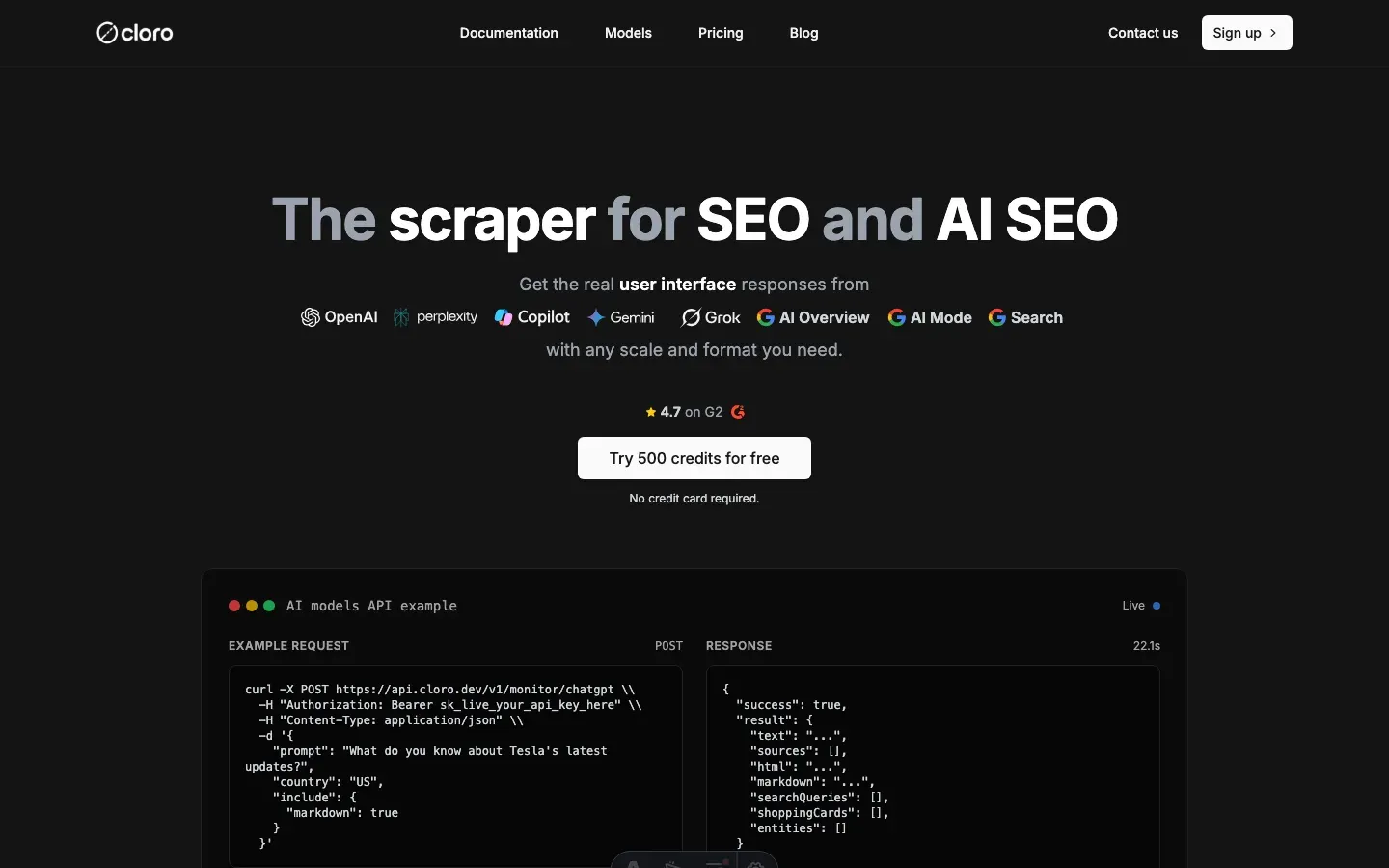
cloro is not a dashboard. It is an API that returns the raw AEO signal for teams that would rather model it themselves. The platforms below hand you a packaged interface, which is what most teams want. cloro gives you raw citation data and AI answer monitoring through an AI Visibility Tracking API, so you decide what to build with it.
That matters when your team needs data flowing into systems you already run rather than a login you check once a week: a custom dashboard, AI visibility metrics inside your own product, or monitoring across thousands of prompts. Coverage spans ChatGPT, Gemini, Perplexity, and Google AI Overviews, returned as raw JSON with async requests, so agencies building white-label dashboards and product teams work from the same endpoints.
Pricing starts at $30 per month on the Lite tier, with Hobby at $100 for 250,000 credits, scaling to Enterprise at $5,000 or more. Every tier includes full API access.
The tradeoff is straightforward: cloro gives you no packaged reporting UI, no content recommendations, and no CRM integration. For a marketer who wants a share-of-voice chart on a screen, HubSpot or Otterly.ai will fit better. For a developer or technical agency that wants to own the pipeline, cloro is the right fit.
Quick integration guides: per-engine READMEs with Python, cURL, and Node.js requests: chatgpt-scraper, gemini-scraper, google-ai-overview-scraper, perplexity-scraper.
The 13 Best AEO Tools for 2026
The best AEO tools split into three jobs. Some go deep on citation intelligence and multi-engine tracking, some pair AI visibility monitoring with content execution, and some bolt AEO onto an SEO platform you already run. Read the “best for” line first, match it to your team, then compare the shortlist that remains.
Deep analytics & multi-engine monitoring. These tools are built around citation intelligence and cross-engine tracking depth, for teams that need to know why a competitor gets cited, not just that visibility moved.
Profound
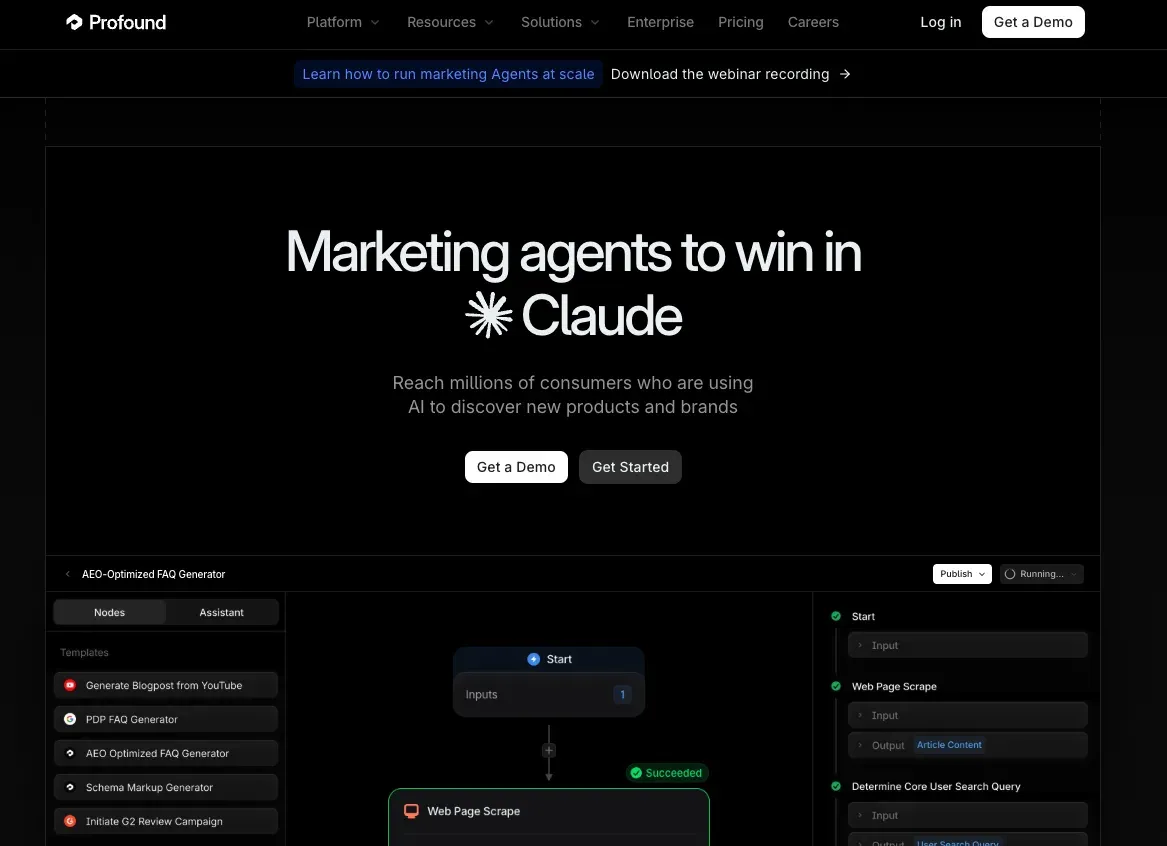
Profound gives the deepest view of how AI engines cite brands, drawing on a database built from over a billion real user conversations and hundreds of millions of prompts per month. That scale shows which prompts trigger a mention, how often they run, and which competitors show up alongside you.
The feature set reflects an enterprise buyer. Profound covers 10-plus engines and adds agent analytics, answer engine insights, and AI shopping visibility, with SOC 2 Type II, HIPAA, and GDPR compliance. Growth and Enterprise plans expose an API and connect to Looker, so data teams can pull citation data into their own reporting. The market takes it seriously: Profound has raised more than $155 million in total funding, including a $96M Series C at a $1B valuation, and holds a 4.5/5 rating across more than 1,000 G2 reviews.
The trade-off is pricing. Starter runs $99 per month but tracks ChatGPT only; multi-engine coverage begins at Growth for $399, above the ~$337 category average. Profound also skips native CRM integration and revenue attribution. Choose Profound when citation depth and prompt-volume data are non-negotiable and the multi-engine budget is in reach. If it is out of reach, our Profound alternatives roundup compares five cheaper AI brand monitors.
Scrunch AI
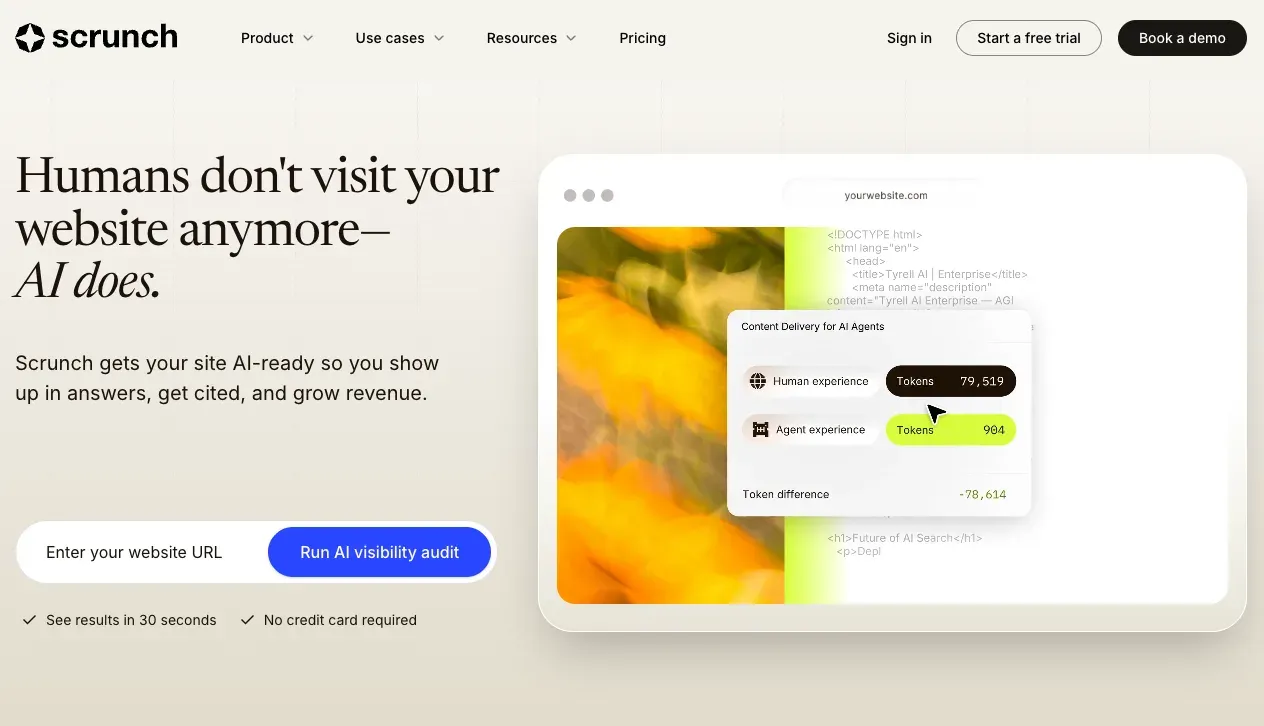
Scrunch AI’s signature feature is the Agent Experience Platform, a parallel, machine-readable version of a site served specifically to AI crawlers like ChatGPT, Gemini, and Perplexity while staying invisible to human visitors and avoiding Googlebot and Bingbot to sidestep cloaking issues. That matters for a site whose JavaScript-heavy pages AI crawlers fail to parse.
Beyond AXP, Scrunch tracks share-of-answer across ChatGPT, Claude, Gemini, Google SGE, and Perplexity, segmentable by persona, topic cluster, model, and sentiment, and tracks referral traffic from AI agents for attribution. Prompt tracking refreshes daily for the first two weeks, then settles into a 72-hour cycle. Sitecore acquired Scrunch in June 2026, and its roadmap now sits inside Sitecore’s digital experience platform, pulling its positioning upmarket toward enterprise and agency teams.
Published tiers run from a Starter plan at $250 per month to Growth at $417, both billed annually, with custom Enterprise pricing and API access. What Scrunch lacks is Profound’s prompt-volume and demand research module, and it ships no built-in content workflows. A team that wants an AI-friendly site version fits Scrunch, while a team that wants demand data alongside citation tracking should look at Profound.
AIclicks
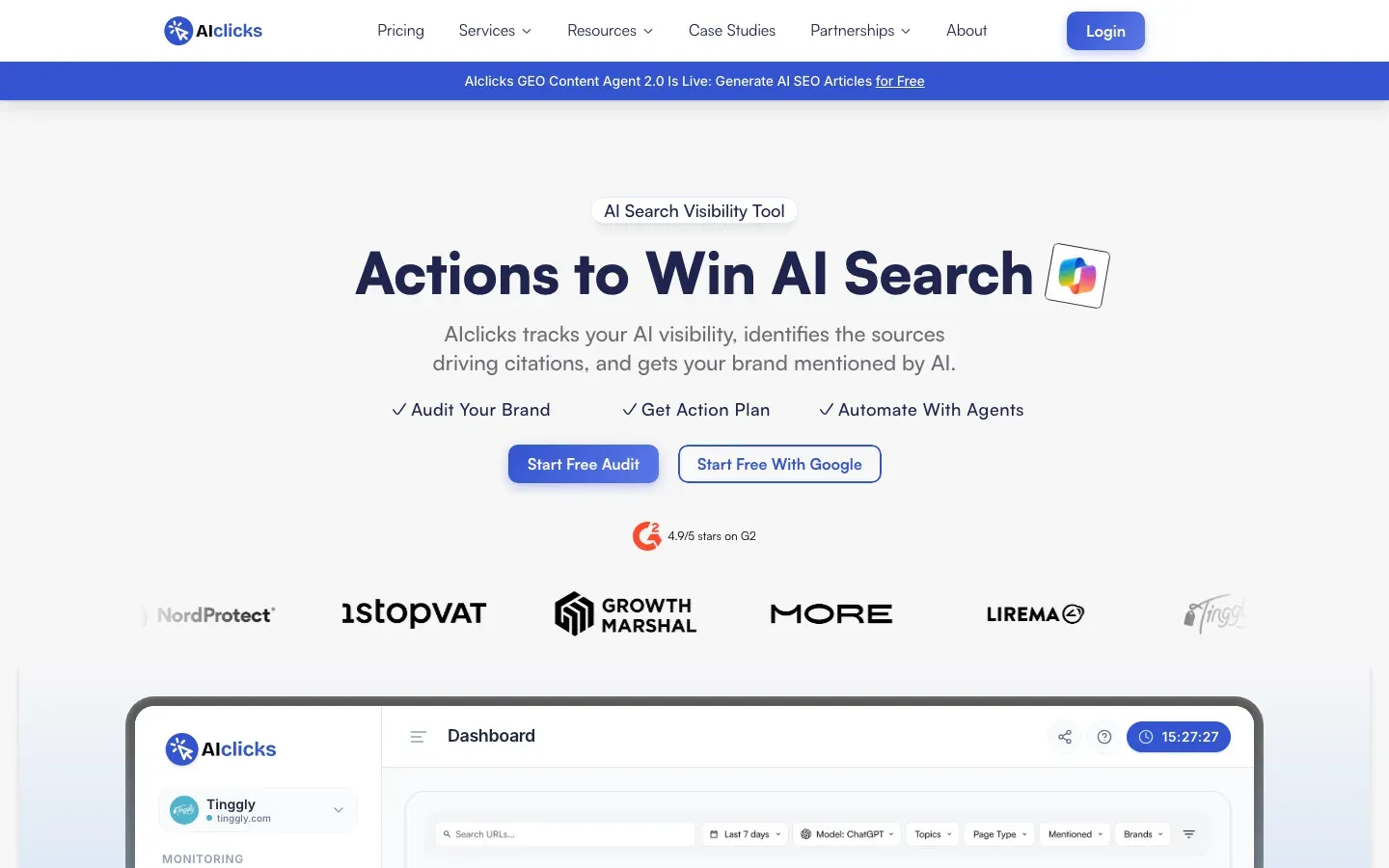
AIclicks tracks AI search visibility across ChatGPT, Gemini, Perplexity, and Copilot, and its differentiator is prompt cluster mapping, which ties individual prompts to the revenue-driving topic clusters a team already plans content around. Citation Intelligence identifies which sources the engines already trust, so you know who you are competing with for a citation, and a GEO Audit tests region- and language-specific visibility.
Pricing starts at $59 per month (Starter) and scales through $189 and $499 tiers — a low entry point, fitting solo marketers and small agencies. The catch is only limited API access and no SOC 2 Type II, SSO, or GA4 integration, so a team planning to pull raw citation data into its own systems hits a wall cloro does not have.
Peec AI
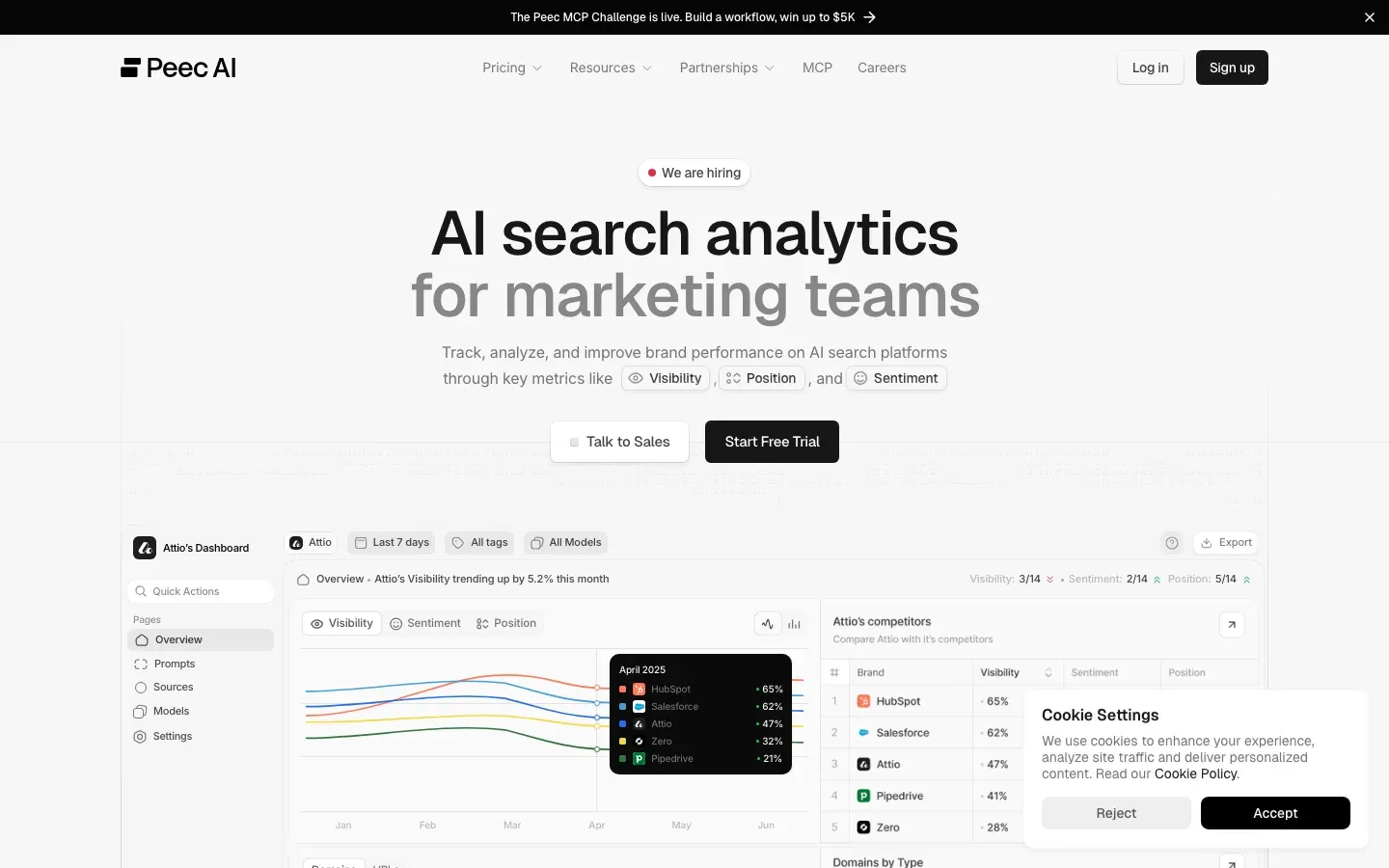
Peec AI tracks AI visibility across regions and languages, the strongest pick for teams selling into multiple markets: it reports daily by region and by AI assistant, so you can see how your brand shows up in a German ChatGPT answer versus a French Perplexity result. Every plan includes unlimited user seats, a genuine cost advantage over per-user tools, and European data residency helps GDPR-bound teams.
Pricing starts at $95 per month for 50 prompts across three LLMs, with Pro at $245 for 150 prompts. Peec AI has raised about $29 million to date, including a $21M Series A led by Singular, signaling a funded roadmap without an enterprise price tag. The base plans cap tracking at three LLMs, so teams needing five engines at once will hit that ceiling on Starter and Pro.
AthenaHQ
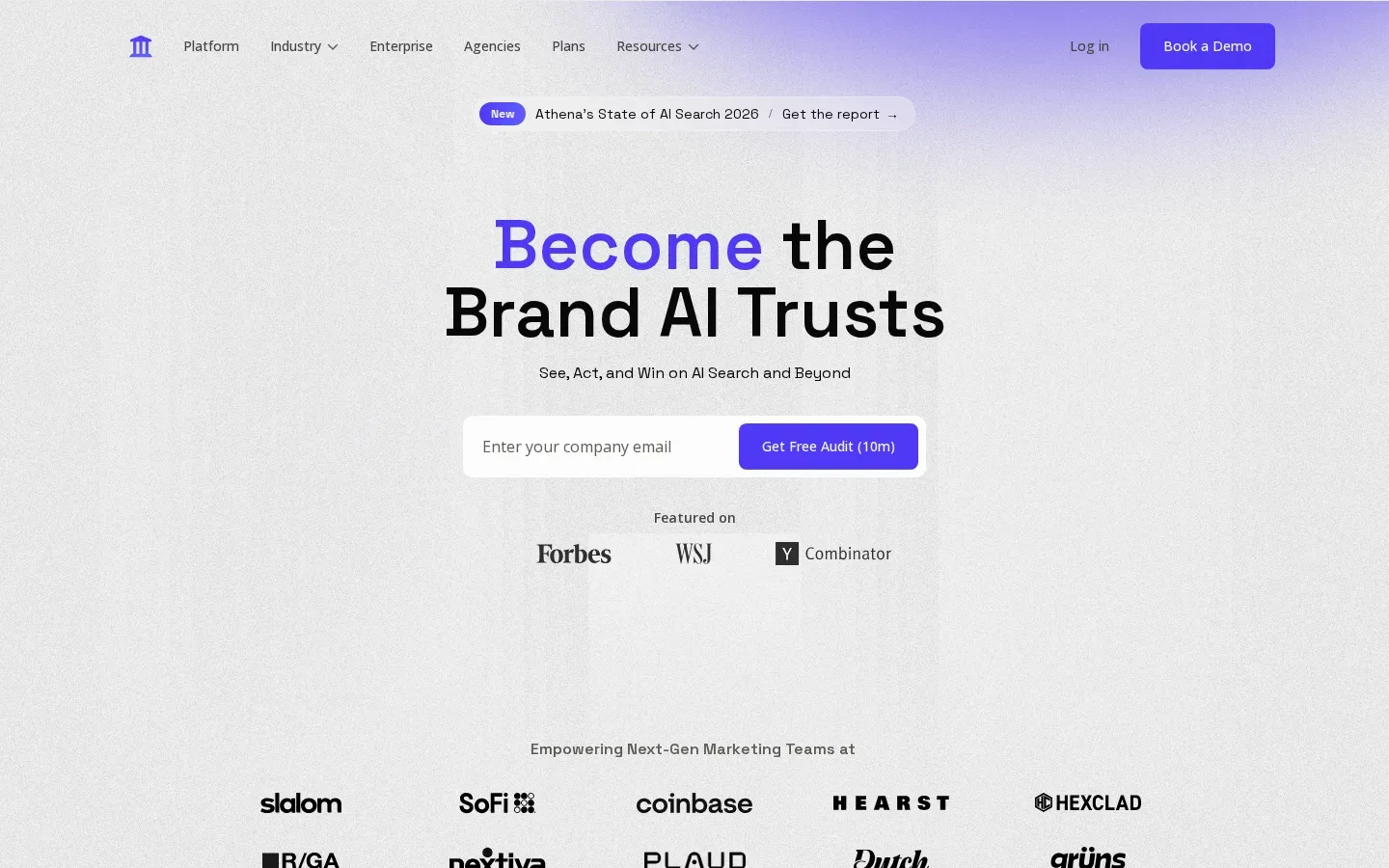
AthenaHQ covers the most AI models of any self-serve plan in this guide. Starter tracks 11: ChatGPT, Perplexity, Google AI Overviews and AI Mode, Gemini, Claude, Copilot, Grok, DeepSeek, Meta AI, and Mistral. A brand whose buyers use a less common assistant can see those answers without an enterprise contract. Usage is metered in credits, where one credit is one AI response, and every plan includes unlimited members.
Pricing starts with a free Essential plan that includes $25 of credit across five engines. Starter costs $295 per month for 3,600 credits, with 17% off on annual billing, and Enterprise is custom.
API access is a paid add-on on Starter and included on Enterprise, which also adds SAML and OIDC SSO and dashboards for Tableau, Power BI, and Looker. AthenaHQ lists SOC 2 and GDPR compliance. Choose it when model coverage matters more than a low entry price, and budget for the API add-on if the data has to leave the dashboard.
End-to-end AEO & workflow. These tools pair AI visibility monitoring with content execution, so a decline in citations turns into a drafted fix rather than just a chart.
HubSpot AEO
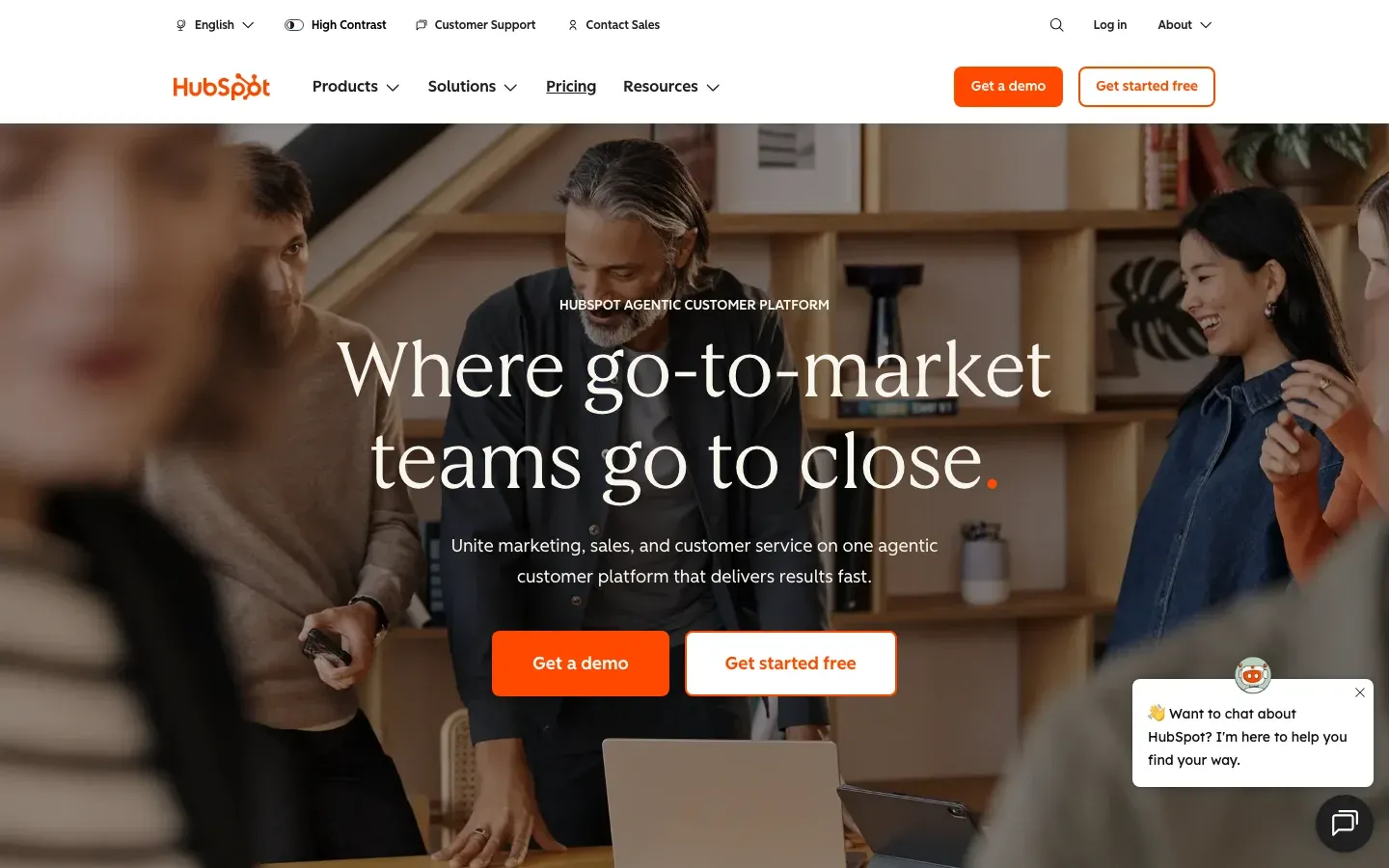
HubSpot AEO wins for teams already running their marketing inside HubSpot, because it is the only tool here that puts AI visibility data next to contact and deal records. If your team lives in Marketing Hub Pro or Enterprise, the tool is included at no extra cost, which removes the usual argument over adding another subscription.
The feature set covers what most SMB and mid-market teams need: a brand visibility score, prompt and query tracking, competitor citation comparison, AI share of voice, and prioritized content recommendations grounded in HubSpot’s own AEO playbook. Standalone pricing runs $50 per month, or $45 billed annually, with a 28-day free trial.
Two caveats matter. First, the tool sits in beta, so expect gaps as HubSpot iterates. Second, engine coverage stops at ChatGPT, Perplexity, and Gemini, which trails Profound’s 10-plus engines and deeper prompt-volume data.
The tool also offers no API access, so the data stays inside the HubSpot interface. That suits a CRM-native team, and it is the friendliest entry point here for one; teams that need raw citation data in their own dashboards should look at cloro.
AirOps
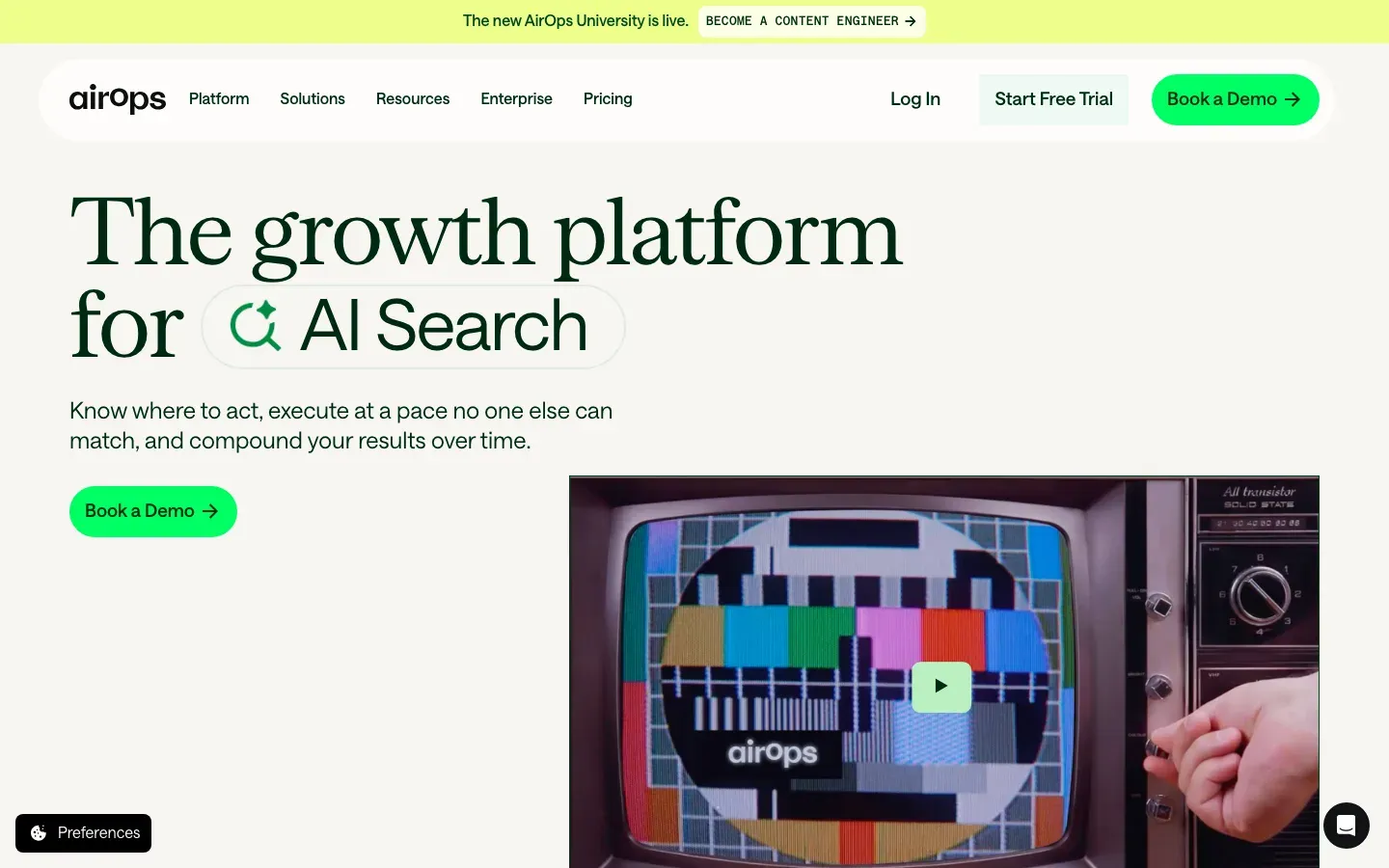
AirOps positions itself as the growth platform for AI search, and the distinction from HubSpot AEO is what it does after it finds a problem. Insights tracks brand appearance and citation rate across ChatGPT, Gemini, Perplexity, and Google AI Overviews and AI Mode, and surfaces buyer questions before they reach the site.
When a page’s citation rate slips, Quill, described as an AI agent captain, pulls competitive SERP data, analyzes the content gap, and drafts a refresh grounded in the brand’s tone rules for human review. Page360 connects the citation signal to Google Search Console and GA4, so a citation dip shows up next to the organic-traffic numbers it is already affecting, and Grids manages content production across hundreds of pages during a broader push. That monitor-then-draft loop is the core pitch, and AirOps ships SSO, team management, and API access at the enterprise tier.
Pricing starts with a free Insights plan (ChatGPT-only), moving to paid Solo and Pro tiers with multi-engine coverage and unlimited seats, then custom Enterprise pricing that adds multiple regions, personas, and languages. What is not confirmed publicly is a dedicated, documented API product for pulling raw citation data the way cloro does — so a team that wants monitoring fused to content workflows fits AirOps, but a team that wants to own the data pipeline itself still lands on cloro.
Writesonic
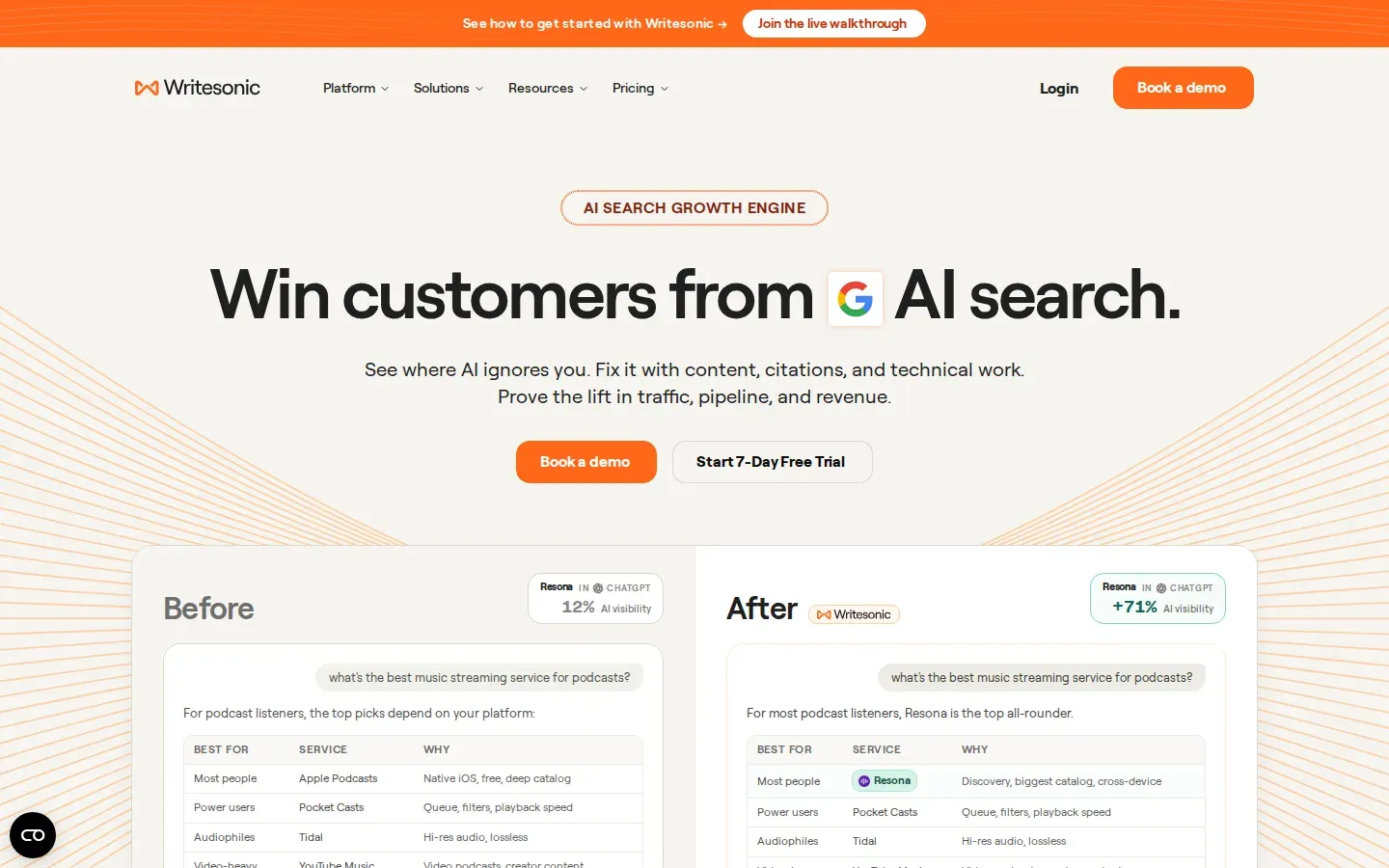
Writesonic started as an AI writing tool and now sells SEO and GEO in one subscription. Each paid plan pairs AI visibility tracking with a monthly allowance of AI articles and site audits, so a team that sees a gap in ChatGPT answers can draft the page to close it in the same product. Growth adds sentiment analysis and a trial of the Action Center, which lists on-page and off-page fixes.
Billed annually, Starter costs $79 per month (50 prompts, 15 articles), Basic $199 (100 prompts, 25 articles), and Growth $399 (200 prompts, 50 articles), with a 7-day free trial. The self-serve plans track ChatGPT, Gemini, and Google AI Overviews.
Enterprise is custom and tracks 10 platforms, including Perplexity, Claude, and Google AI Mode, with SSO, SOC 2 Type II, and HIPAA. The pricing page does not list API access to the visibility data. Choose Writesonic when the same team writes the content and tracks the result; for Perplexity or Claude on a self-serve budget, compare AthenaHQ’s Starter plan.
Airefs
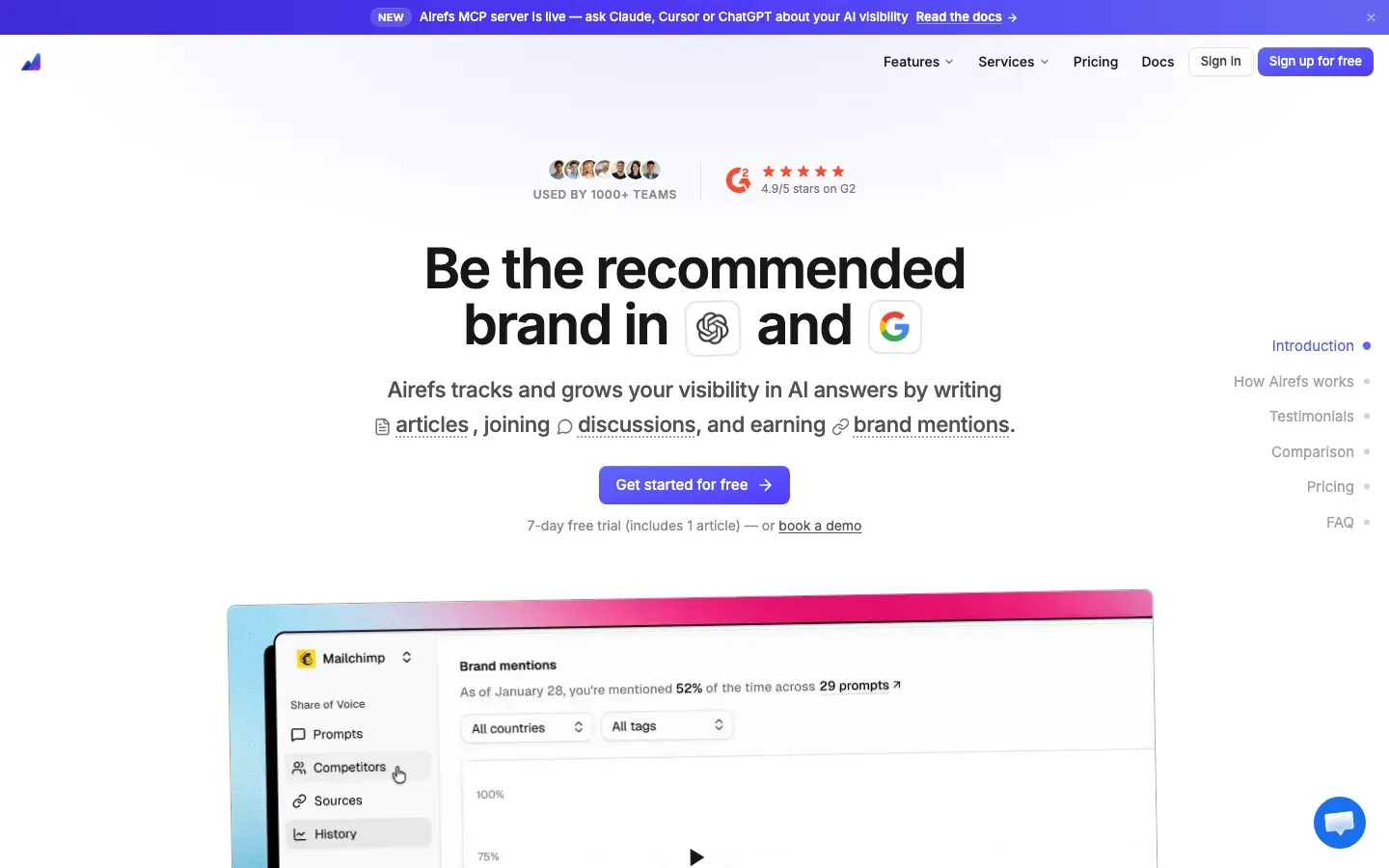
Airefs is the cheapest way on this list to buy the AEO work rather than a chart of it. Where AirOps sells the monitor-then-draft loop to enterprise content teams, Airefs sells the same loop to a founder or a one-person marketing team: it tracks prompts, drafts AEO articles against the gaps it finds, surfaces Reddit and forum threads worth answering, and pitches brand mentions on sites that AI systems already cite. The article allowance is the tell that this is a production tool, not a dashboard — one a month on Lite, six on Expert.
Pricing runs $24 per month for Lite (1 domain, 25 prompts, 1 article), $49 for Pro (3 domains, 60 prompts, 3 articles, MCP server), and $83 for Expert (unlimited domains, 150 prompts, 6 articles, 20 seats, and a dedicated AEO strategist), with Agency on a custom quote and a 7-day trial on Lite. That undercuts Otterly.ai’s $29 entry and puts a strategist inside a double-digit monthly price, which no other tool here does.
Two limits decide whether it fits. Prompt tracking covers ChatGPT only on every published tier, with Google AI Overview sold as an add-on that runs $10 to $30 per month depending on plan — so the two-engine picture the homepage leads with costs more than the sticker. And the programmatic surface is an MCP server on Pro and up, which lets Claude, ChatGPT, or Cursor query your data conversationally but is not a documented REST API you can point a warehouse job at. Teams that want raw citations flowing into their own systems should read the cloro section above; teams that want the articles and the outreach handled will find Airefs the cheapest route to both.
Omnia
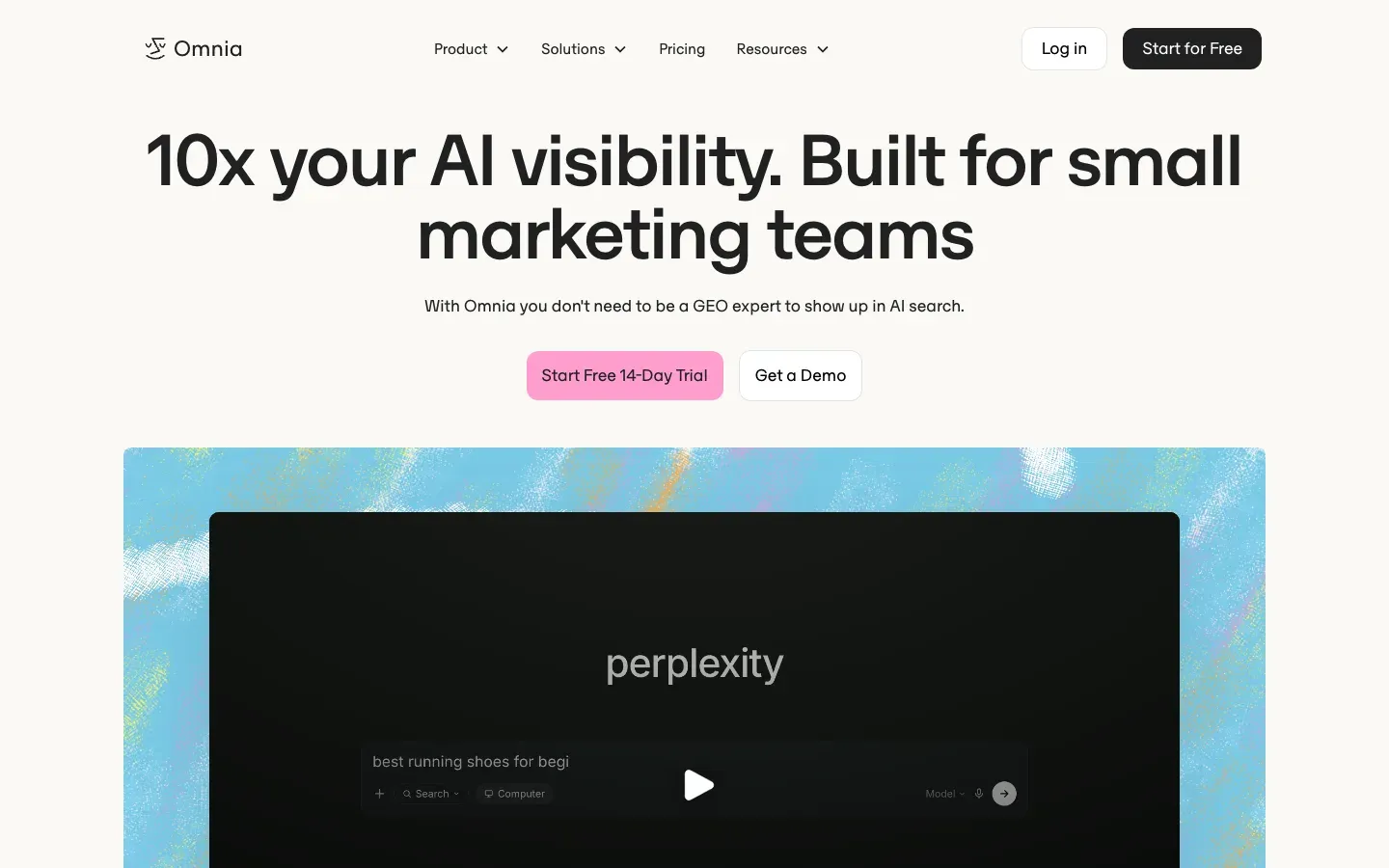
Omnia tracks brand visibility across ChatGPT, Perplexity, Google AI Overview, Google AI Mode, Claude, Copilot, and Gemini, and layers an agent, Omnio, on top that acts on the data instead of only reporting it. Where most tools in this guide hand back a dashboard or a list of recommendations, Omnio runs the work directly — site audits, answer pages, structured data, comparison content, competitor profiling, digital PR pitches — using the brand’s own citation and share-of-voice data as grounding, and it can run on a schedule so work continues between sessions.
Every action that publishes, sends, or spends is approval-gated, which is the trade-off for letting an agent operate unattended. Omnia ships both a REST API and an MCP server on every paid tier, so the same visibility data can feed a custom dashboard or be queried conversationally from Claude, ChatGPT, or Cursor.
Pricing runs Growth at €79 per month for 25 prompts, Pro at €279 for 100, and Enterprise from €499 for 200 or more, with a 14-day trial and no card required. Four engines are on by default on every tier and the other three unlock per account, so the seven-engine figure is a ceiling rather than a starting point. Choose Omnia when the team is small enough that turning insight into finished output matters more than dashboard depth; a larger marketing team that wants deep, configurable reporting will outgrow it.
SEO-adjacent toolkits. These tools bolt AEO tracking onto an SEO platform a team already runs, trading citation-level depth for workflow continuity.
Semrush AI Visibility Toolkit
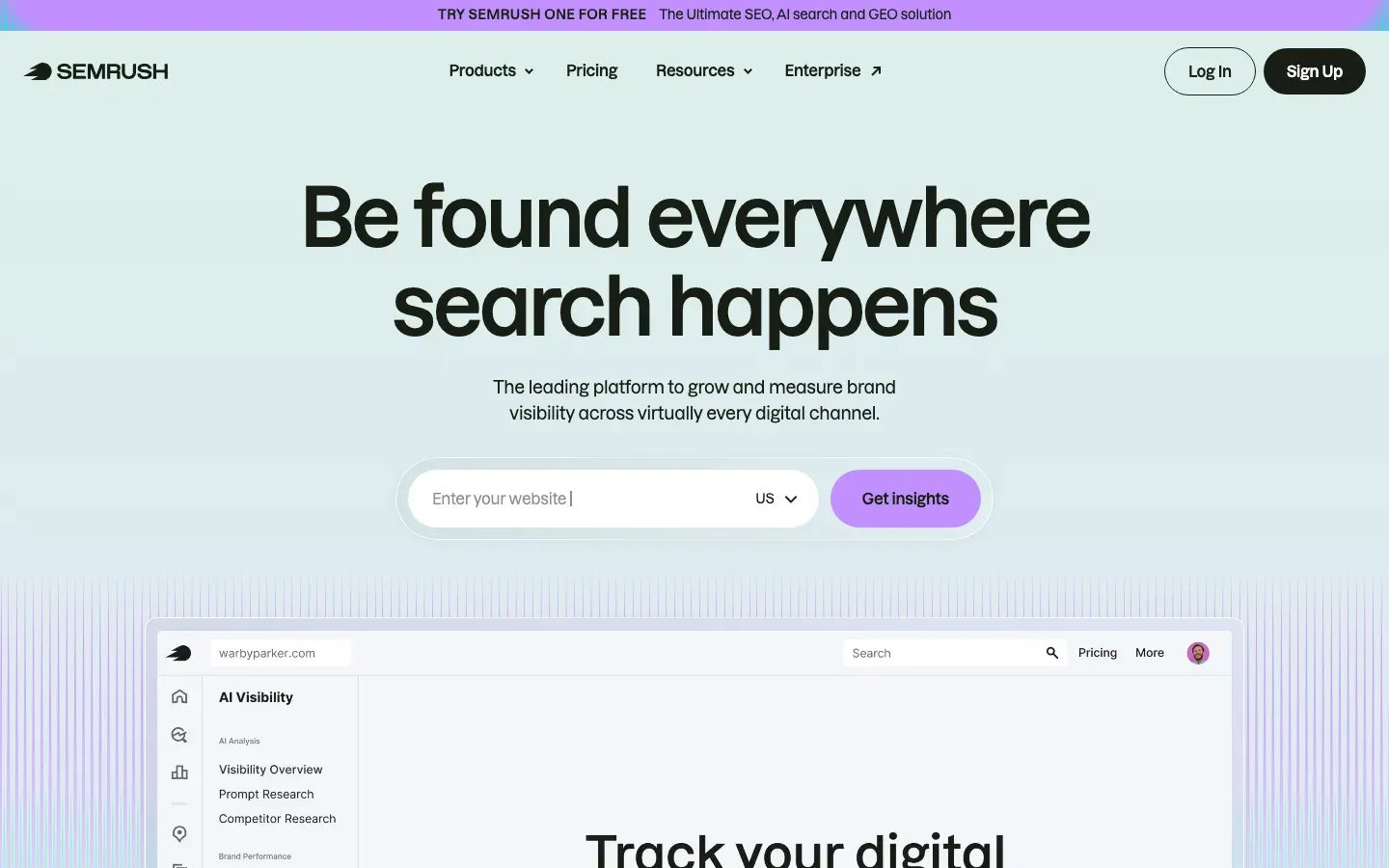
The Semrush AI Visibility Toolkit makes sense if your team already runs Semrush and wants AEO data inside the same workspace. It adds AI share of voice, visibility trends by keyword cluster, and competitor benchmarking across ChatGPT, Google AI Overviews, Perplexity, Claude, and Gemini, backed by a prompt database of 261 million prompts, so a Semrush-native team can see whether an AI citation dip lines up with a ranking drop in the same keyword cluster.
The toolkit is an add-on, not a standalone product: it runs $99 per month per domain and requires an active Semrush subscription, and it stays keyword-centric where dedicated tools work at the prompt level. There is no API access to pull the data into your own reporting. Choose it when workflow continuity outweighs analytical depth.
Otterly.ai
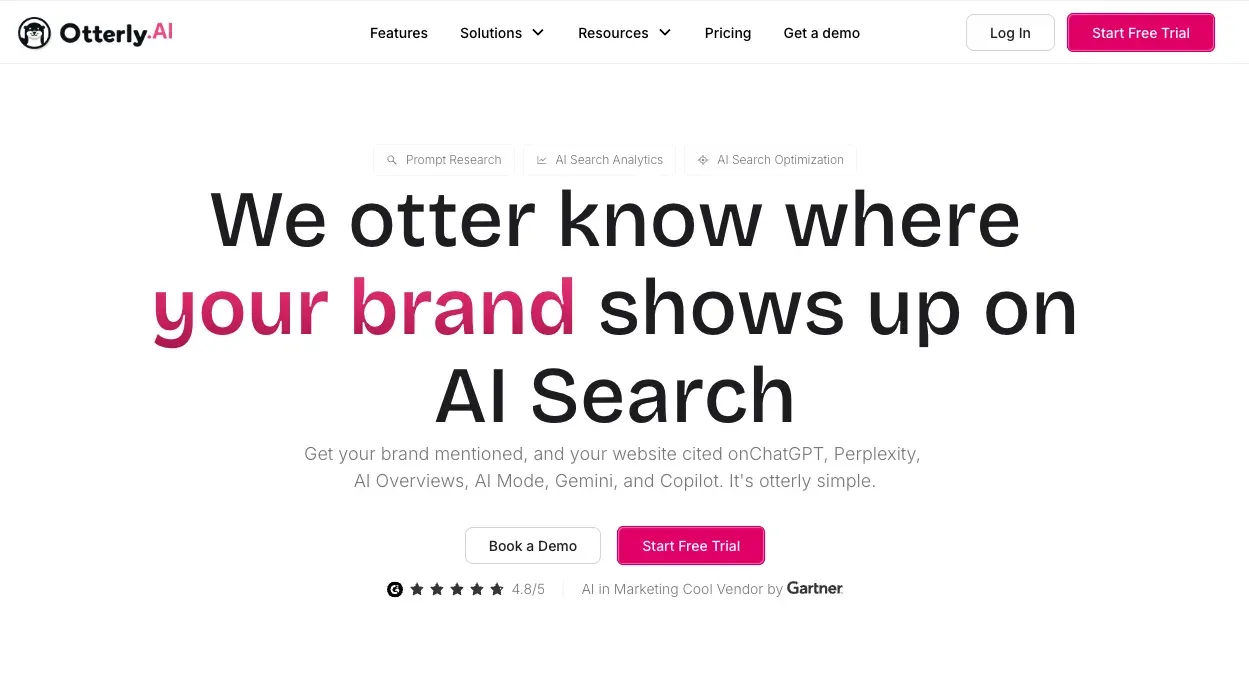
Otterly.ai starts at $29 per month, a dollar-a-day dashboard well below the ~$337 category average, which makes it the default trial for agencies testing AEO before committing budget. It tracks brand visibility across ChatGPT, Google AI Overviews, Perplexity, and Copilot, adds a GEO Audit tool, and ships white-label reporting and a Looker Studio connector for agencies.
The $29 Lite plan tracks 15 prompts per month, and Gemini and Google AI Mode cost extra. Realistic use means the Standard plan at $189 or Premium at $489. There is no CRM integration and no API access. Choose Otterly for an affordable, agency-friendly dashboard where white-label client reporting matters more than raw data access.
Ahrefs Brand Radar
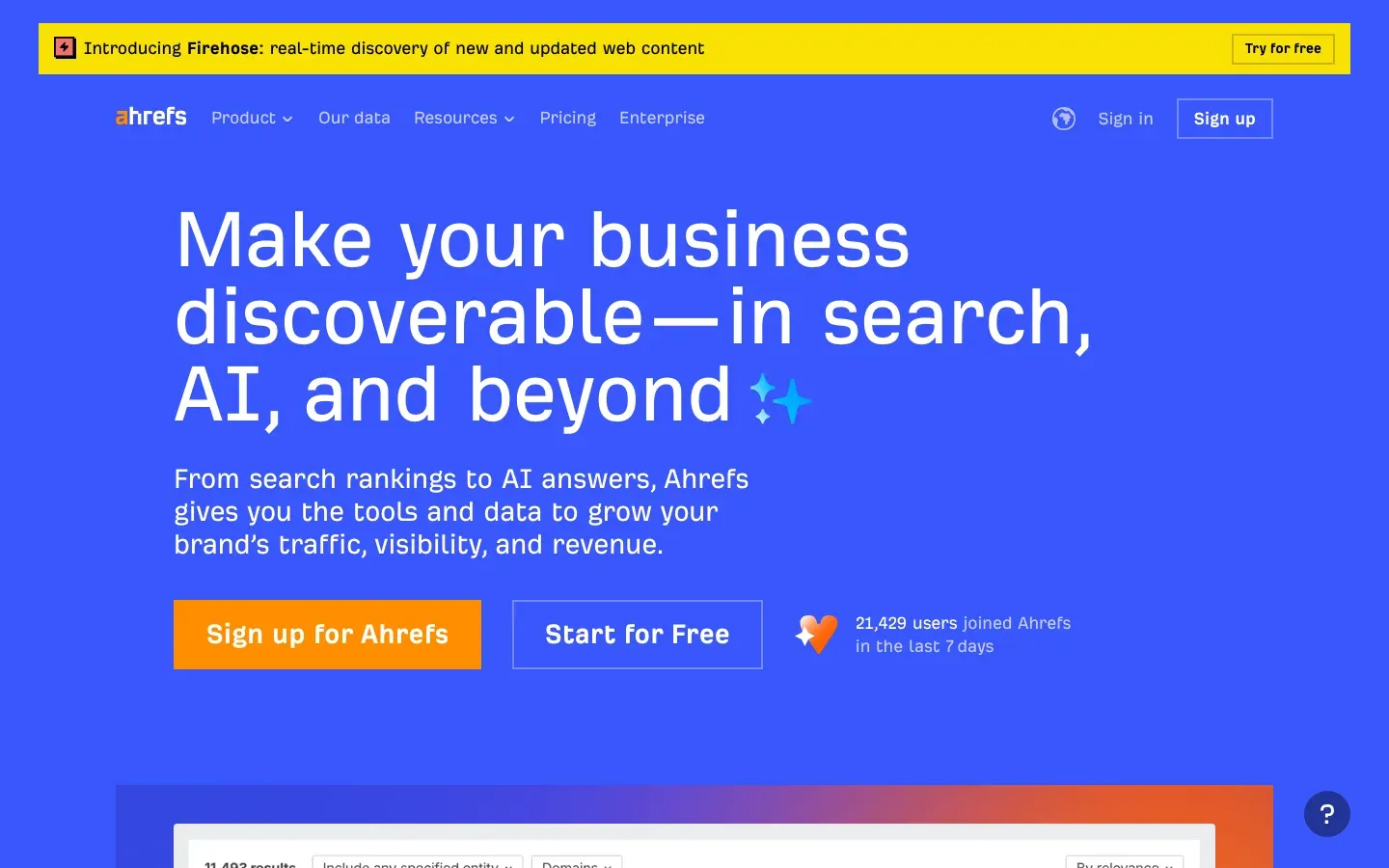
Ahrefs Brand Radar carries the largest prompt database in this comparison, tracking over 405 million monthly prompts across Google AI Overviews, AI Mode, ChatGPT, Perplexity, Gemini, and Copilot, with deeper Google AI Mode coverage than anything else here.
The cost is the deciding factor. Each AI index runs $199 per month and the all-platform bundle $699, and both require an active Ahrefs subscription from $129, a realistic minimum of $828, roughly 2.5× the category average. Brand Radar covers no Claude or Grok and offers no content recommendations. It fits Ahrefs users who need the deepest AI Mode view.
AEO Glossary
Citation Rate
Citation rate measures how often an AI model references your brand or content when answering a relevant prompt. You calculate it as the share of tracked prompts where your source appears in the generated answer. A rising citation rate signals that AI systems treat your content as an authoritative source for a topic.
AI Answer Monitoring
AI answer monitoring tracks what AI models say about your brand, your competitors, and your target queries over time. Tools capture the full generated answer, the sources cited, and how those results shift across models and dates. cloro exposes this data through its AI Visibility Tracking API, so developers can pull raw answers and citations into their own systems.
GEO vs AEO
Generative Engine Optimization (GEO) and Answer Engine Optimization (AEO) describe the same goal, visibility inside AI-generated answers, and vendors use the terms interchangeably. For a deeper walkthrough, see our generative engine optimization guide, or compare the GEO services and agencies that do the work for you.
Methodology
We ranked the best AEO tools with a repeatable method, not vibes. We selected the thirteen tools by three signals: each appears in current AI model recommendations for AEO software, each holds meaningful market presence, and each covers a distinct buyer profile, so the list spans SMB through enterprise.
We evaluated every tool against five criteria. Engine coverage counts how many AI answer engines the tool tracks, from ChatGPT-only to 10 or more. Citation intelligence measures the depth of the underlying prompt and citation database. API access separates programmatic tools from dashboard SaaS. Pricing reflects publicly listed rates as of 2026. Enterprise readiness accounts for security certifications like SOC 2 Type II.
All pricing figures come from each vendor’s published plans at the time of writing, verified against the source pages linked throughout; contract-only enterprise tiers are marked custom. Where a vendor has since changed a plan (Scrunch’s entry tier, AIclicks’ price ladder), the current figure is used.
If you are shopping the infrastructure layer underneath these dashboards rather than a packaged tool, start with cloro’s AI visibility tracking API, which returns parsed citations and AI answers for ChatGPT, Perplexity, Gemini, and Google AI Overviews through one endpoint family. For the wider market, see our best AI SEO tools roundup, our LLM visibility tracking tools comparison, and our roundup of AI Overview tracking tools. To go deeper on a single engine, start with tracking your brand in ChatGPT.

About the author
Ricardo Batista
Founder, cloro
Ricardo is one of the founders and engineers behind its SERP and AI-search scraping infrastructure. Before cloro he scaled a financial comparison site to $7M ARR and ran the full-country operations of a unicorn to $65M ARR, then went back to building. He writes about search engine scraping, generative-engine optimization, and turning live search and AI-answer data into something teams can act on.
Frequently asked questions
What do AEO tools do?
AEO tools track how AI answer engines like ChatGPT, Perplexity, and Google AI Overviews cite and mention your brand. They monitor which prompts trigger your citations, compare your visibility against competitors, and measure your share of AI-generated answers. The practical benefit is knowing whether AI models surface your content when users ask questions in your category.
Are traditional SEO tools enough for AEO?
No, most SEO tools track keyword rankings and backlinks rather than AI citations. Answer engines pull from sources and synthesize responses, so ranking first on Google does not guarantee an AI model cites you. Semrush and Ahrefs now bundle AEO features into their platforms, but dedicated tools like Profound and cloro measure citation-level data that keyword tools miss.
Which AEO tool has API access?
cloro is API-first on every tier, starting at $30 per month, which makes it the practical choice for developers who need raw citation data from an AI Visibility Tracking API to build custom dashboards or embed AI visibility into existing tools. Profound, Scrunch AI, and AirOps also offer API access, but only on higher-priced growth or enterprise plans, AthenaHQ sells it as a paid add-on on Starter, AIclicks offers a limited version, and Airefs ships an MCP server rather than a REST API. Omnia is the one dashboard here that ships both a REST API and an MCP server on every paid tier, starting at €79 per month.
Is SEO dead now with AI?
No. AI answer engines often cite pages that already rank well in traditional search, so SEO still feeds AEO. What changed is the measurement: rank trackers show where a page sits in the blue links, while AEO tools show whether ChatGPT, Perplexity, or Google AI Overviews name and cite the brand. Most teams now run both.
What are the top AEO companies?
The best-known AEO platforms in 2026 include Profound for enterprise citation depth, Scrunch AI for an agent-facing site layer, Peec AI for multi-market tracking, AthenaHQ for 11-model coverage, Writesonic for tracking plus AI articles, Otterly.ai for agencies, HubSpot AEO for CRM-native teams, and AirOps for monitoring tied to content work. Ahrefs Brand Radar and the Semrush AI Visibility Toolkit extend existing SEO suites, and cloro supplies the raw citation data as an API.
How much do AEO tools cost?
AEO tools range from $24 per month for Airefs Lite to $828 per month minimum for Ahrefs Brand Radar. The average for a dedicated AI visibility tool sits around $337 per month, according to an August 2025 Rankability analysis of 20 tools. Enterprise contracts from Profound and cloro extend into custom pricing above $5,000 per month.
How long before AEO efforts show results?
Most teams see citation and visibility changes within four to eight weeks of publishing structured, answer-focused content. AI models update their sources on different schedules, so Perplexity may reflect changes faster than Google AI Overviews. Daily monitoring tools like Peec AI and cloro let you track when each engine picks up new citations.
Related reading
What is AEO? Answer Engine Optimization Explained (2026)
Master Answer Engine Optimization (AEO) in 2026. Learn how to optimize for ChatGPT, Perplexity, and Google AI Overviews, and how AEO differs from SEO.
Best LLM & AI Visibility Tools 2026: 10 Tested
We tested 10 LLM visibility tools (also sold as AI visibility trackers and checkers) on real brand-monitoring workflows across ChatGPT, Perplexity, and Gemini. What works, what doesn't.
Profound Alternatives: 6 AI Brand Monitors Compared (2026)
Profound alternatives compared — Peec AI, AthenaHQ, Scrunch AI, OtterlyAI, Brandlight and FirstAnswer.ai. Pricing, engine coverage, and when each one fits.