
AI Search Tracking 2026: Monitor Every Engine

On this page
If you ran a brand-monitoring playbook in 2024 that only watched Google SERPs, you are no longer measuring where your buyers form opinions. By 2026, the surface where prospective customers ask questions about your category has fragmented across at least seven AI engines: ChatGPT, Perplexity, Gemini, Google AI Overview, Google AI Mode, Copilot, and Grok. Each one produces a different answer to the same question, with a different citation pattern and a different model behind it.
This post is the practitioner’s playbook for AI search tracking in 2026. It covers what to measure, how often, which tools handle which engines, and how to build a program that catches brand-visibility risk before your sales team hears about it from a prospect. For the engineering side of any specific engine — say, our walkthrough on how to scrape Google AI Mode — the same content map applies one layer up.
The program has four moving parts: the foundational metrics, the engine-coverage priority order, the cadence, and the build-vs-buy decision. That last choice is between rolling your own AI search tracking on top of an API like cloro and adopting a dashboard-first platform (Peec AI, OtterlyAI, Profound, AthenaHQ). If you’ve already worked through our LLM visibility tools roundup or the AI rank tracking tools comparison, this post is the next layer up — operational rather than evaluative.
How do you monitor brand presence in AI search engines?
Run a fixed set of buyer prompts against every engine your market uses on a weekly schedule, then score each answer on four metrics: mention rate, share of voice, citation rate, and sentiment. The rest of this post is the operational detail.
Why AI search tracking became unavoidable in 2026
The shift isn’t subtle, and the raw adoption numbers make it concrete. By late 2025, ChatGPT had reached 800 million weekly active users, OpenAI’s Sam Altman announced — roughly a tenth of the world’s adult population. Google’s own AI surfaces moved just as fast: AI Overviews reached 1.5 billion monthly users in Q1 2025. By mid-year, AI Overviews had crossed 2 billion monthly users and AI Mode had passed 100 million.
The business stakes follow directly. Gartner predicts traditional search engine volume will drop 25% by 2026 as buyers shift to AI chatbots and virtual agents. And when an AI summary appears, Pew Research found users click a traditional result in just 8% of visits, versus 15% without one.
The referral pipeline that does convert is moving to AI too. Adobe Analytics measured a 1,200% jump in traffic from generative-AI sources to U.S. retail sites between mid-2024 and early 2025.
An AI answer can recommend your competitor without naming you, which is materially different from a SERP where your domain at least appears at position 8. In an AI answer, you exist or you don’t. That binary is exactly why AI search tracking has become a board-level metric rather than a marketing curiosity.
The harder problem is that these engines don’t share a ranking algorithm and don’t agree on what counts as a citation. ChatGPT, by default, doesn’t cite at all — you only see brand mentions if the model decided to name your company in the prose.
Perplexity cites everything, while Google AI Overview blends Search-style citations with model-style summarization. A program that tracks one engine and assumes the others behave similarly will systematically miscalibrate. That is the core reason AI search tracking has to be multi-engine from day one.
The four foundational metrics
Strip away the dashboards and the marketing copy and AI search tracking measures four things across every engine you cover.
1. Mention rate
The percentage of target queries (the queries your buyers actually ask) that include your brand somewhere in the answer, prose or citations. Mention rate is the headline metric and the one most worth aligning the team around. A mention rate of 15% on your top 50 buyer queries means 85% of those conversations happen without you in the room. Improving mention rate is downstream of improving the content and citation patterns the engines pull from.
2. Share of voice
Your mentions divided by total competitor mentions across the same query set. Share of voice is what your CMO will care about because it normalizes for category attention. A 15% mention rate looks worse if your competitor is at 60% and better if they’re at 12%. Share of voice on the same queries is also the only honest comparator over time, because the queries themselves change attention as the category evolves.
3. Citation rate
Citation rate is the share of your mentions where your URL appears as a source link, not just a name in prose. Citation rate matters because it’s the lever between AI mention and actual referral traffic. Mentions without citations build brand awareness; mentions with citations also drive sessions.
The two don’t move together. Perplexity has high citation density across the board, while ChatGPT has near-zero unless you explicitly trigger citation mode. Tracking them as one number hides which content investments are actually earning links.
4. Sentiment
Whether the mention is positive, neutral, or negative. Standard NLP libraries do this well on AI-generated text. It’s structured prose with consistent register, easier than scoring social media. Sentiment is the metric most worth surfacing to leadership during competitive moves: knowing your competitor is being recommended negatively in 30% of their mentions is a different posture than uniform positive recommendation.
These four metrics, multiplied across 7 engines and a query set in the 50–500 range, are the substrate of every AI search tracking program. Everything else — share-of-voice movement charts, citation source breakdowns, competitive gap analysis — is derived from these primitives. A useful scorecard tracks all four per engine, then blends them into one visibility index leadership can read in ten seconds.
AI search tracking vs. traditional rank tracking: run both, they measure different things
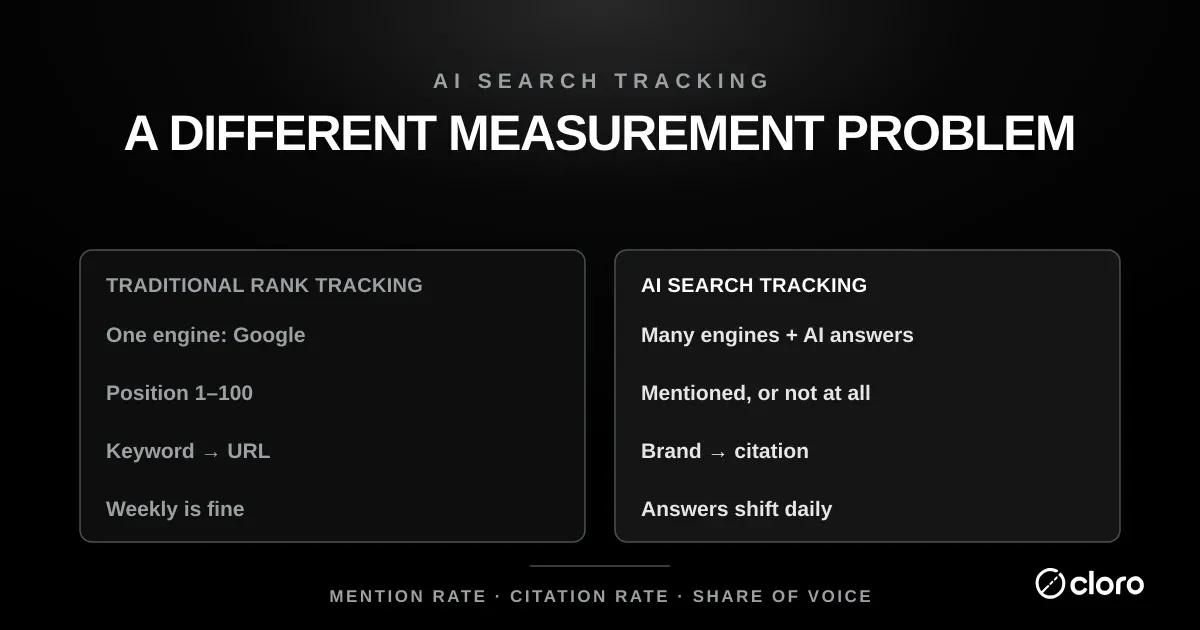
The instinct to treat AI search tracking as “rank tracking with extra engines” is the most common setup mistake. Traditional rank tracking answers one question: what URL sits at what position for a keyword. AI search tracking answers a different one: is your brand named, described, and cited inside a generated answer.
The ranking factors diverge just as sharply. Backlinks and on-page keywords still move the classic SERP, but AI answers lean on training-data presence, structured data, third-party citations, and social proof. A page can rank on page one of Google and still be invisible to every AI engine, which is why AI search tracking is a separate instrument on the dashboard.
The click economics differ too — the same Pew Research analysis of click behavior under AI summaries is why mention and citation now matter as much as raw position. Run both disciplines in parallel; neither one substitutes for the other.
Engine coverage priority
You probably can’t cover all seven engines on day one. Two measurements should inform the order alongside audience size, because they change what a tracked engine can even tell you.
Across roughly 2,500 prompts per engine, five of six engines grounded 91-98% of answers in live sources while Gemini grounded 41.1%, a spread that had narrowed to 70.7-99.2% when we re-measured on 2026-08-19. And across roughly 13,000 answers, citation depth varied about twentyfold, from Google AI Mode at 17.7 sources per answer down to Perplexity at 1.3. An engine that rarely grounds gives you few citations to compete for; an engine that cites shallowly makes each slot scarcer and your share more volatile.
The priority order most programs converge on, ranked by buyer-attention impact:
| Priority | Engine | Why first |
|---|---|---|
| 1 | ChatGPT | Largest single AI traffic source. Skipping it is unacceptable. |
| 2 | Perplexity | High citation density makes it the cleanest engine for citation-rate measurement. SEO-adjacent buyer audience. |
| 3 | Google AI Overview | Sits above the Google SERP for most informational queries — massive raw reach, even if a smaller fraction of buyers engage deeply. |
| 4 | Gemini | Google’s flagship; pulls heavily from Search index, so SEO-positive moves transfer here. |
| 5 | Google AI Mode | Conversational variant of Search; growing share through 2026. |
| 6 | Copilot | Microsoft’s bet; integrates with Bing search index and the Microsoft 365 surface. |
| 7 | Grok | xAI’s model; smaller share but real-time X-integrated citations matter for breaking-news verticals. |
The takeaway: cover ChatGPT, Perplexity, and Google AI Overview first (the minimum defensible set), then expand down the list as budget allows.
This isn’t a static order. By the end of 2026 the rankings will have shifted again. Gemini’s Search integration is the most likely riser; Grok’s share depends on xAI’s enterprise momentum. Treat the priority order as a rolling estimate, not a settled fact.
The cadence question: weekly by default, daily only for a crisis
There’s one expensive answer to “how often should I track” and one cheap answer.
The expensive answer is daily, which most teams reach for because they’re used to social-media monitoring cadence. AI engines don’t update citation patterns that fast. Daily checks burn API credits and produce noise.
Reserve daily runs for crisis windows: PR events, product launches, and competitive moves where you need to see the engines respond in near-real-time. After the event, return to weekly. Set the cadence in your AI search tracking config once, and let the crisis flag override it rather than re-tuning by hand.
The cheap answer is weekly. Weekly cadence catches most meaningful citation drift, gives you enough samples to compute share-of-voice with reasonable confidence intervals, and keeps API spend in the low hundreds per month for a typical 100-query program across 7 engines. Monthly is acceptable as a floor. Anything less frequent and you’re reporting historical artifacts to leadership rather than reacting to the current state.
API-driven vs dashboard-first: most mature programs run both
The build-vs-buy decision in AI visibility tracking is an API such as cloro, which gives you raw data for a Looker dashboard you maintain, or a platform such as Peec AI, OtterlyAI, Profound or AthenaHQ, which gives you a pre-built dashboard you customize.
API-driven (cloro, manual scripts, internal data warehouse): you pay per API call, get raw JSON, and run the metrics in your own analytics layer. Better for teams that already operate a data stack, want custom segmentation, or need the data inside an existing BI tool. Trade-off: you build the dashboard.
Dashboard-first (Peec AI, OtterlyAI, Profound, AthenaHQ): you pay a monthly fee, get a polished UI with mention-rate charts and share-of-voice graphs out of the box, and the platform handles the engine-API integration for you. Better for teams that want to ship a monitoring program in days rather than weeks. Trade-off: you’re locked into the platform’s data model and segmentation.
What dashboard-first tools cost to start
Entry prices are lower than many teams assume, and they scale with the number of prompts tracked:
| Tool | Starting price | Source |
|---|---|---|
| Otterly AI | $29/month | Orchly, Nightwatch |
| Peec AI | $89/month | Orchly, Marketer Milk |
| Profound | $99/month to $499/month (Lite), reviewers disagree | Nightwatch, Marketer Milk |
| Ahrefs Brand Radar | about $199/month | Orchly |
| Scrunch AI | $300/month for up to 350 prompts | Orchly, Marketer Milk |
The takeaway: the entry tier is rarely the plan a real program runs on. Prompt caps of a few dozen to a few hundred cover one brand’s core queries, and engine coverage, refresh frequency and exports tend to sit on the higher tiers, so price the plan that fits your query set rather than the sticker.
Mature programs tend to run both: a dashboard tool for stakeholder reporting and an API such as cloro’s AI visibility tracking for the deep ad-hoc analysis a dashboard can’t slice. We covered this trade-off in more detail in build vs buy for AI search visibility tools.
Which AI monitoring API supports ChatGPT, Perplexity, Gemini, and AI Mode through one unifying interface?
cloro returns ChatGPT, Perplexity, Gemini, Google AI Overview, Google AI Mode, and Copilot through one REST interface: one request format, one response schema, six surfaces, so you integrate once instead of maintaining six separate scrapers or API wrappers. The alternative is per-engine assembly (a SerpApi or DataForSEO endpoint for AI Overview, a separate ChatGPT scraper, a Gemini grounding integration) with the response shapes normalized by you. Dashboard platforms like Peec AI, Profound, and Otterly track multiple engines too, but through their UI and data model, not an API you query.
What to look for in AI search tracking software
Whichever side you land on, the same four requirements separate serious AI search tracking software from a dashboard that only demos well. First, engine breadth: the tool must cover at least ChatGPT, Perplexity, and Google AI Overview, with a roadmap for AI Mode and Gemini. Second, parsed citations: it should return the actual source URLs behind each answer, not just a mention flag, because citation rate is where AI visibility turns into referral traffic.
Third, clean-account sampling: results must come from de-personalized sessions or an API, or your numbers reflect your own logged-in history rather than a prospect’s view. Fourth, exportable raw data: if you can’t pull the underlying answers into your own warehouse, you can’t audit the metric or reconcile it against pipeline. Score any AI search tracking tool against those four before you sign an annual contract, and treat a tool that hides its raw answers as a reporting layer, not a source of truth.
Building the query set
The query set is the most-underrated ingredient of an AI visibility program. The wrong queries produce a precision-looking report on the wrong question. The right queries come from three sources, weighted roughly equally:
- Branded queries (“what does [brand] do”, “[brand] vs [competitor]”, “is [brand] reliable”) measure how engines describe you when buyers already know your name.
- Category queries (“best [product category] for [audience]”, “alternatives to [category leader]”) measure whether you appear at all when buyers are still in discovery.
- Use-case queries (“how to [job-to-be-done your product solves]”) measure recommendation in problem-context, where buying intent is highest.
A 100-query set roughly split 30/30/40 across these three buckets is a defensible starting point. Refine quarterly based on which queries actually moved over the previous period.
Treat the query set as a living asset, not a one-time export. Buyer language drifts as a category matures, and a phrasing that surfaced you in January can go quiet by spring. Keep the wording verbatim as your buyers would type it, because AI engines reward natural phrasing over keyword-stuffed strings. When you retire a dead query, log why — that note is what stops the same weak query from creeping back into next quarter’s AI search tracking set.
Common mistakes to avoid
- Tracking only ChatGPT. Single-engine coverage misses 60-70% of AI brand-visibility signal in 2026. The minimum defensible coverage is ChatGPT + Perplexity + AI Overview.
- Daily cadence at steady state. Burns budget without producing actionable signal. Move to weekly; reserve daily for crisis windows.
- Conflating mention rate and citation rate. They measure different things and respond to different inputs. Report them separately or you’ll over-credit content moves that improve one without the other.
- Personalizing the tracking environment. If you log into ChatGPT with your company SSO and ask “what’s the best CRM”, you’ll get personalized results that don’t match what your prospects see. Track from clean accounts, ideally via API to avoid the personalization layer entirely.
- Treating Reddit as the universal cheat code. Reddit’s forums are genuinely valuable training data — Google reportedly signed a $60-million-per-year content-licensing deal with Reddit in 2024. But Reddit citations have been declining as a fraction of LLM source data through 2026 (we covered this in the Reddit LLM relevance decline). It’s still a strong signal, not the only one.
Next steps
If you’re starting from zero, the first 30 days of an AI search tracking program should produce three things. First, a 100-query set split across the three intent buckets. Second, weekly tracking on the top 3 engines (ChatGPT + Perplexity + AI Overview). Third, a single share-of-voice chart you show leadership monthly.
Once that baseline is stable, expand engine coverage to 5+ and add a citation-rate breakdown by engine. Then wire the output into whatever your team already reads — a Slack digest, a BI tile, a weekly email — so the numbers get seen rather than archived. The programs that compound are the ones where AI search tracking becomes a standing input to content and PR decisions, not a quarterly slide nobody acts on.
cloro’s AI visibility tracking handles the seven-engine API layer through a single endpoint with pay-per-call pricing. You get parsed citations, source URLs, and entity extraction without integrating each engine separately. If you’d rather start with a dashboard-first tool, our LLM visibility tracking tools roundup has the comparative breakdown.

About the author
Ricardo Batista
Founder, cloro
Ricardo is one of the founders and engineers behind its SERP and AI-search scraping infrastructure. Before cloro he scaled a financial comparison site to $7M ARR and ran the full-country operations of a unicorn to $65M ARR, then went back to building. He writes about search engine scraping, generative-engine optimization, and turning live search and AI-answer data into something teams can act on.
Frequently asked questions
What is AI search tracking?
AI search tracking is the practice of monitoring whether and how a brand appears in answers generated by AI engines — ChatGPT, Perplexity, Gemini, Google AI Overview, Google AI Mode, Copilot, and Grok. Each engine produces conversational answers rather than ten blue links, so traditional rank tracking doesn't capture the surface where buyers increasingly form opinions. AI search tracking measures four foundational metrics: mention rate (% of target queries that include the brand), share of voice (your mentions vs competitors), citation rate (% of mentions that include your URL as a source), and sentiment.
How is AI search tracking different from traditional SEO rank tracking?
Traditional rank tracking watches what URL appears at what position on a Google SERP. AI search tracking watches whether your brand is named or cited in an AI-generated answer, which is a different surface with different ranking factors — model training data, citation patterns, structured-data signals, and Reddit-style social proof matter more than backlinks. The two are complementary, not substitutes. Most teams that take AI seriously in 2026 run both, because Google itself is hybrid (the SERP still exists below the AI Overview).
Which AI engines actually matter for brand tracking?
Coverage priority depends on your buyer geography and category. ChatGPT is the largest single AI traffic source globally, and skipping it is unacceptable. Perplexity has high citation density (almost every answer cites sources), which makes it disproportionately important for SEO-adjacent measurement. Google AI Overview reaches the most users by raw volume because it sits above the SERP. Gemini, Copilot, AI Mode, and Grok are growing share rapidly. By late 2026, anything less than 5-engine coverage misses material brand-visibility signal.
How often should AI search tracking run?
Monthly is the floor for trend monitoring. Weekly is appropriate for active brand-management programs. Daily is overkill in steady state — AI engines do not update citation patterns that fast, and you burn API credits without learning anything new. Crisis situations (PR events, product launches, competitive moves) justify daily checks for the duration of the event, then return to weekly.
What does AI search tracking actually cost?
At the API layer, tracking 100 queries per week across 7 engines is roughly 2,800 API calls/month. At cloro's pay-per-call pricing that runs in the low tens of dollars; dashboard-first tools start lower but cap prompts per plan: Otterly AI from $29/month, Peec AI from $89/month and Scrunch AI from $300/month, with prices rising as the prompt count grows. The trade-off is real: API tools give you raw data and require you to build the dashboard; platform tools give you the dashboard and limit how you slice the data. Most mature programs use both.
Related reading
Best LLM & AI Visibility Tools 2026: 12 Tested
We tested 12 LLM visibility tools (also sold as AI visibility trackers and checkers) on real brand-monitoring workflows across ChatGPT, Perplexity, and Gemini. What works, what doesn't.
ChatGPT Visibility Tracker: Track Your Brand Mentions
Learn how a ChatGPT visibility tracker works, run a free manual baseline, and compare the best tools to monitor your brand mentions in AI search.
AI Share of Voice: How to Measure Brand Visibility
AI share of voice measures how often your brand appears in ChatGPT, Perplexity, Gemini, and AI Overviews versus competitors. Learn the formulas.