
Content Theft: How to Find Who's Copying Your Work

On this page
Every writer, publisher, and documentation team eventually discovers the same thing: somewhere on the internet, your words are earning someone else clicks. A scraper mirrored your blog. A content farm respun your guide. A competitor lifted your three best paragraphs and never linked back.
That is content theft, and it is more common than most teams assume.
Content theft is the unlicensed reproduction of your original work on a property you don’t control. The first and hardest problem isn’t the takedown. It’s finding the copies at all.
This post is a build recipe for the finding part, and a guide to the removal part. The content theft detection mechanism is the same one Copyscape has used for two decades (exact-phrase search), and it turns out to be a native workload for a SERP API. We’ll build the pipeline with cloro, in curl and Python. Then we run it against 18 of our own articles to see whether stolen copies actually leak into search rankings.
We also cover the anti-piracy angle for rights holders, and lay out the DMCA takedown paths, DIY versus service.
One clarification up front, because it’s the most common confusion in this space. Content theft, a human or a scraper republishing your work, is a different problem from AI models training on or retrieving your content. Different threat, different defenses. This post owns the first; there’s a short bridge at the end to the second.
What content theft actually is (and what it isn’t)
Content theft covers a spectrum, and the spectrum matters because it changes both detection and response:
- Wholesale scraping. A bot mirrors your site, sometimes minutes after you publish. The copy is verbatim, often across many pages.
- Content-farm respinning. Your article is paraphrased, reordered, or run through a rewriter to dodge duplicate-content filters while keeping your structure and facts.
- Selective lifting. A competitor or aggregator takes your strongest passages (the definition, the data, the step-by-step) verbatim, and wraps them in their own filler.
- Unlicensed syndication. Someone republishes your full piece without a license and without a
rel="canonical"link pointing back to you. Search engines then can’t tell who’s the original, which is content theft dressed up as sharing.
All four are forms of content theft, and all four shade from nuisance into policy violation. Google’s own spam policies name scraped content, republishing others’ work without adding value, as an abuse that can rank lower or be dropped from results entirely.
What content theft isn’t matters just as much. A site that quotes a sentence or two of yours with attribution is fair-use citation, which US copyright law lists comment and criticism among. So is a partner republishing under a license you granted, or an AI answer engine summarizing your page.
The exact-phrase method below is excellent at finding verbatim reproduction, which means it will also catch legitimate quotes. That’s not a flaw; it’s a property you have to account for, and we’ll come back to it hard in the data study.
What it’s called, and whether it’s a crime
The names depend on the angle. Passing the work off as your own is plagiarism; copying it at scale with bots is content scraping; distributing it without a license is piracy. All three fall under content theft, and in law the usual name is copyright infringement.
Most content theft is handled as a civil matter, not a criminal one. The owner’s tools are takedown notices, cease-and-desist letters, and lawsuits for damages and legal costs, and copyright law allows fines and, in some cases, imprisonment. You rarely need a court: a valid DMCA notice requires the host to remove the infringing content, with no lawsuit needed. The removal paths are below.
Detection: turn your own sentences into an exact-phrase search
The core mechanism of content theft detection is almost embarrassingly simple, which is why it has survived twenty years. A long, distinctive sentence from your article is a fingerprint. The odds that another site independently wrote the exact same fourteen-word sentence are effectively zero. So search Google for that sentence wrapped in quotation marks, which forces an exact-phrase match. Every result that isn’t you is a copy or a quote of you.
That’s the entire Copyscape trick. Doing it by hand for one article is trivial: grab three or four unusual sentences, paste each into Google inside quotes, and read the results. The engineering problem is scale. Running content theft detection across a hundred articles, on a schedule, and turning the raw results into a ranked list of who’s republishing you is a SERP pipeline.
That pipeline is a build-your-own Copyscape alternative you fully control.
The one query that does the work
Everything hinges on the quoted query. The workflow is one call: send the quoted phrase to cloro’s /v1/monitor/google endpoint, and get back Google’s organic results for it as structured JSON, ready to scan for domains that aren’t yours. Here’s the primitive, as a single exact-phrase search against that endpoint. Note the escaped quotation marks inside the JSON. The wrapping quotes are what force Google into exact-phrase mode:
curl -X POST https://api.cloro.dev/v1/monitor/google \
  -H "Authorization: Bearer sk_live_your_api_key_here" \
  -H "Content-Type: application/json" \
  -d '{
    "query": "\"the exact distinctive sentence lifted verbatim from your own article\"",
    "country": "US",
    "device": "desktop"
  }'
The response is the parsed organic results for that phrase. Any link in there whose domain isn’t yours is a page carrying your sentence word-for-word. That’s the atom. The pipeline is just this call, repeated over good phrases, with the results deduplicated and ranked.
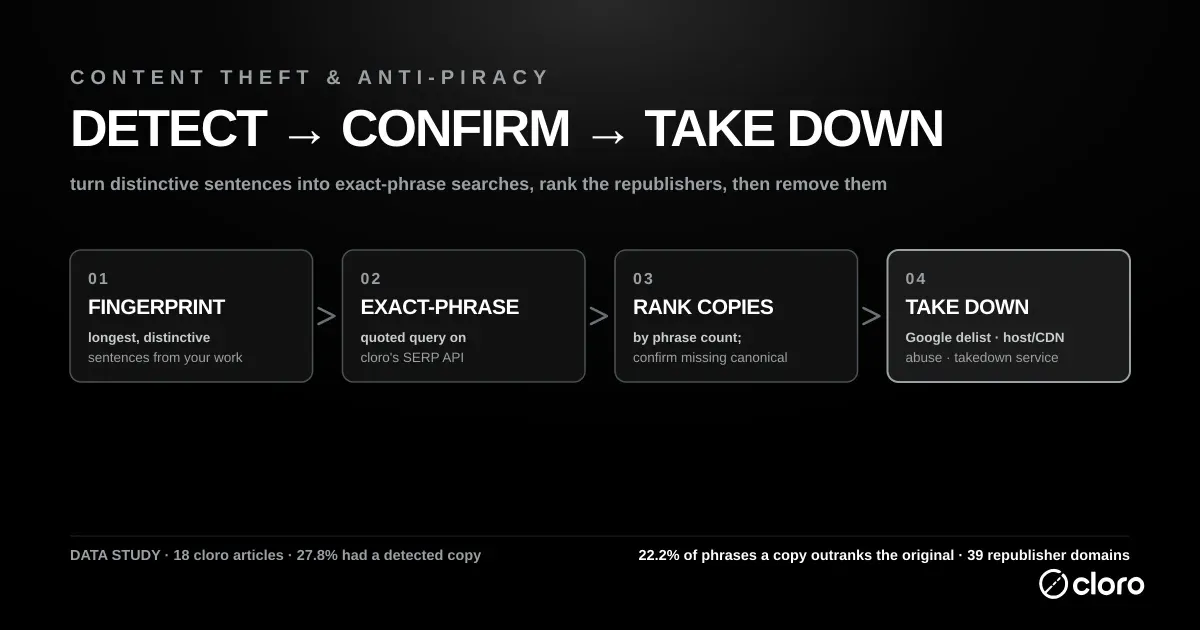
The pipeline: phrases in, ranked republishers out
Four steps turn the primitive into a content theft monitoring tool:
- Pick distinctive phrases. Not every sentence is a good fingerprint. Short or generic sentences (“This is important for SEO.”) return noise. Long, specific sentences (with numbers, proper nouns, or unusual phrasing) are rare enough that a verbatim match is almost certainly a copy. Pull the longest few sentences from each article.
- Batch the quoted queries. One exact-phrase query per fingerprint, several fingerprints per article. Spread them out so you’re not hammering the endpoint.
- Filter out the legitimate matches. Your own domain will (and should) rank for your own sentences. Drop it. Drop any syndication partners you’ve licensed. And a genuine unlicensed syndicator sometimes still sets
rel="canonical"back to you; those you may choose to tolerate. What’s left is the suspect set. - Dedup and rank. Collapse results to registrable domains and count how many of your distinctive phrases each domain carries. A domain matching one phrase might just be quoting you. A domain matching four or five of your fingerprints has copied the article.
Here’s the whole thing in Python:
import re
import time
import requests
from urllib.parse import urlparse

API_URL = "https://api.cloro.dev/v1/monitor/google"
API_KEY = "sk_live_your_api_key_here"

# Domains allowed to carry your content: your own site plus partners
# you've explicitly licensed. Matches on these are not theft.
OWN_DOMAINS = {"cloro.dev", "www.cloro.dev"}
SYNDICATION_PARTNERS = {"medium.com"}  # your licensed republishers, if any


def distinctive_phrases(article_text, max_phrases=5, min_words=12):
    """Longest sentences make the strongest verbatim fingerprints."""
    sentences = re.split(r"(?<=[.!?])\s+", article_text)
    ranked = sorted(
        (s.strip() for s in sentences if len(s.split()) >= min_words),
        key=lambda s: len(s.split()),
        reverse=True,
    )
    return ranked[:max_phrases]


def search_phrase(phrase):
    """Run one exact-match query; return the organic result URLs."""
    resp = requests.post(
        API_URL,
        headers={
            "Authorization": f"Bearer {API_KEY}",
            "Content-Type": "application/json",
        },
        json={
            "query": f'"{phrase}"',  # wrapping quotes force an exact-phrase match
            "country": "US",
            "device": "desktop",
        },
        timeout=60,
    )
    resp.raise_for_status()
    return [r["link"] for r in resp.json()["result"]["organicResults"]]


def registrable_domain(url):
    host = urlparse(url).netloc.lower()
    return host[4:] if host.startswith("www.") else host


def find_republishers(article_text):
    hits = {}  # domain -> set of your phrases it carries
    for phrase in distinctive_phrases(article_text):
        for url in search_phrase(phrase):
            domain = registrable_domain(url)
            if domain in OWN_DOMAINS or domain in SYNDICATION_PARTNERS:
                continue  # your copy or a licensed one, not theft
            hits.setdefault(domain, set()).add(phrase)
        time.sleep(1)  # be polite; spread the batch out
    # Rank by how many distinctive phrases each domain carries.
    return sorted(hits.items(), key=lambda kv: len(kv[1]), reverse=True)


if __name__ == "__main__":
    with open("my-article.txt", encoding="utf-8") as f:
        text = f.read()
    for domain, phrases in find_republishers(text):
        print(f"{len(phrases)} phrase(s)  ->  {domain}")
Point it at a folder of articles instead of one file, and store the ranked hits per article per run. Now you have continuous content theft monitoring. The same pipeline is, in effect, a plagiarism checker API you own: no per-scan credits, and no third party seeing your unpublished drafts.
The phrase-count ranking even gives you a severity signal Copyscape’s binary match doesn’t. Schedule it weekly and you’ll catch scrapers within days of them lifting a new post.
The one piece of judgment the code can’t make for you is the canonical/syndication call. Legitimate syndication points a rel="canonical" tag back to your URL, which tells search engines you’re the original; unlicensed copies almost never do.
When you fetch a suspect page to confirm, check for that canonical tag. Its presence pointing at you usually means an authorized (or at least deferential) republish. Its absence on a full-article match is the strongest signal you’re looking at content theft.
Anti-piracy: the search-visible layer of stolen content
For rights holders (publishers, course creators, software vendors, media companies), content theft shades into anti-piracy: not just someone republishing your article, but pirated copies of paid or licensed work. Ebooks on file-lockers, a course ripped and reposted, a software manual mirrored on a warez blog, unlicensed streams and download listings for video. The word “anti-piracy” covers the whole discipline of finding and suppressing that unauthorized distribution.
A large part of piracy is search-visible, and that’s the part the pipeline above already covers. Pirates need traffic. So pirated copies, unlicensed mirrors, and “free download” or “watch free” listings deliberately rank in Google for your title and your product name. More usefully for you, they also rank for distinctive phrases lifted from the work itself.
The exact-phrase method finds a pirated ebook the same way it finds a scraped blog post. A sentence from chapter three is a fingerprint whether the copy is a scraper’s or a pirate’s. Content theft and piracy share the same tell. Swap the distinctive-phrase seeds for lines from the pirated work, and add title-plus-intent queries ("your title" free download, "your title" watch online). The same batched, deduped, ranked pipeline then maps the search-visible piracy surface for your catalog.
Be clear about where this stops, though, because overclaiming here helps no one. The search-visible layer is not the whole piracy surface:
- Video and audio piracy that’s distributed through streaming rippers, and identified by the content rather than by text, needs video/audio fingerprinting (think Content ID-style matching against a reference database), not phrase search.
- Torrent and P2P distribution lives off the indexed web entirely; monitoring it means watching torrent indexes, DHT swarms, and Usenet, which specialized torrent-monitoring vendors do.
- Dedicated anti-piracy platforms (the enforcement-heavy vendors) combine fingerprinting, torrent monitoring, and bulk automated takedowns across all of these.
What SERP-based detection gives you is the search-indexed slice: the pirated copies and listings someone can find by searching, mapped continuously and cheaply. It feeds the same takedown workflow you use for content theft. It’s a strong first layer, and a genuine input to an anti-piracy program. It is not a replacement for fingerprinting or torrent monitoring when your risk lives off the indexed web.
Data study: does content theft leak into search rankings?
Finding copies is one thing. The question that actually determines whether content theft matters is sharper: does a stolen copy ever outrank the original in Google? If copies always sit far below you, theft is an annoyance. If they sometimes beat you, it’s costing you traffic on your own work, and potentially feeding wrong attribution into AI answers that cite whichever copy ranks.
So we ran the pipeline on ourselves. In July 2026 we took 18 of cloro’s own published articles and extracted distinctive phrases from each. We ran the exact-phrase search, filtered out our own domain, and looked at what came back, and where it ranked relative to us.
Methodology, disclosed in full so you can reproduce it: we analyzed a sample of 18 cloro articles (n=18), pulling the longest distinctive sentences from each as fingerprints. We ran every fingerprint as a single quoted exact-phrase query through cloro’s SERP API. Then we filtered our own domain before scoring which non-cloro domains carried a phrase, and where each copy ranked against the original.
No third-party panel, no modeling, no estimates: every figure in the table below is a direct count from that one run. That’s why we report it with the caveat that follows, rather than as a precise census.
| Metric | Value |
|---|---|
| cloro articles analyzed | 18 |
| Articles with a detected non-cloro copy of a distinctive phrase | 27.8% (5 of 18) |
| Phrases where the cloro original still ranks #1 | 77.8% |
| Phrases where a copy outranks the original | 22.2% |
| Distinct republisher domains observed | 39 |
Read carefully, the result is genuinely two-sided: the original wins most of the time. For 77.8% of the distinctive phrases, cloro’s own page holds the #1 spot, so Google’s duplicate-detection largely does its job and credits the source. That matches how Google says it treats duplication: it selects one canonical version to show rather than penalizing the copy. Google is even blunt that there is no duplicate content penalty. Duplication is an efficiency problem, not a manual action.
On the other hand, content theft is not harmless. A copy outranks the original for 22.2% of phrases, more than one in five, and across the set we saw 39 distinct republisher domains. Roughly a quarter of the sampled articles (27.8%) had at least one detected non-cloro copy. Content theft is common, and it leaks into rankings often enough to cost real impressions.
The honest caveat, because it’s load-bearing: an exact-phrase match cannot, by itself, distinguish a wholesale scraper from a site legitimately quoting and citing us. Some of those 39 domains are almost certainly fair-use citations, not thieves. That means the 27.8% copy rate is an upper bound on true unauthorized republication, not a precise count. Directional, not definitive.
The phrase-count ranking helps: a domain matching one phrase is likely a quote, while a domain matching several is likely a copy. Confirming the missing rel="canonical" on a full-article match tightens it further. But the headline number should be read as “up to about a quarter,” not “exactly a quarter.” We’d rather report the ceiling honestly than inflate a clean-sounding statistic.
The fresh angle this surfaces is about AI answer engines. Because they increasingly cite whatever ranks, a scraped copy that outranks you isn’t just stealing search clicks. It’s positioned to be cited as the source in an AI answer, attributing your work to the thief. That’s the bridge between content theft and the AI layer, and it’s why ranking position, not just the existence of a copy, is the metric that matters.
DMCA takedown service vs. DIY: getting copies removed
Once you’ve found and confirmed a genuine copy, you have three removal paths. They’re not interchangeable, and knowing which does what saves a lot of wasted effort.
1. Google’s DMCA delisting form (removes it from search, not from the web). Google’s copyright removal request, the “Remove Content” tool, asks Google to delist the infringing URL from its search results. This is fast, free, and directly attacks the harm you measured above: if a scraped copy is outranking you, delisting it hands the ranking back to the original. What it does not do is take the page down; the copy still exists at its URL, just not in Google’s results.
Google also logs each granted request to the public Lumen database, swapping the delisted result for a link to the notice. For the “copy outranks me” problem specifically, this is often the highest-leverage move.
2. Host / CDN abuse report (removes the page itself). To actually remove the content, send a DMCA notice to the infringing site’s hosting provider or CDN, not the site owner (who’s ignoring you by definition). Find the host via a WHOIS or IP lookup, or the CDN via its HTTP headers, then send the notice to their published abuse or DMCA address. US-based hosts have a strong legal incentive to act on valid notices to preserve their safe-harbor protection.
That safe-harbor incentive is the DMCA’s section 512 safe harbor, which shields a host from liability only when it acts on valid notices. Real teeth against content theft. A valid notice must identify the original work and the infringing URL. It also has to carry a good-faith statement made under penalty of perjury. It’s more work per copy than the Google form, and offshore or bulletproof hosts may not cooperate.
3. A DMCA takedown service (someone files for you). Services file and track notices on your behalf, which is useful when you have volume (dozens of copies, or a catalog under continuous attack), difficult hosts, or no time to chase each one. You trade money for throughput and persistence; a good service handles counter-notices and follow-ups. For a single obvious copy, a service is overkill.
The DIY-versus-service call comes down to volume. If you’re dealing with a handful of content theft copies a month, DIY is entirely doable. Google’s form plus a host notice covers most cases, and the detection pipeline above already hands you the URLs.
If you’re a rights holder facing continuous, high-volume piracy across many hosts, a takedown service (or a full anti-piracy platform) is worth the spend. Either way, scope your notices to genuine infringement: filing DMCA notices against fair-use quotes or content you don’t actually own carries real legal risk. That risk is exactly why the confirmation step (phrase count, missing canonical) matters before you file.
Content theft vs. AI training and retrieval
It’s worth closing the loop on the distinction we opened with, because the defenses are completely different. Content theft is a human or a scraper republishing your work as a competing page. You find it with exact-phrase search and you remove it with a DMCA takedown, as above. AI training and retrieval is a model ingesting your content to answer questions, which produces no competing page to take down and no URL to delist.
Those need their own playbooks. If your concern is AI crawlers reaching your content in the first place, meaning GPTBot, ClaudeBot and friends, and how or whether to gate them in robots.txt, that’s covered in the AI crawlers guide. If your concern is the flip side, making sure AI engines cite you rather than a scraped copy when they use your work, that’s the LLM citations breakdown, which is exactly where the “a copy outranks me and gets cited instead of me” risk from the data study lands. Content theft and AI usage overlap at that seam, but they’re distinct problems; don’t reach for a DMCA notice when the issue is a crawler, and don’t reach for robots.txt when the issue is a scraper republishing you.
For the broader picture of defending your brand across search and the AI answer layer, see the brand protection pillar; the detection primitive in this post is the same exact-phrase SERP search covered mechanically in how to scrape Google Search.
Monitor your own content on cloro
Content theft is common, it leaks into rankings more than a fifth of the time, and the copies that outrank you are the ones AI engines are most likely to cite instead of you. The detection is a native SERP workload: distinctive sentences become exact-phrase queries, and the results, deduped and ranked by phrase count, are your list of who’s republishing you, refreshed on whatever schedule you set.
That’s the pipeline cloro is built to run. Point it at your catalog, filter your own domain and licensed partners, and get a ranked republisher list per article plus alerts when a new copy appears, a Copyscape alternative and plagiarism-checker API you control end to end, feeding straight into your DMCA workflow. New accounts get 500 free monthly credits, enough to fingerprint a real batch of your articles and see who’s already carrying your work. Start at cloro’s brand protection use case.
Finding the copy is the hard part. Once you have the URL, the takedown is a form.

About the author
Ricardo Batista
Founder, cloro
Ricardo is one of the founders and engineers behind its SERP and AI-search scraping infrastructure. Before cloro he scaled a financial comparison site to $7M ARR and ran the full-country operations of a unicorn to $65M ARR, then went back to building. He writes about search engine scraping, generative-engine optimization, and turning live search and AI-answer data into something teams can act on.
Frequently asked questions
What is content theft?
Content theft is the unauthorized reproduction of your original work (articles, product descriptions, documentation, images, or video) on a property you don't control, without a license and usually without attribution or a canonical link back to you. It ranges from a scraper that mirrors your blog wholesale, to a content farm that spins your article into a near-duplicate, to a competitor who lifts your best paragraphs verbatim. The defining trait is that someone is publishing your words as if they were theirs. It's distinct from AI training or retrieval, where a model ingests your content to answer questions. That's a different problem with different defenses.
How do I find copies of my content?
The most reliable method is exact-phrase search. Pull several long, distinctive sentences from your article, ones unusual enough that a verbatim match almost certainly means a copy, then wrap each in quotation marks, and search Google for that exact string. Every non-you domain that returns is a candidate republisher. Doing this by hand works for one article; to monitor a whole catalog you script it against a SERP API, filter out your own domain and any licensed syndication partners, and rank the remaining domains by how many of your distinctive phrases each one carries. A domain carrying many of your phrases is a wholesale copy; a domain carrying one might just be quoting you.
How do I file a DMCA takedown?
There are three paths. To remove a copy from Google's search results, submit Google's DMCA delisting request (the 'Remove Content' / copyright removal form). This delists the infringing URL but doesn't take the page down. To remove the page itself, send a DMCA notice to the site's hosting provider or CDN abuse address (find it via a WHOIS or host lookup); hosts in the US are legally motivated to act on valid notices. For volume or difficult hosts, a DMCA takedown service files and tracks notices for you. A valid notice needs to identify the original work, the infringing URL, your contact details, and a good-faith statement. Filing against non-infringing content carries legal risk, so scope it to genuine copies.
Does a copied page outranking me hurt my SEO?
There's no 'duplicate content penalty' that demotes your site just because a copy exists. Google's own guidance is that duplication is handled by picking a canonical, not by punishing you. The real harm is narrower and concrete: when a scraped copy outranks your original, it takes the clicks and impressions for your own work, and because AI answer engines increasingly cite whatever ranks, the copy can get cited as the source instead of you. In cloro's study the original held #1 for 77.8% of distinctive phrases, but a copy outranked it for 22.2%, more than one in five. The fix isn't an SEO tweak, it's removal: a Google DMCA delisting request hands the ranking back to the original, and a host/CDN takedown removes the page.
Is content theft a crime?
Usually it is handled as a civil matter: copyright infringement, dealt with through takedown notices, cease-and-desist letters, and lawsuits for damages and legal costs. Copyright law also allows fines and, in some cases, imprisonment. Most owners never need a court, because a valid DMCA notice to the host or a Google delisting request removes the copy or its search listing.
What is it called when someone steals your content?
Plagiarism when someone passes your work off as their own, content scraping when bots copy it at scale, and piracy when it is distributed without a license. All three are forms of content theft, and the legal term is copyright infringement.
Related reading

Brand Protection in 2026: Search and the AI Layer
Across 40 major brands and 6 AI engines (2,400 answers), 31%–72% of triggered answers cited only third-party domains, never the brand's own site. On Perplexity, the brand's own domain is cited in ~0% of answers. Trustpilot, BBB, ConsumerAffairs, and Reddit narrate your brand when you're absent.
AI Crawlers Explained: GPTBot, ClaudeBot & robots.txt
GPTBot, ClaudeBot, and the new wave of AI scrapers are visiting your site daily. Learn who they are, their user agents, and how to control them.
LLM Citations: How Each AI Engine Cites Sources (Study)
Across six AI engines and six verticals, citation depth varies ~20×: Google AI Mode averages 15–22 sources per answer, ChatGPT/Gemini/Copilot land around 4–8, and Perplexity ranges from ~4 down to literally zero depending on the topic. Reddit sits top-2 in every vertical. AI Overview decides whether to answer at all: it triggers on 98% of shopping queries and 3% of dining.