
GEO Services in 2026: 7 Platforms and Agencies Compared

On this page
The GEO services market is roughly 18 months old in 2026 and still consolidating. GEO services are the platforms, specialist tools, and agencies that help a brand earn citations inside AI-generated answers. They have multiplied faster than buyers can evaluate them, and the category names still overlap in confusing ways. We tested 7 GEO services that span the spectrum from full-service agencies to self-serve platforms (Profound, Peec AI, OtterlyAI, AthenaHQ, Brandlight, FirstAnswer.ai, and a representative GEO agency engagement) on the same brand-monitoring workflow over four weeks.
This guide covers what each option is good at, where each one falls short, and which GEO services to pick depending on your team’s setup. Search demand backs the confusion up: “generative engine optimization services” and “generative engine optimization agency” both carry meaningful commercial-intent volume, yet most buyers cannot name the three product types before they start shopping.
If you’re earlier in the decision and want the conceptual framing, see what is GEO.
What GEO services actually measure
Every platform here reports some blend of the same four metrics. Understanding them makes vendor demos far easier to judge, because most GEO services describe the same numbers with different labels.
Mention rate: the widest signal, and the easiest to move early
Mention rate is the share of tracked queries where the AI names your brand at all. It is the widest signal and the easiest to move early. A rising mention rate means the model now considers you a candidate answer for more prompts in your category.
Citation rate: the number that tracks real traffic
Citation rate is narrower and more valuable. It measures how often the AI links or attributes an answer to your own pages rather than merely naming you. Citation rate is the metric that most closely tracks referral traffic from AI answers, so mature GEO services treat it as the headline number.
Share of voice: are you visible, or are you winning
Share of voice compares your presence against named competitors on the same query set. It reframes the question from “are we visible” to “are we winning”. Competitor-led programs weight this metric most heavily, which is why Brandlight and Peec AI lean into it.
Answer quality: what’s at stake for your reputation
Answer quality asks how the model describes you once you appear. Positive, negative, complete, or partial framing all matter for reputation. FirstAnswer.ai is the specialist here, but the broader GEO services are slowly adding sentiment layers of their own.
How we tested these GEO services
We ran every option against the same live workload so the comparison stays honest. Here is the methodology, disclosed in full.
The test workload
We monitored one mid-market B2B brand across a fixed 40-query set for four weeks. The query set mixed category terms, competitor-comparison prompts, and buying-intent questions. Every platform tracked the identical queries on the identical engines. We logged mention rate, citation rate, and share of voice once a week.
The engines we covered
Each of the GEO services ran against ChatGPT, Perplexity, Gemini, and Google AI Overview. Those four engines carry the most commercial weight in 2026. Where a platform also offered AI Mode, Copilot, or Grok, we enabled them. That kept coverage differences visible rather than buried in plan footnotes.
What we scored
We scored each tool on five axes: engine coverage, measurement depth, segmentation flexibility, export and API access, and price relative to tier. The tables below distill four weeks of hands-on use into a single view. No vendor saw the results before publication, and no placement here is sponsored.
The three types of GEO services
Before comparing individual tools, it helps to sort every option into one of three buckets. Most confusion in the GEO services market comes from comparing products that are not actually the same kind of thing.
Measurement platforms
Measurement platforms tell you where your brand already stands in AI answers. They track mention rate, citation rate, and share of voice across engines, then chart the trend over time. Peec AI, OtterlyAI, Profound, AthenaHQ, and Brandlight all live here. These GEO services do not write content for you; they tell you what to write about.
Specialist tools
Specialist GEO services solve one narrow slice of the problem exceptionally well. FirstAnswer.ai, for example, analyzes answer quality rather than raw presence. You reach for a specialist when a single question — sentiment, answer accuracy, or a specific competitor gap — dominates your program.
Agencies and managed services
Agencies bundle measurement, strategy, and execution into a single retainer. They pick the platform, produce the content, and report monthly. These GEO services suit brands with no in-house content team. You trade budget for one point of contact and hands-off delivery.
The seven options
| Option | Type | Mid-tier price | Best for |
|---|---|---|---|
| Profound | Platform (enterprise) | Enterprise tier | Enterprise programs with brand-intelligence teams |
| Peec AI | Platform (mid-market) | $200–400/mo | Marketing teams, dashboard-first |
| OtterlyAI | Platform (analyst-leaning) | $250–500/mo | Analyst-led teams, citation-rate focus |
| AthenaHQ | Platform (enterprise) | Enterprise tier | Audience-segmented enterprise reporting |
| Brandlight | Platform (mid-market) | $200–400/mo | Cleanest competitor-tracking workflow |
| FirstAnswer.ai | Platform (specialist) | Plan-dependent | AI-answer-quality analysis |
| Reporter Outreach | Managed service (earned media) | $3,000 to $12,000/mo retainer | Brands that need third-party mentions in the publications AI engines cite |
The takeaway: five of the seven are self-serve platforms priced in the low hundreds a month. Profound and AthenaHQ are the enterprise-tier outliers, and Reporter Outreach is the only managed service: it earns the third-party mentions the platforms measure.
1. Profound: enterprise platform
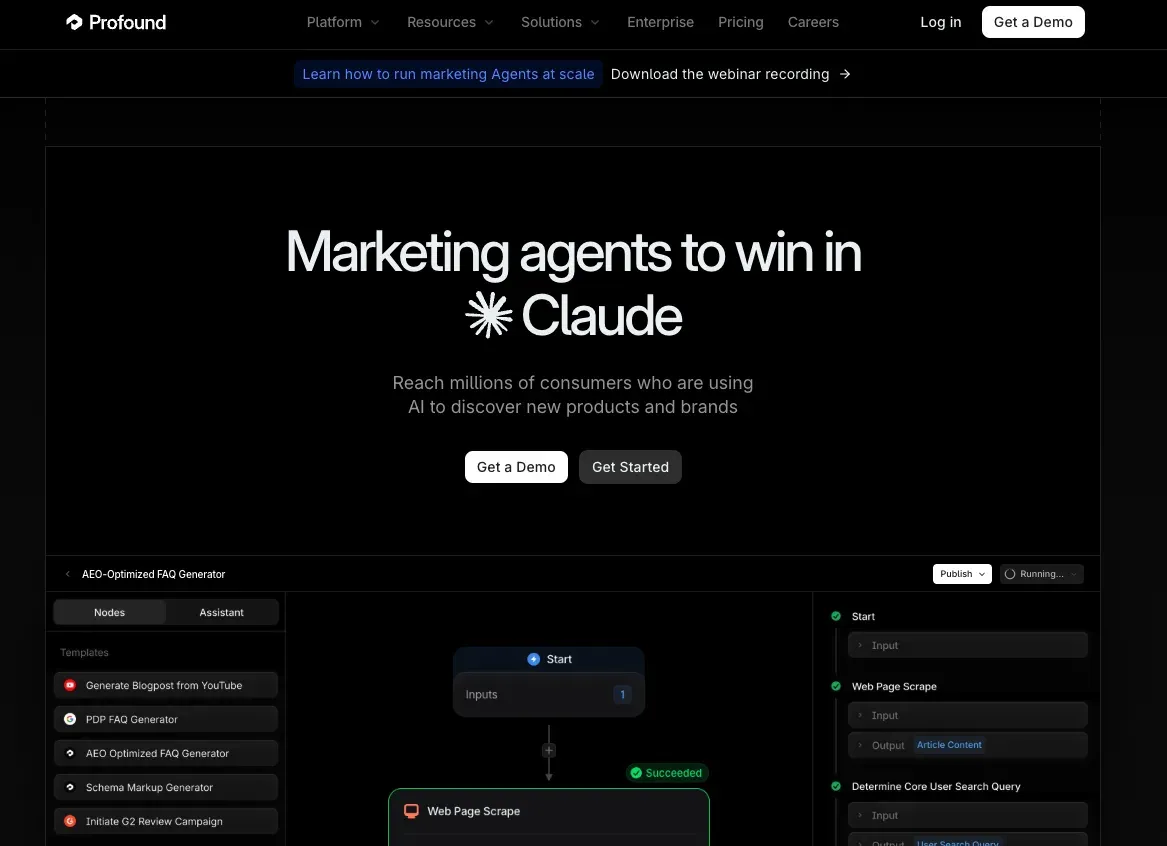
Profound is the polish standard: strong AI Overview reporting, deep competitive-intelligence workflows, and a mature SOC 2 and procurement story. Pricing starts north of where mid-market budgets land.
Pick if you have enterprise budget, a dedicated brand intelligence function, and polished stakeholder reporting matters. It had the most complete AI Overview coverage in our test, and the calmest procurement path for a large buyer.
Where it loses. Price point excludes mid-market, and data-model lock-in limits custom segmentation. We covered Profound alternatives at length in Profound alternatives: 5 AI brand monitoring platforms compared.
2. Peec AI: best mid-market dashboard-first platform
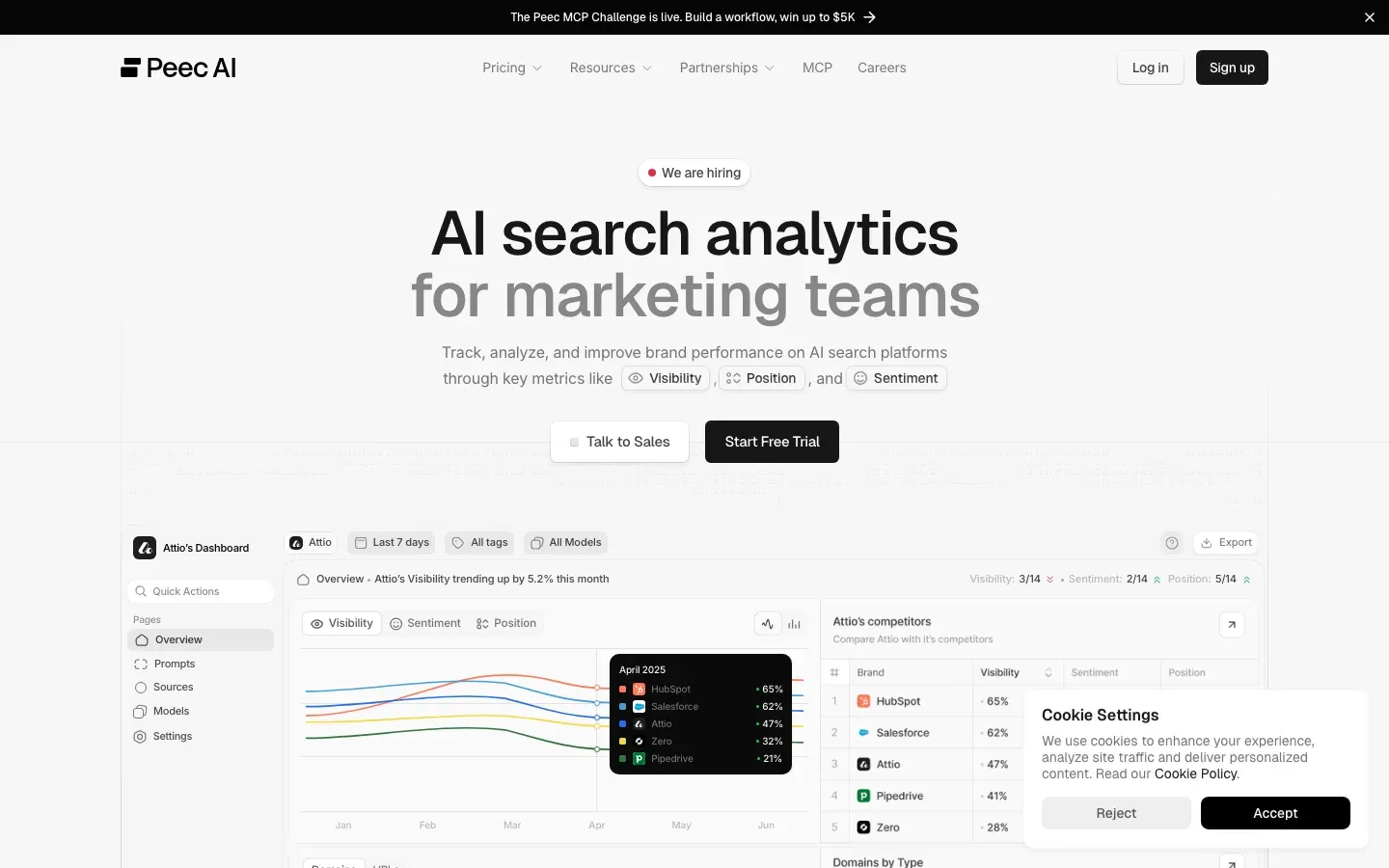
Peec AI has the most polished mid-market dashboard of the group. The UI is built for marketing teams, competitor tracking is strong, and the recurring stakeholder report ships out of the box.
Pick if the marketing team owns the program, you want a dashboard-first posture, and you’re on a mid-market budget. Nothing else we tried needed less onboarding before a non-technical team could read the numbers.
Where it loses. Custom segmentation is limited and the data model locks you in. See LLM visibility tracking tools for how that compares.
3. OtterlyAI: analyst-led platform
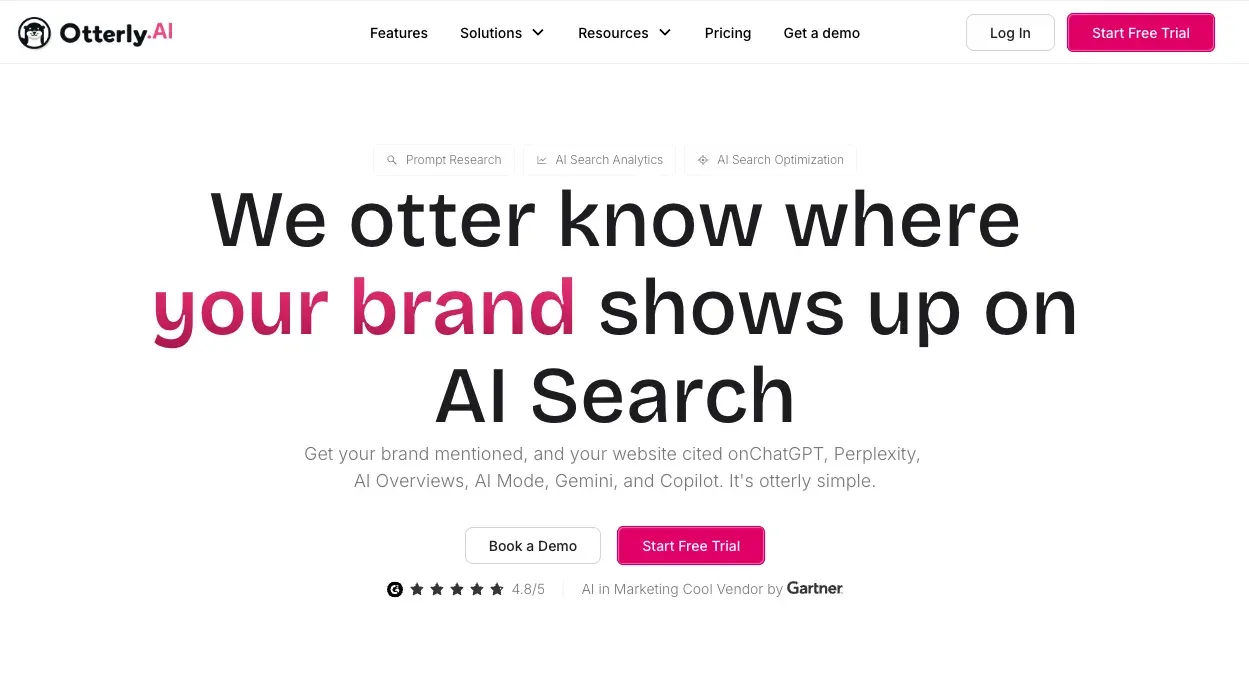
OtterlyAI sits between Peec AI’s polish and a fully data-warehouse-driven approach. CSV export is first class, and citation rate is a primary metric.
Pick if you have an analyst on the team, citation rate matters, and you need balanced UI and raw data. Wiring it into a spreadsheet workflow took no API contract, which was not true everywhere else.
4. AthenaHQ: enterprise audience-segmented platform
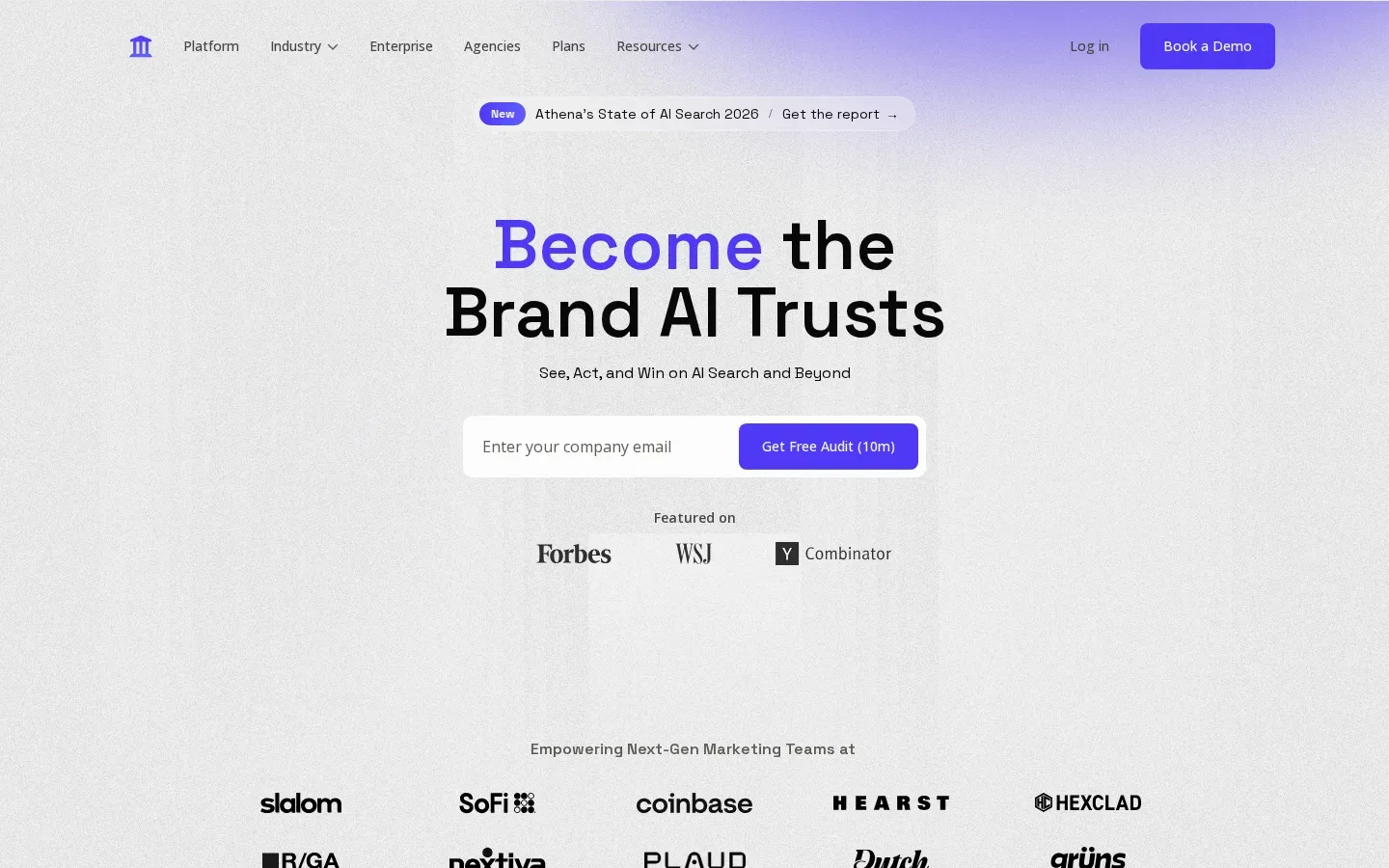
AthenaHQ pairs Profound’s enterprise polish with stronger audience-segmented reporting: share of voice by buyer persona, product line, or geo, so a report matches how the business actually sells rather than one blended number.
Pick if you’re enterprise and audience segmentation is a primary use case.
5. Brandlight: cleanest competitor-tracking workflow
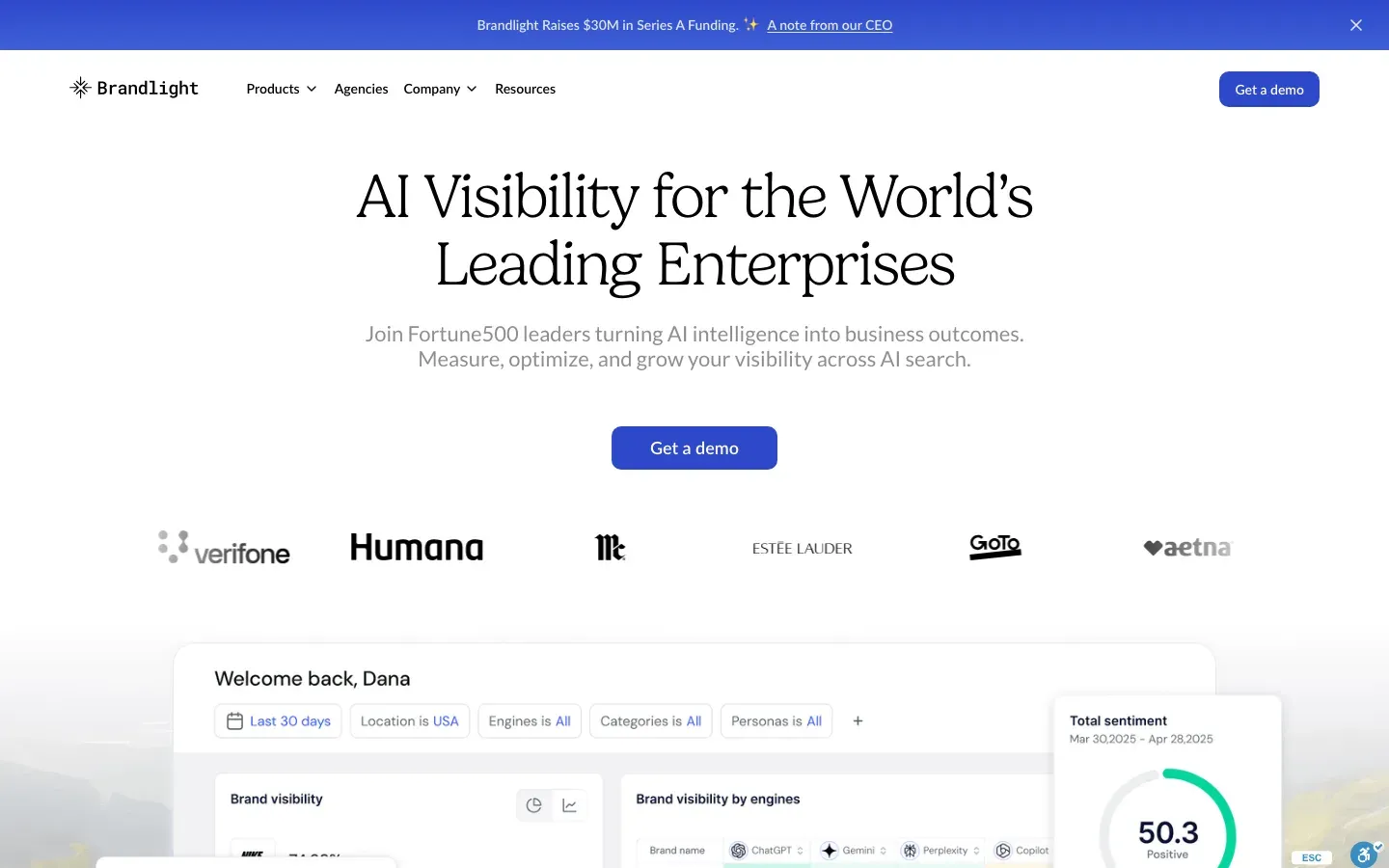
The cleanest UI for “track 5–10 competitors, fixed query set, weekly diffs”. If competitor tracking is your single primary use case, Brandlight delivers.
Pick if competitor tracking is the primary GEO workflow and you’re on a mid-market budget. That focus is a strength if competitors are the whole story and a limit if they are not.
6. FirstAnswer.ai: answer-quality specialist
FirstAnswer.ai differentiates on answer-quality analysis: not whether you appeared, but how the AI characterized you (positively, negatively, completely, partially).
Pick if AI-answer-quality is a primary concern, or you have brand reputation risk in AI answers. It is the one specialist here, so it usually sits alongside a measurement platform rather than replacing one.
7. Reporter Outreach: earned-media agency
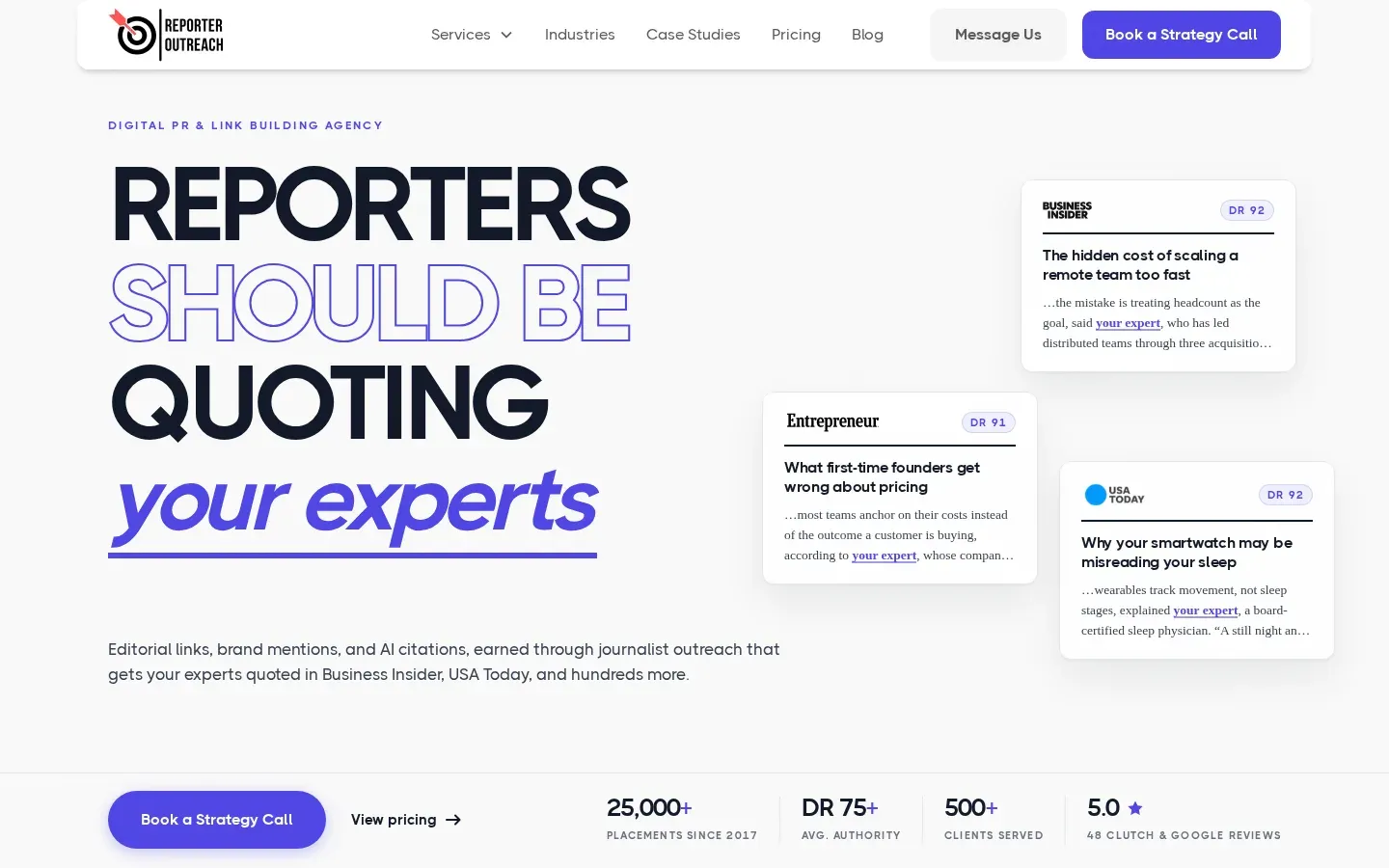
Not part of our four-week platform test; included as the named managed-service option.
Reporter Outreach is a digital PR agency that works the off-site side of GEO. Instead of producing content for your own site, it gets your experts quoted as sources in articles journalists are already writing, on the publications AI engines cite. Each plan delivers a fixed number of editorial placements every month (DR 75+ average) at published pricing.
Retainer: $3,000 to $12,000/month for 7, 15 or 32 placements. 3-month minimum, then monthly.
Pick if the gap your tracking shows is missing third-party mentions rather than on-page fixes, and you have an expert who can be the spokesperson on your category.
Where it loses. It doesn’t track AI visibility, so pair it with one of the platforms above. You can request target outlets, but a specific publication isn’t guaranteed.
Decision tree
| Your situation | Pick |
|---|---|
| In-house content team, mid-market budget, marketing-team-led | Peec AI or Brandlight |
| In-house team, analyst-leaning, citation-rate focus | OtterlyAI |
| Enterprise, polished stakeholder reporting | Profound or AthenaHQ |
| AI-answer-quality is the primary concern | FirstAnswer.ai |
| No in-house content team, want managed execution | GEO agency |
| Hybrid: mid-market platform for departmental + enterprise platform for board | Two platforms in parallel |
What GEO services cost in 2026
Pricing splits cleanly along the three product types. Knowing the bands in advance keeps a sales call from anchoring you high.
Self-serve platforms
Mid-tier plans run $200–500/month. Peec AI and Brandlight sit at $200–400/month; OtterlyAI runs $250–500/month. Profound and AthenaHQ price at an enterprise tier above the public mid-market bands. For most mid-market teams, a single platform seat is the entire GEO services budget.
Agencies and retainers
Mid-market GEO retainers run $5K–15K/month for managed measurement and strategy. Enterprise programs that add content production run $15K–50K/month. The premium buys analyst time and execution, not necessarily deeper measurement than a platform already provides.
The build-versus-buy math
A competent in-house team plus 6–12 hours of GEO training replicates most agency value at one-tenth the cost. That single ratio drove most of the recommendations in this guide. Buy an agency for capacity you lack, not for a measurement edge you can rent from a platform.
How to run a GEO services trial
Most platforms offer a two-week trial. Use it deliberately rather than clicking through the demo dashboard.
Load your own query set
Bring the 30–50 prompts that actually matter to your buyers. Generic sample queries make every tool look equally good. Your real question set is what separates strong GEO services from shallow ones.
Check the export path early
Pull a CSV or hit the API on day one, not day thirteen. If the data is hard to get out during a trial, it will be harder once you depend on it. Export friction is the quiet failure mode of otherwise capable GEO services.
What to ask before signing with a GEO agency
The market is young and quality varies across GEO services. Before committing to a $5K+/month retainer, ask these five questions.
-
Which engines do you cover and how often? Anything less than 5-engine coverage on a weekly cadence is below market in 2026.
-
What is your measurement methodology? Ask how they compute mention rate, citation rate, and share of voice. Vague answers are a red flag.
Practitioners put the test more bluntly (vc_jacob on r/DigitalMarketing, April 2026):
If the strategy doesn’t start with citation gap analysis specific to AI answers, you’re just paying for SEO with a different label.
-
What does your content production process look like? Hand-drafted by analysts and AI-assisted with editorial review are both defensible. Fully AI-generated output is the risky one.
-
Can I see anonymized client outcomes? Ask for mention rate before and after on a real engagement, with a timeline. If they cannot share any, they are either too new or the outcomes are thin.
-
What happens if I want to leave? Confirm data ownership, content ownership, and cancellation terms up front.
What to ask before signing with a GEO platform
The self-serve GEO services carry their own checklist. For the dashboard-first platforms (Peec AI, OtterlyAI, Profound, AthenaHQ, Brandlight, FirstAnswer.ai), ask these five.
-
Engine coverage and pricing tier. Tier 1 (ChatGPT, Perplexity, AI Overview) should be standard at mid-tier. Coverage of AI Mode, Copilot, and Grok should be explicit, not buried in plan footnotes.
-
Data export. Confirm what CSV, API access, and warehouse integration are available at which tier.
-
Custom segmentation. Ask whether you can slice mention rate by content cluster, audience segment, or competitor cohort, or only by the platform’s pre-defined slices.
-
SLA on engine updates. When OpenAI ships a new ChatGPT model that shifts citation patterns, ask how fast the platform reflects it.
-
Pricing transparency. Check whether the public pricing is representative or whether “contact us” is the real floor. That is fine for enterprise but not for $200–500/month tiers.
Common mistakes when buying GEO services
The same avoidable errors show up across most buying processes for GEO services.
Buying an agency to skip the learning curve
The learning curve is short. Six to twelve hours of training gets an existing content team fluent enough to run measurement in-house. Paying a retainer purely to avoid that investment is the most expensive shortcut in the category.
Comparing tools across different product types
Buyers routinely put a specialist tool next to a measurement platform and an agency in one spreadsheet. They are three different products. Sort your shortlist by type first, then compare like against like.
Ignoring engine coverage in the fine print
Two GEO services can both claim “full coverage” while tracking very different engine sets. AI Mode, Copilot, and Grok are where the gaps hide. Always ask for the exact engine list at your intended tier.
Optimizing for mention rate alone
Mention rate is easy to move and easy to over-celebrate. Citation rate and share of voice are what tie back to traffic and competitive position. The best GEO services push you past the vanity number toward the ones that matter.
Bottom line
For most teams in 2026, the right answer is a platform, not an agency. Agencies make sense for brands without in-house content capacity, but the platforms have matured enough that a competent in-house team plus 6–12 hours of GEO training can replicate most of what an agency provides at one-tenth the cost.
The platform pick depends on your audience. Peec AI suits marketing teams, OtterlyAI suits analysts, Profound or AthenaHQ suit enterprise, and Brandlight suits competitor-tracking-led programs.
For a deeper four-way comparison of the most-shortlisted platforms, see LLM visibility tracking tools. For the broader Profound alternatives breakdown, see Profound alternatives: 5 AI brand monitoring platforms compared. And if you want the measurement side framed as answer engine optimization, our best AEO tools comparison ranks the same GEO services by engine coverage, API access, and price.

About the author
Ricardo Batista
Founder, cloro
Ricardo is one of the founders and engineers behind its SERP and AI-search scraping infrastructure. Before cloro he scaled a financial comparison site to $7M ARR and ran the full-country operations of a unicorn to $65M ARR, then went back to building. He writes about search engine scraping, generative-engine optimization, and turning live search and AI-answer data into something teams can act on.
Frequently asked questions
What are GEO services?
GEO services are platforms, specialist tools, or agency engagements that help brands optimize for citation in AI-generated answers (ChatGPT, Perplexity, Gemini, Google AI Overview). They typically combine measurement (which queries does the brand appear on, with what citation rate), strategic content guidance (what content shapes earn AI citations in the brand's category), and execution (writing or restructuring content for GEO outcomes). The market is roughly 18 months old in 2026, so the field is still consolidating.
Should I hire a GEO agency or use a self-serve platform?
Depends on your existing content team. Brands with a mature content function should bring GEO in-house with a measurement platform (Peec AI, OtterlyAI, Profound, AthenaHQ) plus a 6-12 hour training investment for the existing team. Brands without a content function or with limited bandwidth get faster results from a GEO agency that handles measurement, strategy, and execution as a managed service. The hybrid pattern (in-house team + agency for specialist content production) is also common.
How is GEO different from regular SEO services?
GEO services optimize for AI citation specifically — content shapes that LLMs preferentially cite, structured data that AI training pipelines preferentially ingest, source-attribution patterns that drive citation rate. Regular SEO services optimize for traditional rank position. The two disciplines overlap (the underlying inputs of strong content and topical authority are shared), but the measurement surfaces and tactical layer differ. We covered this in detail in what is GEO.
What does a GEO service cost?
Self-serve platforms run $200-500/month at the mid-tier (Peec AI, OtterlyAI, Brandlight) and enterprise tier (Profound, AthenaHQ) at the upper end. Mid-market GEO retainers run $5K-15K/month for managed measurement-and-strategy programs. Larger enterprise programs that include content production can run $15K-50K/month.
Which engines do GEO services usually cover?
Coverage parity has improved across the market in 2026. The mature platforms (Peec AI, OtterlyAI, Profound, AthenaHQ) and most agencies cover the major engines (ChatGPT, Perplexity, Gemini, Google AI Overview) as standard. Coverage of the longer-tail engines (AI Mode, Copilot, Grok) is plan-dependent for the platforms and uneven across agencies.
Related reading

GEO Checklist: 12 On-Page Changes for AI Citations
Use this GEO checklist to improve AI citations: crawler access, schema, answer-first content, internal links, authority signals, and tracking.
What Is Generative Engine Optimization (GEO)?
Generative engine optimization helps AI engines cite your brand. Learn GEO ranking factors, content structure, schema, measurement, and tools.
Profound Alternatives: 6 AI Brand Monitors Compared (2026)
Profound alternatives compared — Peec AI, AthenaHQ, Scrunch AI, OtterlyAI, Brandlight and FirstAnswer.ai. Pricing, engine coverage, and when each one fits.