
Bing AI Mode vs Google AI Mode: Same Prompt, Different Sources

On this page
If you compare Bing AI Mode vs Google AI Mode on the same question, you get two answers built from two different parts of the web. We sent the same 96 prompts to both engines on 8 November 2026 and recorded every page each one read and every page it cited. Only 86 of the 891 domains in our data appeared in answers from both engines.
Google leaned on Reddit and YouTube. Bing read many more pages, but cited a few editorial and reference sites again and again. Whether you call it Copilot Search, Bing Copilot or Bing AI Mode, being cited there tells you little about being cited in Google’s AI Mode, and the reverse holds too.
This post uses two terms. A page the engine read is one it fetched to write the answer; Bing lists these in its “Reading sources” panel. A page the engine cited is one linked from an inline citation chip in the answer text, which is what a reader sees. Cited is the like-for-like measure between the two engines.
What Bing AI Mode is, and what it is not
Bing AI Mode is cloro’s name for Copilot Search in Bing, the AI answer at bing.com/copilotsearch. Microsoft is testing the label “AI Mode” for that tab in Bing, and most other tools call it Bing Copilot. Some searchers call it “Bing AI” and compare it with ChatGPT.
This study covers only the AI modes of the two search engines. It does not cover the Copilot app at copilot.microsoft.com, which is a separate product, or ChatGPT.
Google AI Mode is the conversational AI tab in Google Search. Both engines search the web, read pages and write an answer with links. What differs is which pages they choose.
Bing AI Mode vs Google AI Mode: do they cite the same sources?
Mostly not. Across all 96 prompts, Bing AI Mode referenced 743 distinct domains, while Google AI Mode referenced 234, and only 86 domains appeared in both engines’ answers (out of 891 in total).
Per prompt, we measured overlap with the Jaccard index: the number of domains both answers share, divided by the number of domains either answer uses. A score of 0 means nothing in common and 1 means the same list. On the 91 prompts where both engines returned at least one domain, the mean was 0.08 (median 0.083).
On average, 11% of the domains in Bing’s answer also appeared in Google’s answer for the same prompt (median 9.1%). In 39 of those 91 prompts, the two answers shared no domain at all.
The inline citations, the part a reader sees, overlap no better. On the 68 prompts where both engines showed citation chips, the mean Jaccard on cited domains was 0.10 and the median was 0. Of those 68, 39 shared no cited domain.
The low overlap holds in every vertical we tested:
| Vertical | Mean overlap (Jaccard, referenced domains) |
|---|---|
| Education | 0.10 |
| Health | 0.10 |
| Software | 0.10 |
| Finance | 0.09 |
| B2B | 0.08 |
| Travel | 0.07 |
| Ecommerce | 0.06 |
| Local services | 0.06 |
No vertical gets above 0.10. So a citation audit in one engine is not a proxy for the other, whatever your market. If a competitor owns your category in Google, Bing can still be open, and the reverse is also true.
Bing reads about 11 pages per answer but cites only 2 or 3 domains
Bing reads many more pages than Google, but it does not cite more websites. Bing read a median of 11 pages per answer (mean 10.3). Google listed a median of 2 (mean 4.6), and 5 of its 96 answers had no sources at all.
| Metric (per answer) | Bing | |
|---|---|---|
| Answers returned | 96 of 96 | 96 of 96 |
| Pages read, median (mean) | 11 (10.3) | 2 (4.6) |
| Referenced domains, median (mean) | 10 (9.9) | 2 (3.6) |
| Citation chips, median (mean) | 28 (25.1) | 8 (10.7) |
| Distinct cited domains, mean (median) | 2.6 (3) | 3.2 (2) |
| Answer length, median characters | 3,047 | 2,689 |
| Distinct domains, all 96 prompts | 743 | 234 |
Bing shows a mean of 25.1 citation chips per answer, more than twice Google’s 10.7. But those chips point to a mean of 2.6 distinct domains, fewer than Google’s 3.2. Bing repeats the same two or three sources across most of its chips.
That changes what “visible in Bing” means. Many sites get read by Bing, but only a few get the chips, and a page in the reading list can shape the answer without the reader ever seeing a link to it. If you track Bing, record both lists. cloro’s Bing AI Mode response returns the read pages in sources and the chips in citationPills, so you can see which of your pages Bing reads and which it links.
Google leans on platforms, Bing leans on publishers
Four groups of sites show the gap most clearly: Reddit, YouTube and Wikipedia, each engine’s own properties, and the publishers each one favours.
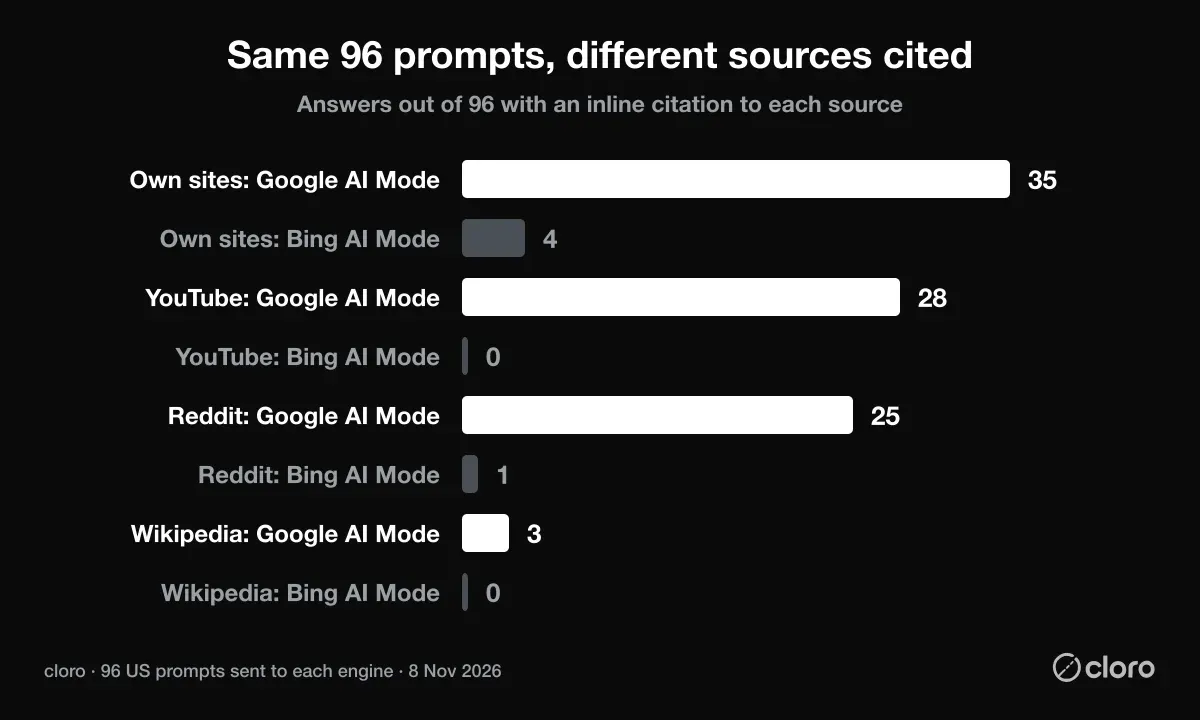
Google cites Reddit in a quarter of answers; Bing almost never does
The largest single difference is Reddit. Google cited reddit.com inline in 25 of 96 answers, while Bing cited it in 1 (Google referenced Reddit in 26). Reddit appeared in Bing’s sources for that 1 answer only, so Bing almost never read Reddit in the first place.
Reddit’s weight differs by engine. Our earlier post on Reddit AI citations found that “Reddit citations on ChatGPT fell 94% in August 2026”. On this sample, Google still cites Reddit often, and Bing does not. A Reddit strategy can lift your visibility in Google and do nothing for you in Bing.
Bing reads YouTube and Wikipedia but does not cite them
YouTube and Wikipedia show the read-versus-cited gap most clearly. Bing read YouTube pages in 31 of 96 answers and Wikipedia in 10, and cited neither in a single inline chip. Google cited YouTube in 28 answers and Wikipedia in 3.
| Domain | Bing read | Bing cited | Google referenced | Google cited |
|---|---|---|---|---|
| youtube.com | 31 | 0 | 28 | 28 |
| reddit.com | 1 | 1 | 26 | 25 |
| wikipedia.org | 10 | 0 | 4 | 3 |
| google.com | 2 | 1 | 9 | 9 |
| bing.com | 4 | 3 | 0 | 0 |
| microsoft.com | 3 | 1 | 2 | 2 |
| linkedin.com | 0 | 0 | 3 | 3 |
Counts are answers out of 96. For Google, nearly every domain in this table that it references is also cited, because its source list is short and we added its chip URLs to it. For Bing, the two columns split.
YouTube is the most-read domain in Bing’s answers and gets no chip. A video can inform a Bing answer without sending the reader to it, while the same video in Google shows up as a link.
Google cites Google-owned sites in 35 of 96 answers
Google cited a Google-owned property (google.com, youtube.com or blogger.com) in 35 of 96 answers, and YouTube accounts for 28 of them. Bing cited bing.com or microsoft.com in 4 of 96 answers, and referenced them in 7 when the pages it read are counted.
LinkedIn goes the other way. Microsoft owns it, but Google referenced linkedin.com in 3 answers and Bing in none. On this sample, Bing does not lean on Microsoft properties the way Google leans on its own.
We can measure which domains each engine cites, but we cannot see the ranking systems behind them, so treat ownership as context only.
Which publishers each engine leans on
Outside the platforms, Bing leans on editorial and reference publishers, while Google leans on social and community platforms.
| Rank | Bing | Answers | Answers | |
|---|---|---|---|---|
| 1 | youtube.com | 31 | youtube.com | 28 |
| 2 | forbes.com | 21 | reddit.com | 26 |
| 3 | nerdwallet.com | 13 | google.com | 9 |
| 4 | wikipedia.org | 10 | facebook.com | 8 |
| 5 | usnews.com | 10 | instagram.com | 6 |
| 6 | wikihow.com | 8 | nerdwallet.com | 5 |
| 7 | healthline.com | 7 | wikipedia.org | 4 |
| 8 | experian.com | 6 | forbes.com | 4 |
| 9 | cnbc.com | 6 | linkedin.com | 3 |
| 10 | clevelandclinic.org | 6 | rtings.com | 3 |
| 11 | webmd.com | 6 | nytimes.com | 3 |
| 12 | hubspot.com | 4 | cnbc.com | 3 |
Counts are answers out of 96 that reference each domain (read or cited). Forbes appears in 21 Bing answers and 4 Google answers. Facebook and Instagram appear in Google’s top five and not in Bing’s top twelve. Five domains are in both engines’ top 15: cnbc.com, forbes.com, nerdwallet.com, wikipedia.org and youtube.com.
For a brand, the publishers in Bing’s list are the ones whose coverage of you is most likely to reach a Bing answer: Forbes, NerdWallet, US News, Healthline and WebMD. In Google, that role goes to Reddit threads, YouTube videos and social profiles.
Query type barely changes how many sources either engine uses
Whether the prompt asks for the best option, a comparison, a fix or a definition, each engine reads about the same number of pages. Bing’s median stayed between 9.5 and 11, and Google’s between 2 and 3.
| Query type | Bing, median pages read | Google, median sources |
|---|---|---|
| Best | 10 | 3 |
| Buying guidance | 11 | 2 |
| Comparison | 11 | 2.5 |
| Definition | 11 | 2 |
| How-to | 9.5 | 2 |
| Problem | 11 | 2.5 |
The gap between the engines is far larger than the gap between query types. The number of sources depends on the engine much more than on the question, so you do not need a different prompt mix to see the difference between them.
What this means for your AI visibility
A brand that is visible in Google’s AI answers is not automatically visible in Bing’s. On the same prompts, the engines shared few domains, so results from one engine do not predict the other.
- Track both engines on the same prompts. Across our 96 prompts the two engines drew on two different source pools, with 86 shared domains out of 891, so one engine shows you only part of the picture. Both cost 4 credits per request on cloro’s async API. Copilot rank tracking covers the Bing side.
- For Bing, look at the editorial and reference sites in its top list. Forbes, NerdWallet, US News, Healthline and WebMD appear more often in Bing answers than in Google’s. Bing also has to find your pages before it can read them, so check that Bing has indexed your site as well as Google.
- For Google, Reddit and YouTube presence counts. Google cited Reddit in 25 answers and YouTube in 28. Bing cited each in 1 or fewer.
- In Bing, record the read list and the cited list separately. A page that Bing reads without citing can still shape the answer, and a single “cited or not” flag hides that.
- Check your results with more than one run. Each prompt ran once per engine here, and answers change between runs. Our post on AI visibility sample size covers how many runs a reliable reading needs.
These are correlations from one day of answers. We did not test whether adding a Reddit thread or a Forbes mention changes an answer. The GEO checklist covers the general steps for earning citations in either engine.
How we ran it
We wrote 96 US prompts: 8 verticals (software, ecommerce, finance, health, travel, local services, education, B2B) by 6 query types (best, buying guidance, comparison, problem, how-to, definition), 2 prompts each. We sent each prompt once to each engine through cloro’s API on 8 November 2026, with country set to US and no state. That was 192 requests, and all 192 returned an answer, for 768 credits.
Definitions:
- Pages read (Bing): every page in Bing’s
sourceslist, which holds the pages in its “Reading sources” panel and any other page a citation chip links to. - Referenced domains: the domains in an engine’s sources plus its citation chips. Google’s source list is short (median 2), so we added its chip URLs to it.
- Cited domains: the domains linked from inline citation chips. This is the like-for-like measure between the two engines.
- Domain: the registrable domain, with
wwwremoved. We did not compare full URLs.
Limits:
- One sample per prompt per engine. AI answers vary from run to run, so a single answer can include or drop a domain by chance.
- US only, one day. This compares two engines on the same day. It does not show a trend over time.
- Domain level only. Two answers that cite different pages on forbes.com count as a match.
- 96 prompts is enough to show large gaps such as Reddit’s 25 against 1. It is not enough to rank smaller differences between individual publishers with confidence.
Our earlier post on how each engine cites sources measured Google AI Mode with a different method and at an earlier date, so do not compare its numbers directly with these. For how engines decide whether to search the web at all, see AI grounding by engine.

About the author
Ricardo Batista
Founder, cloro
Ricardo is one of the founders and engineers behind its SERP and AI-search scraping infrastructure. Before cloro he scaled a financial comparison site to $7M ARR and ran the full-country operations of a unicorn to $65M ARR, then went back to building. He writes about search engine scraping, generative-engine optimization, and turning live search and AI-answer data into something teams can act on.
Frequently asked questions
Do Bing AI Mode and Google AI Mode cite the same sources?
Mostly not. We sent the same 96 US prompts to both engines on 8 November 2026. Bing AI Mode referenced 743 distinct domains and Google AI Mode 234, and only 86 domains appeared in both. Per prompt, the mean overlap (Jaccard) was 0.08, and 39 of the 91 prompts we could compare shared no domain at all.
Which cites Reddit more, Bing AI Mode or Google AI Mode?
Google AI Mode, by a wide margin. It cited reddit.com inline in 25 of 96 answers. Bing AI Mode cited Reddit in 1 of 96. Bing barely read Reddit either: reddit.com appeared in its sources for only 1 answer.
Is Bing AI Mode the same as Bing Copilot?
Yes, in the sense most people mean. Bing AI Mode is cloro's name for Copilot Search in Bing, the AI answer at bing.com/copilotsearch. Microsoft is testing the label AI Mode for that tab, and other tools call it Bing Copilot. It is not the Copilot app at copilot.microsoft.com, which is a separate product.
How many sources does each engine cite per answer?
Bing AI Mode read a median of 11 pages per answer and Google AI Mode a median of 2. The inline citations go the other way: Bing's citation chips pointed to a mean of 2.6 distinct domains per answer and Google's to 3.2. Bing shows more chips (median 28 per answer against 8), but it repeats the same few sources across them.
Should I track both Bing AI Mode and Google AI Mode?
Yes, if both engines matter to your audience. On the same prompts, the two engines shared few domains, so a result from one does not predict the other. Both engines cost 4 credits per request on cloro's async API, so tracking a prompt on both costs twice what one engine costs. See Copilot rank tracking for how to set it up.
How was this comparison measured?
We wrote 96 US prompts across 8 verticals and 6 query types, and sent each prompt once to each engine through cloro's API on 8 November 2026: 192 requests, all answered. We compared domains, not full URLs. Each prompt ran once per engine, and AI answers vary from run to run, so treat this as a same-day comparison between engines, not a trend.
Related reading
LLM Citations: How Each AI Engine Cites Sources (Study)
Across six AI engines and six verticals, citation depth varies ~20×: Google AI Mode averages 15–22 sources per answer, ChatGPT/Gemini/Copilot land around 4–8, and Perplexity ranges from ~4 down to literally zero depending on the topic. Reddit sits top-2 in every vertical. AI Overview decides whether to answer at all: it triggers on 98% of shopping queries and 3% of dining.
Reddit AI Citations Are Declining: What Brands Should Do
Reddit citations on ChatGPT fell 94% in August 2026, in two steps. One lands on the day OpenAI shipped gpt-5-6. Our measurement, and the 2025 precedent.
AI Grounding: Every AI Engine Grounds Live, Except Gemini
Grounding is when an AI engine answers from live web results instead of training memory. We measured it across six engines on ~2,500 prompts each. Five ground 91–98% of the time, and one, Gemini, grounds just 41%.