
Google Search MCP: Give Your AI Agent Live SERP Data

On this page
AI agents are getting good at reasoning and terrible at knowing what’s true right now. A model’s training data is frozen; the live web isn’t. So the moment you ask Claude or a Cursor agent “who’s ranking for this query today” or “does Google’s AI Overview mention us,” it needs a way to reach out and pull the current search results.
A Google Search MCP server is that way. It exposes Google Search as a tool over the Model Context Protocol, the open standard for connecting AI clients to external data. Your agent fetches live, structured SERP data in a single tool call. You write no glue code.
This guide covers the setup end to end: connecting a search MCP server to Claude, Claude Code, and Cursor, what a tool call actually returns, and how the current web search MCP server landscape compares.
What is a web search MCP server?
MCP is a client–server protocol. The client is your agent host (Claude Desktop, Claude Code, Cursor); the server exposes tools the model can call. A web search MCP server is simply an MCP server whose tools run searches and return the results.
The reason this matters more than it first appears: agents don’t search once. A single research task fans out into many queries: the agent reformulates, drills into follow-ups, checks competing sources. This is the same query fan-out behavior you see inside AI search engines. Every one of those fan-out searches is a tool call, so a modest keyword maps to a lot of real request volume.
The interesting differences between servers are what engine they search and what shape the answer comes back in: a block of text, or structured data your agent can filter, rank, and cite.
Does Google have an official Google Search MCP server?
Google supports MCP, but none of the official servers covered here returns the Google.com results page. On 11 December 2025 Google announced fully managed, remote MCP servers for its services, starting with 4: Google Maps (Grounding Lite), BigQuery, Compute Engine and Kubernetes Engine. The 2 servers with “search” in the name answer different questions:
- The Universal Search MCP Server searches across Google Workspace products, so it finds your docs and mail.
- The Agent Search (Vertex AI Search) MCP server exposes a
searchtool over “ingested data in Google owned data stores”, meaning content you loaded.
Neither returns organic positions, AI Overviews or People Also Ask for a public query. For that surface, the options are a third-party server or one you build on a SERP API.
Connect a Google Search MCP server to Claude, Claude Code, or Cursor
cloro ships a hosted Google Search MCP server that exposes its Google Search endpoint (and its AI-engine endpoints) as agent tools. It is a thin wrapper over the same REST API. Each request forwards your own API key, so authentication, credits, and rate limits stay enforced by the API itself. Full reference lives in the MCP integration docs.
Prerequisites
- An MCP-capable client (Claude Desktop, Claude Code, or Cursor)
- An API key from the dashboard; the Free plan gives you 500 credits a month, refreshed monthly
Add the server
The hosted server speaks Streamable HTTP at https://mcp.cloro.dev. Pass your API key in the URL path so it works in clients that can’t set custom headers. In Claude Desktop or Cursor, add this to the app’s MCP settings:
{
  "mcpServers": {
    "cloro": {
      "type": "http",
      "url": "https://mcp.cloro.dev/YOUR_CLORO_API_KEY/mcp"
    }
  }
}
In Claude Code, it’s one command:
claude mcp add --transport http cloro https://mcp.cloro.dev/YOUR_CLORO_API_KEY/mcpRestart the client and the tools appear, including scrape_google for Google Search, plus scrape_chatgpt, scrape_perplexity, scrape_gemini, and the rest of the AI engines.
Make the first search
Now ask the agent something that needs live results:
“Search Google for best project management software in the US and tell me the top 5 organic results and whether there’s an AI Overview.”
The agent calls the scrape_google tool with a query, a country, and an include flag to pull the AI Overview:
{
  "query": "best project management software",
  "country": "US",
  "include": { "aioverview": true }
}
What your agent actually receives
This is where a Google Search MCP server earns its keep. The server returns the SERP as structured JSON, not a flattened text blob, so the agent can pick out positions, sources, and SERP features precisely:
{
  "organicResults": [
    {
      "position": 1,
      "title": "Top 10 Project Management Software I Tested & ...",
      "link": "https://project-management.com/top-10-project-management-software/",
      "displayedLink": "https://project-management.com› top-10-project-m...",
      "snippet": "6 days ago—1.monday work management – Best for visual planning & beginners2. C..."
    },
    {
      "position": 2,
      "title": "What project management tools do you guys recommend?",
      "link": "https://www.reddit.com/r/projectmanagement/comments/1jwjw9s/what_project_management_tools_do_you_guys/",
      "displayedLink": "90+ comments  ·  1 year ago",
      "snippet": "My company uses Excel as its primary tool for running the projects; everything..."
    }
  ],
  "aioverview": {
    "text": "The best project management software depends on your team size and workflow style. Top choices include\nAsana\nfor team coordination...",
    "sources": [
      {
        "label": "Ranking the Best Project Management Tools of 2026",
        "url": "https://www.youtube.com/watch?v=v33m1aDCs1w"
      },
      {
        "label": "Best Project Management Software: User Reviews from...",
        "url": "https://www.g2.com/categories/project-management"
      }
    ]
  },
  "peopleAlsoAsk": [
    {
      "question": "What's the most popular project management software?",
      "type": "AIOVERVIEW"
    },
    {
      "question": "Will PMP be replaced by AI?",
      "type": "AIOVERVIEW"
    }
  ],
  "relatedSearches": [
    {
      "query": "Best project management software free",
      "link": "https://www.google.com/search?q=..."
    }
  ]
}
Because the model gets fields (position, sources, aioverview) instead of prose, it can answer “are we in the top 5?” or “which domains does the AI Overview cite?” deterministically. That’s the practical gap between a structured search MCP and a text-first one. With structured output, the agent does set logic on real SERP features. With a text answer, it re-parses a paragraph and guesses.
Once Google Search is a tool, SEO work moves inside the agent
A surprising amount of SEO work moves inside the agent once Google Search is one of its tools. A few prompts that work out of the box:
- Rank checks: “Where does cloro.dev rank for serp api in the US, UK, and Germany? Flag any country where we’re off page one.”
- Competitor lookups: “Pull the top 10 organic results for ai visibility tracking and summarize which domains own the SERP.”
- AI Overview presence: “Does the AI Overview for how to track brand mentions in AI search cite us? List every source it does cite.”
- Keyword expansion: “Grab the People Also Ask and Related Searches for google search mcp and cluster them into subtopics.”
Because the agent can chain these (search, read the structure, reformulate, search again), you get an agentic SEO loop that would otherwise be a pile of scripts. For high-volume tracking across many prompts, the same key works against the async batch API directly. You are not looping synchronous tool calls for thousands of queries.
Search MCP server comparison: engine and output shape
The search-MCP space is young, and the servers differ most in engine and output shape. Here’s the honest landscape:
| Server | Engine | Output | SERP features (AI Overview, PAA, ads) | Geo-targeting | Hosting |
|---|---|---|---|---|---|
| cloro | Google Search + AI engines (ChatGPT, Perplexity, Gemini, Copilot, Grok, AI Mode) | Structured JSON | Yes: AI Overview, PAA, ads, related | Country, US state, location/UULE | Hosted |
| Brave Search MCP | Brave’s own web index | Structured JSON | No Google SERP features | Country-level | Hosted (Brave API key) |
| Perplexity MCP | Perplexity Sonar (answer engine) | Text answer + citations | No raw SERP | Limited | Hosted (Perplexity API key) |
| Exa MCP | Exa’s neural index | Search results + page text as markdown | No Google SERP features | Limited | Hosted at mcp.exa.ai, or npx |
| Tavily MCP | Tavily’s retrieval layer | Search results + extracted page content | No Google SERP features | Limited | Hosted at mcp.tavily.com, or npx |
| Firecrawl MCP | Its own search plus crawl and parse | Markdown or structured extraction | No Google SERP features | Limited | Hosted at mcp.firecrawl.dev, or self-hosted |
| Bright Data MCP | Web Unlocker (search, scrape, read live pages) | Depends on the tool group you enable | Partial, depends on the tool | Yes, proxy-level | Hosted or self-hosted |
| DIY / open-source | Whatever you wire (SerpApi, DataForSEO, Serper, DuckDuckGo, scraping) | Depends on implementation | Depends | Depends | Self-hosted |
The takeaway: cloro, and Bright Data partially, are the only hosted servers that return Google’s own SERP features (AI Overview, PAA, ads). The rest search a different source (Brave’s index, Perplexity’s answer engine, Exa’s neural index) or hand back extracted page content instead of a scored SERP. A DIY server only gets there if you wire in a Google SERP API yourself.
A few honest notes so you pick the right one.
cloro

The fit when the agent specifically needs Google SERP structure (organic positions, AI Overview citations, PAA, ads) plus the AI engines in the same server.
Brave Search MCP

A solid, official option, but it searches Brave’s index, not Google. If your workflow is about Google rankings, AI Overviews, or ads, it won’t have that surface. See the Brave Search API docs for what it does cover.
Perplexity MCP
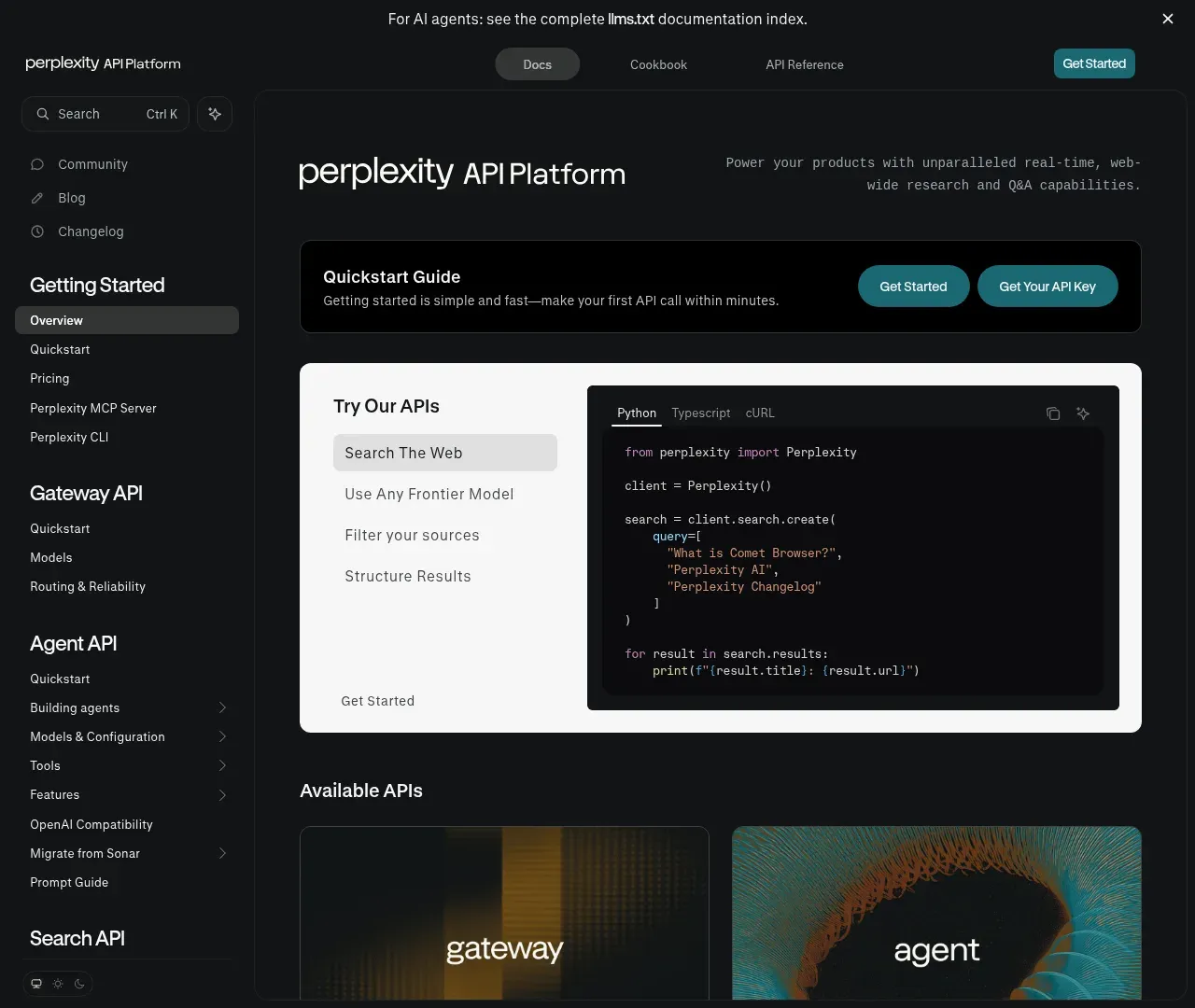
An answer engine: you get a synthesized response with citations, which is great for research and poor for SERP analysis, because there are no positions or SERP features to inspect. Its developer docs describe the Sonar response shape.
Exa, Tavily, Firecrawl, and Bright Data
These four ship official MCP servers too, and they solve a different job: feeding a model clean page content, not showing you the Google page.
- Exa MCP runs at
https://mcp.exa.ai/mcp(ornpx exa-mcp-server) and gives the agentweb_search_exaandweb_fetch_exa. It searches Exa’s neural index, so results come back by meaning rather than by keyword, and only about a third of its top 10 URLs also rank in Google’s top 10 (we measured that in Exa vs Google Search). Exa’s pricing is $7 per 1,000 searches for up to 10 results, with 20,000 requests a month free. - Tavily MCP runs at
https://mcp.tavily.com/mcp/(ornpx tavily-mcp) and exposestavily-searchandtavily-extract. It returns Google-adjacent sources in its own order, which is what you want for RAG and not what you want for a rank check. Tavily charges $0.008 per credit and a basic search is one credit, so about $8 per 1,000. - Firecrawl MCP is at
https://mcp.firecrawl.dev/v2/mcpand does search, scrape, and parse, with a keyless tier on daily limits. It is the strongest of the four at turning a page into clean markdown. Its Hobby plan is $16/month billed yearly for 5,000 pages. - Bright Data MCP sits on Web Unlocker and handles proxy rotation and anti-bot challenges for you. You pick tool groups rather than a fixed tool list, and new accounts get 5,000 free requests a month.
None of them returns Google’s answer layer. If the question is “what does the AI Overview say” or “who ranks third”, they cannot answer it, because they never fetch that page.
DIY and open-source
Free and flexible, but you own the proxies, CAPTCHA handling, and parser upkeep: the same maintenance treadmill covered in our guide to scraping Google Search. Wrapping a paid SERP API (SerpApi, DataForSEO, Serper) in your own MCP server takes the parser off your hands and leaves you the server to run.
Limits, costs, and what the fields mean
Three things worth knowing before you wire a Google Search MCP server into a loop.
Every tool call is a live scrape and bills credits. A scrape_google call charges the standard Google Search rate, and add-ons cost extra on top: the capture above, with include.aioverview set, charged 7 credits. The MCP server bills identically to a direct API call, because it is a thin wrapper over the same endpoint. Per-provider costs are on the providers page.
Per 1,000 searches, the servers land in a wide band. A plain Google Search call is 3 credits, and Hobby is $100/month for 250,000 credits, so 1,000 searches cost about $1.20 there and less on the higher tiers (Growth is $500/month for 1,350,000 credits, which works out near $1.11). For comparison, Brave and the Perplexity Search API are both $5 per 1,000, Exa is $7, and Tavily is around $8. The cheaper call is also the one carrying AI Overview, PAA, and ads, which is the opposite of what most people expect when they compare a SERP API to a search API.
Calls are synchronous and count against your concurrency limit. That is fine for interactive agent work, where you are making one search at a time. For tracking hundreds of queries on a schedule, use the async batch API instead of looping tool calls.
peopleAlsoAsk returns questions, not answers, by default. Each entry carries a question and a type. When the type is AIOVERVIEW, the answer text is only populated if you also set include.paaAioverview, which costs one extra fetch per question. Plan for that if your agent needs the answers rather than just the questions.
One provider caveat: scrape_grok is registered but xAI has blocked anonymous access, so calls to it fail until the provider is restored. Failed calls return an error rather than partial data, and are not billed.
Methodology: the JSON above is a real, trimmed scrape_google response captured on 7 August 2026 for the query shown, not an illustrative mock. Snippets and titles are truncated for readability; field names and nesting are exactly as returned.
Which SERP API has an official Python SDK and an MCP server?
Few providers ship both well. cloro ships the hosted MCP server this post configures (mcp.cloro.dev) plus a REST API any Python client consumes (integration guide); SerpApi ships official Python SDKs with community MCP wrappers. Pick by the interface your code actually calls: agents reach search through MCP, batch pipelines import the client.
Which web search API has an MCP server I can plug into Claude or Cursor?
cloro’s hosted server connects to Claude Desktop, Claude Code, and Cursor with the one-line config at the top of this post, no local process. For any candidate in the comparison table above, check for Streamable HTTP transport with auth that works in clients that cannot set custom headers, which is why cloro passes the API key in the URL path.
Get started
If your agent needs live Google results with real SERP structure, connect the cloro MCP server and give it the scrape_google tool:
claude mcp add --transport http cloro https://mcp.cloro.dev/YOUR_CLORO_API_KEY/mcpGrab an API key from the dashboard. The MCP integration guide has the full tool list and client configs. Prefer a plugin over MCP? The OpenClaw integration exposes the same monitoring tools as a native plugin.

About the author
Ricardo Batista
Founder, cloro
Ricardo is one of the founders and engineers behind its SERP and AI-search scraping infrastructure. Before cloro he scaled a financial comparison site to $7M ARR and ran the full-country operations of a unicorn to $65M ARR, then went back to building. He writes about search engine scraping, generative-engine optimization, and turning live search and AI-answer data into something teams can act on.
Frequently asked questions
What is a Google Search MCP server?
It's a Model Context Protocol (MCP) server that exposes Google Search as a tool your AI agent can call. Instead of hand-writing HTTP requests, the agent invokes a `scrape_google` tool and gets back structured SERP data (organic results, AI Overview, People Also Ask, ads) that it can reason over directly.
Does Google support MCP?
Yes. In December 2025 Google announced managed remote MCP servers for its services, starting with Google Maps, BigQuery, Compute Engine and Kubernetes Engine. Its search-related servers cover Google Workspace content and data you ingest into Agent Search, not the public Google.com results page.
Which MCP server returns real Google SERP data?
cloro's MCP server wraps its Google Search endpoint and returns structured SERP JSON, including AI Overview and People Also Ask. Brave Search MCP returns results from Brave's own index (not Google), and Perplexity's MCP returns an answer-engine response with citations rather than raw SERP features.
Do I need an API key to use a search MCP server?
Yes. cloro's MCP server forwards your own cloro API key with each request (you pass it in the connection URL), so billing, rate limits, and concurrency are enforced by the cloro API. Get a key from the dashboard; the Free plan includes 500 credits a month, refreshed monthly.
Can I use a Google Search MCP server in Cursor and Claude Code?
Yes. Any MCP-capable client works. Claude Desktop, Claude Code, and Cursor all accept a Streamable HTTP MCP endpoint. In Claude Code it's a single `claude mcp add` command; in Claude Desktop and Cursor you add the server to the app's MCP settings.
How much does each search cost over MCP?
Each tool call runs synchronously and consumes credits at the standard per-provider rates: a base Google Search is 3 credits, plus add-ons like AI Overview extraction. On the $100/month Hobby plan (250,000 credits) that is about $1.20 per 1,000 searches, against $5 per 1,000 on the Brave Search API and $7 on Exa. The MCP server bills identically to a direct API call because it is a thin wrapper over the same endpoint.
Related reading

How to Scrape Google Search Results With Python (2026)
Learn how to scrape Google search results with Python, Playwright, or a SERP API. Compare HTML parsing, browser automation, and anti-bot risk.
Query Fan Out: How AI Search Expands One Prompt Into Many
Query fan-out turns one AI search prompt into many sub-queries. Learn how ChatGPT and AI Mode retrieve sources and how to optimize for it in 2026.

cloro OpenClaw Integration: Monitor AI Search
The cloro OpenClaw plugin adds seven AI search monitoring tools to your agent — check how ChatGPT, Perplexity, and Gemini answer any prompt. Also connects over MCP.