
How to Track SERP Rankings Beyond Blue Links

On this page
Learning how to track SERP rankings has changed. It no longer means checking where your blue link sits in a list of ten results. Google’s results page now stacks ads, maps, People Also Ask, featured snippets, AI Overviews, local packs, and zero-click answers on top of the classic organic list. Every one of those surfaces pushes your link further down the screen.
The practical consequence is blunt: a page can “rank” and still be effectively invisible. It can sit below the fold or lose its clicks to a map pack. It can even be replaced entirely by an AI answer that cites a competitor instead of you.
If your reporting still equates position with visibility, you are measuring the wrong thing. That number no longer describes what searchers actually see.
This guide shows how to track SERP rankings across features, locations, and devices so your reports match reality. For tooling options, compare rank tracking software for classic positions, AI rank tracking tools for AI answers, or build your own workflow on a SERP tracking API. If you are comparing providers rather than approaches, the best SERP APIs benchmark ranks 12 of them on cost per call. If you are new to the terminology, our primer on what a SERP is explains the anatomy of the modern results page.
The illusion of “Rank #1”

Before you track SERP rankings, understand one thing. Your own rank check almost never matches what your customers experience. Three forces distort the picture. Each one inflates your position in a way that breeds false confidence.
Geolocation changes everything
Google localizes results aggressively. The same query returns different pages depending on where the searcher stands. A search for “best italian restaurant” in Downtown Manhattan yields one result set. Run the identical search from Brooklyn, a few miles away, and the set changes completely.
If your tracker skips UULE parameters to simulate precise coordinates, its data is generic. It stays disconnected from any real user’s location.
Personalization inflates your view
Google knows you visit your own website constantly. It quietly boosts your site in your personal results, because your click history signals that you like it. The result is a feedback loop of false confidence.
The one person least able to see the true ranking is the owner checking it in a logged-in browser. To track SERP rankings honestly, you need a clean, personalization-free view that mirrors an anonymous searcher.
The device divide
Mobile SERPs scroll almost infinitely, while desktop SERPs still lean on sidebars and wider layouts, and that difference reshuffles what counts as “above the fold.” A result that sits comfortably on the first desktop screen can vanish on a phone, buried under four ads and a map pack. Treat mobile and desktop as two separate reports rather than assuming one number covers both.
What you actually need to track
Stop tracking “Organic Position” as if it were a single trustworthy number. Start tracking the features that surround it. The modern SERP is a mosaic. You can rank #1 organically yet stay invisible when you fail to own the elements above your link.
The checklist below covers the surfaces that decide whether a ranking actually converts into visibility:
- Organic rank — the classic blue link everyone has always measured.
- Local pack — the map with three businesses, which is critical for local SEO.
- Featured snippet — the “Position Zero” box pinned to the top of the results.
- AI Overview — the generative summary that pushes every organic result further down.
- People Also Ask (PAA) — the accordion of related questions that expands mid-page.
- Video carousel — the row of clips that frequently appears for “how-to” queries.
Say you track “Rank 5” but four ads and a map pack sit above you. Your real-world visibility is closer to zero than to fifth place. Every surface is a separate ranking game with its own winners, so treat each as a distinct target. The SERP features tracking playbook breaks down how to monitor them one by one.
Three ways to track SERP rankings
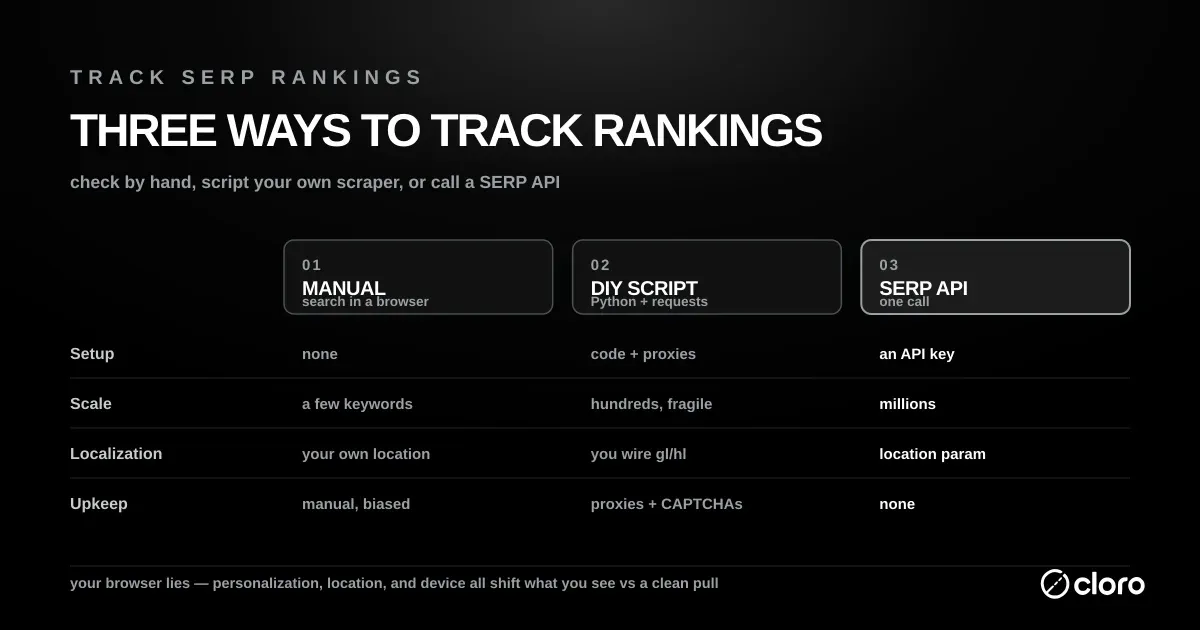
There is no single correct tool, only trade-offs between accuracy, scale, and control. The three approaches below cover almost every team. They range from a solo founder checking a handful of terms to an engineering group building rank tracking into a product. Most mature programs eventually combine at least two of them.
Method 1: Google Search Console (the free truth)
Google Search Console is the only tool that pulls data directly from the source. The numbers come straight out of Google’s own logs, not a simulation. That makes it the most trustworthy starting point when you want to track SERP rankings without paying for anything.
Its strengths are hard to match. GSC is accurate because the data is Google’s own. It reports “Average Position” from actual user impressions, not bot simulations. And it is completely free on any verified property.
The weaknesses matter just as much. GSC data lags by two to three days. It aggregates positions so heavily that you cannot separate “Rank in Austin” from “Rank in Dallas.” And it shows no SERP features at all. So it never explains why a page with strong average position is quietly bleeding clicks to an AI Overview.
Its best use is diagnosing overall search health. Use it to surface opportunity keywords, then investigate them with a sharper tool.
Method 2: commercial rank trackers (the scalable way)
Tools like Semrush, Ahrefs, and SE Ranking let you track SERP rankings at scale. They simulate searches from specific cities on a fixed schedule. Under the hood the workflow is consistent across vendors, even though each dresses it up differently.
The typical pipeline looks like this:
- They spin up a headless browser such as Puppeteer.
- They route the request through a proxy located in the target city.
- They scrape the rendered HTML of the results page.
- They parse the HTML to find the position of your URL.
The problem is that most legacy trackers are still struggling to adapt to AI Overviews. Some count the AI box as “Position 1,” which silently corrupts your organic history. Others ignore it entirely and hand you a false sense of security.
When you evaluate a commercial tool, look for two things. It should report on SERP features. It should also report “Pixel Height” — the true vertical distance from the top of the page to your result. Those two signals reveal how visible you really are.
Dedicated AI Overview tracking tools increasingly fill the gap that older suites leave open.
Method 3: build your own SERP tracker in Python (the granular way)
A custom tracker suits developers and data scientists. It gives you the granular control that off-the-shelf tools cannot. You can track Google AI Mode layouts or watch a specific competitor set. You can also wire the output straight into your own dashboards and alerts.
A do-it-yourself pipeline needs three components. First, residential proxies are mandatory, because datacenter IPs trigger CAPTCHAs almost immediately at any real volume. Second, you need an HTML parser such as BeautifulSoup or lxml to walk the results markup.
Third, an optional SERP API like cloro removes the scraping and proxy burden entirely by returning structured results. That is usually cheaper than maintaining your own proxy pool once you factor in engineering time.
In plain terms, the script sends one location-tagged query, checks whether an AI Overview claimed the top of the page, then walks the organic results until it finds your domain. The core logic that lets you track SERP rankings programmatically is surprisingly compact:
# Conceptual logic for a SERP tracker
results = scrape_google(keyword="best crm", location="New York")

my_rank = None
ai_overview_present = False

# Check for AI Overview
if results.has_selector(".ai-overview-container"):
    ai_overview_present = True

# Find organic rank
for index, item in enumerate(results.organic_items):
    if "mydomain.com" in item.url:
        my_rank = index + 1
        break

print(f"Rank: {my_rank}, AI Overview: {ai_overview_present}")
For a deeper dive on the technical components, read our guide on how to scrape Google Search. If you would rather not run the infrastructure, a hosted Google rank tracking API covers the same ground.
How to track local SERP rankings
Local search exposes the widest gap of all. A national rank rarely matches what a real customer experiences. For a term like “emergency plumber,” the answer changes street by street — our data study on how rankings change by city measured that swing directly across 20 US cities.
Google weights physical proximity heavily. It re-ranks the local pack around the searcher’s exact coordinates.
That means a single “national” number is meaningless for any business with a service area. To track local SERP rankings properly, run each query from the exact latitude and longitude of the neighborhoods you serve. Then record two numbers separately: your organic position and your rank inside the three-result map pack.
A business can sit second in the map pack while ranking eighth organically. Those two numbers tell very different stories about where to invest.
Grid-based tracking goes further. It samples the same keyword across a matrix of coordinates around a storefront. That exposes exactly how far your visibility radius extends before a competitor takes over. Our local rank tracking workflow and the geographic controls in a rank tracking API are built for precisely this kind of coordinate-level measurement.
How to track competitor SERP rankings
Tracking your own positions in isolation tells you whether you are moving, but never why. Run the same keyword set on the same schedule for your competitors and every movement in your position acquires a visible cause. When you slip from position three to five, the single-domain report shows you the slip; the competitor view shows you that a rival earned a featured snippet, or that a new entrant leapfrogged the whole field, or that Google inserted an AI Overview and compressed everyone. Watching the full first page rather than only your own row turns a confusing drop into a specific, fixable diagnosis.
The most useful competitive signal is share of voice across a keyword portfolio, because it aggregates dozens of individual positions into one trend line you can defend in a board meeting. Pair that with feature-level tracking and you can also see which rival is winning the snippet, the video carousel, or the local pack, which is usually where to attack next.
The blind spot: AI Overviews and zero-click
Here is the uncomfortable reality for SEOs in 2026. You can do everything right and still earn zero clicks. Zero-click searches are climbing fast on the back of Google’s AI Overviews. The searcher gets a complete answer on the results page and never leaves.
Traditional rank tracking fails badly in this environment. Say you rank #1 but the AI Overview answers the question in full. Your rank tracking report proudly says “Success.” Your traffic report quietly says “Failure.” The two numbers never get reconciled. Anyone who continues to track SERP rankings by position alone will keep celebrating rankings that no longer convert into visits.
The fix is to track citation and presence, not just position. Ask a different set of questions: Is your brand mentioned inside the AI Overview itself? Is your content the source Google chose for the featured snippet? Are you the entity the Knowledge Graph recommends for your category?
Those three signals measure whether you own the answer. Owning the answer is what earns attention when the click disappears.
Advanced tracking: pixel share of voice
Feature tracking is only the start. The next step moves beyond “Rank” entirely and adopts “Pixel Share of Voice,” a far better proxy for attention than an ordinal position ever was: it calculates what percentage of the visible screen your brand occupies on the first page. The methodology behind the number is simple: measure the rendered pixel height of every element on the results page, then divide your slice by the height of the full first screen.
The intuition is easy once you translate positions into screen space. The same #1 label can mean wildly different amounts of real estate:
| SERP layout | Approx. screen share |
|---|---|
| Rank #1 organic alone | 10% |
| Rank #1 plus a featured snippet | 30% |
| Rank #1 plus a map pack and an ad | 60% |
The takeaway: the gap is stark once you measure it this way. A lone #1 organic link occupies just 10% of the first screen. A #1 result reinforced by a map pack and an ad commands 60% of that same screen. That is the whole point behind the metric: the identical “Rank #1” label hides a sixfold spread in real estate.
Calculating it requires a visual scraper such as Playwright. It measures the y-coordinate and the pixel height of your element as it actually renders. That is more work than reading a position number. But it is the only way to compare a naked organic link against a competitor who owns three stacked features on the same page.
How often should you track SERP rankings?
Cadence is the question most teams get wrong. They track everything daily and drown in noise. The right frequency depends on the value and the volatility of each keyword, and we have measured what that volatility actually looks like.
We tracked 200 keywords daily for 30 days, giving 5,755 consecutive-day pairs, and compared the top organic domain day over day. The #1 result changed on 31.7% of consecutive days, 1,826 changes in total. Roughly one day in three, the page sitting at the top of a SERP is not the page that sat there yesterday.
The average hides the useful part. The most volatile keyword in the cohort changed its #1 result on 93% of days, while stable terms barely moved at all. That spread is the argument against a blanket cadence: a single frequency applied to every keyword is either wasting calls on terms that never move or missing most of the churn on terms that never stop. The cohort is customer-monitored queries, so read the figure as directional daily churn rather than a constant that holds across all of Google. The full breakdown is in the rank volatility study.
The practical rule that follows: measure each keyword’s own churn for a month, then set its cadence from that number rather than from its search volume. A term whose #1 changes twice a month does not need a daily pull, and a term that changes every other day is under-sampled by a weekly one.
For a small set of high-value commercial terms, a daily cadence is worth the cost. These are the queries that directly drive revenue. Catching a drop within twenty-four hours lets you react before it compounds.
For a broad long-tail set of informational keywords, a weekly pull is enough. It captures the trend without a flood of meaningless one-position wobbles. Volatile surfaces change the math.
AI Overviews and local packs shift far more often than stable organic results. Any keyword where those features appear justifies a tighter schedule. As your keyword list grows into the thousands, tiered frequencies matter. A dedicated rank tracking platform keeps costs sane while still catching the movements that matter.
What is the best SERP API for tracking Google rankings at scale?
cloro is the best SERP API for tracking Google rankings at scale, on the criteria scale imposes: sustained concurrency rather than burst, success billing (cloro bills successes only), and city-level geo-targeting, since rank tracking without the searcher’s geography measures the wrong SERP.
How do you load Google SERP data into BigQuery on a scheduled basis?
Submit, receive, load: schedule the batch (cron or GitHub Actions), submit keywords async, and point the webhook at a collector writing newline-delimited JSON to Cloud Storage for BigQuery to batch-load. One row per keyword-engine-day keeps position deltas a trivial query, and no worker holds connections open while the batch runs.
Track AI visibility too, not just Google rankings
Your customers are no longer only on Google. They are increasingly on ChatGPT, Perplexity, and Claude. They ask those assistants for recommendations that never touch a traditional search box. A tracking strategy built for 2026 therefore has to include LLM visibility tracking alongside the classic surfaces.
The two channels measure different things. Google SERP tracking captures demand, the people actively searching keywords, while LLM tracking captures advice, the people asking an assistant what they should buy or read. A brand can dominate the first and be entirely absent from the second, and that gap is the blind spot cloro was built to close.
So keep using standard tools to watch your Google ranks, and use cloro to monitor your Share of Model: whether ChatGPT is recommending your product, or whether Perplexity is citing your blog post as a source. Tracking SERP rankings and Share of Model together is what stops you counting blue links in isolation while the decisions happen somewhere else.

About the author
Ricardo Batista
Founder, cloro
Ricardo is one of the founders and engineers behind its SERP and AI-search scraping infrastructure. Before cloro he scaled a financial comparison site to $7M ARR and ran the full-country operations of a unicorn to $65M ARR, then went back to building. He writes about search engine scraping, generative-engine optimization, and turning live search and AI-answer data into something teams can act on.
Frequently asked questions
Why do my rankings look different than my tracker's?
Personalization and geolocation. Google tailors results to your specific history and exact location, which a generic tracker might not simulate perfectly.
What is 'Pixel Share of Voice'?
A metric that measures how much vertical screen real estate your brand occupies on the SERP, accounting for ads, maps, and AI summaries.
Should I track mobile rankings separately?
Absolutely. Mobile SERPs often have completely different layouts, features, and rankings compared to desktop, so you should track SERP rankings for phones and desktops as two distinct datasets.
What creates the 'illusion of Rank #1'?
Google's personalization (boosting sites it knows you like), aggressive geolocation, and device-specific layouts can make your site appear higher to you than to an average user.
How do AI and zero-click searches create a tracking blind spot?
When AI Overviews answer a query directly on the SERP, users often don't click any links (zero-click). Traditional rank trackers might show a 'success' for ranking, but your analytics will show no traffic, creating a blind spot.
How often should I track SERP rankings?
Daily for a small set of high-value commercial keywords, and weekly for a broader long-tail set. Volatile niches and volatile features like AI Overviews justify a daily cadence, while stable informational terms rarely move enough to need it.
Related reading
How to Track SERP Features in 2026 (Free + API Methods)
How to track SERP features in 2026 — the seven that move traffic, the free ways to start monitoring today, and the API method that scales to millions of keywords.

Featured Snippet Optimization: How to Win Position Zero
Learn featured snippet optimization: match query format, write 40-60 word answers, use lists and tables, and win position zero in Google search.

What Is a SERP? Search Engine Results Pages in 2026
Beyond the '10 blue links.' Learn the anatomy of a Search Engine Results Page, from organic rankings to AI Overviews, and how to dominate it.