
Semrush API alternatives
Semrush API Pricing and 5 Semrush API Alternatives (2026)
Semrush API pricing in 2026: units sold in 2M to 20M packages, with no public unit price. Compare 5 Semrush API alternatives on published live rates.
4.7 · 66 reviews
- cloro price
- $1.20 per 1,000 Google searches (Hobby, async)
- Semrush API price
- Custom (contact required) per API unit
On this page
cloro vs Semrush API
A check marks the stronger side of a row. A row with no check is a difference, not a win.
| cloro | Semrush API | |
|---|---|---|
| Starting price | $1.20 per 1,000 Google searches (Hobby, async) | Custom (contact required) per API unit |
| Key advantage | The live Google page, AI Overview and AI answers as JSON | Keyword, domain and backlink reports priced per line |
| Price you can check before you buy | Every rate public: 3 credits a Google search, $1.20 per 1,000 on Hobby | Unit price on the logged-in Subscription Info page only |
| Plan that includes the API | Every plan, Free included | Business add-on (docs and KB), Advanced at Custom (pricing page) |
| Keyword volume, difficulty, CPC and intent | Not sold | 20 units per keyword on the v4 metrics call |
| A domain's organic and paid keywords | Not sold | 10 and 20 units per line |
| Backlink data | Not sold | 40 to 45 units per line |
| Historical data | None, each request is a live read | Most reports, at 5 times the current-data rate |
| Billing unit | Credits per request | Units per report line |
| MCP server | Hosted at mcp.cloro.dev/mcp | Hosted, 50,000 units a month on Starter and Pro+ |
Why teams switch from Semrush API
- 01
No public price per API unit
Semrush sells API units in packages of 2 million to 20 million, and most reports cost 10 units per line. Its public pages give no price per unit; the price shows on the logged-in Subscription Info page, so you cannot cost a workload from the website. cloro publishes every rate: a Google search is 3 credits, $1.20 per 1,000 on Hobby, so you can price a job before you sign up.
- 02
Check which plan carries the API
Semrush's developer docs and knowledge base say the Standard API is an add-on to the Business tier. Its pricing page lists no Business plan and shows API access on Advanced, priced as Custom. Every cloro plan includes the API, Free included, with 500 credits a month and no card, so you can test on your own queries before you pay.
- 03
AI answers need the live page
To report what Google's AI Overview, ChatGPT or Gemini say about a brand, you need each answer as it is served, country by country. cloro returns Google's live page as JSON, AI Overview with its cited sources and People Also Ask included, plus ChatGPT, Gemini, Copilot, Perplexity and AI Mode answers under one key. So you measure what a searcher sees today.
The Semrush API has no public price per call. Semrush sells API units in packages of 2 million, 5 million, 10 million or 20 million, and most domain and keyword reports cost 10 units per line, so 1,000 rows of a domain’s organic keywords cost 10,000 units. The price of a unit shows only on the logged-in Subscription Info page. Which plan includes the API depends on the page you read: the developer docs say the Standard API is an add-on to the Business tier, and the pricing page shows API access on Advanced, priced as Custom. The five Semrush API alternatives below publish rates you can check: cloro for the live Google page and AI answers, DataForSEO for pay-as-you-go SEO data, the Ahrefs API from its $129 Lite plan, SE Ranking and Moz. We read every price on 2026-10-24.
The Semrush API is well documented: each report in the developer docs carries its unit price, and requests that return no data cost nothing. The hard part is the budget. You need the right plan, then a units package, and the unit price is not on the public site. Below is what Semrush’s own pages say, then five alternatives compared on the live rate and on what each one returns.
The 5 best Semrush API alternatives at a glance
The best Semrush API alternative for keyword, SERP and backlink data on published pay-as-you-go rates is DataForSEO, and the best for the live Google page, AI Overview and AI answers is cloro. The Ahrefs API is the closest swap for another SEO suite’s API, SE Ranking sells API credits without a web app subscription, and Moz has the lowest monthly entry for link and authority metrics.
| Tool | Best for | What the API returns | Published live rate | Way in |
|---|---|---|---|---|
| cloro | The live Google page and AI answers | Google results with AI Overview and People Also Ask, Google News, AI Mode, ChatGPT, Gemini, Copilot, Perplexity | $1.20 per 1,000 Google searches (Hobby) | Free plan, 500 credits a month |
| DataForSEO | Pay-as-you-go SEO data | Live SERPs, keyword volume, Labs keyword and domain data, backlinks | $2.00 per 1,000 Google SERPs | $50 minimum top-up |
| Ahrefs API | An SEO suite API with public plan limits | Site Explorer, Keywords Explorer, SERP Overview, backlinks | 200,000 units a month on Lite, 50 units minimum a request | Lite plan, $129 a month |
| SE Ranking | API credits without the web app | Backlinks, domain research, keyword research, website audit, AI search | $50 for 250,000 credits (Wallet) | Wallet, or a 14-day trial with 100,000 credits |
| Moz API | Link and authority metrics on a small budget | URL metrics, links, Brand Authority, keyword metrics | $6.67 down to $1 per 1,000 rows, by plan | $20 a month for 3,000 rows |
| Semrush API (incumbent) | Semrush’s keyword, domain and backlink reports | Domain, keyword and backlink reports; Trends API sold apart | 10 units per line for most reports; unit price Custom (contact required) | Business add-on (docs) or Advanced at Custom (pricing page) |
The five split on one question first: do you need SEO metrics, or the search page itself? DataForSEO, Ahrefs, SE Ranking and Moz sell metrics in the same family as Semrush. cloro sells the page, meaning what Google and the AI answer engines return to a searcher, by country. DataForSEO sells both.
Semrush API pricing: you pay for a plan, then for units by the line
Semrush’s SEO, Starter and Pro+ plans cost $139, $199 and $299 a month on monthly billing, or $117.33, $165.17 and $248.17 a month billed annually, and Advanced is Custom (Semrush pricing, read on 2026-10-24). The Standard API costs extra, in units. Most domain and keyword reports cost 10 units per line, so 1,000 lines cost 10,000 units, and the price per unit is Custom (contact required) because the public pages do not show it.
The plan that includes the API differs between Semrush’s own pages
Semrush’s pages give two answers, and both are live today.
- The API access docs say “Standard API access is available to users of the SEO Toolkit who have a Business subscription.” The knowledge base calls the API “an add-on to the Business tier of the SEO Toolkit subscription.”
- The pricing page lists no plan named Business. It puts “API access” on Advanced, priced as Custom, and “MCP access” on Starter.
The docs and the knowledge base both add that after you upgrade to Business, your unit balance is still zero. The plan gives you the right to buy units, not an allowance. Confirm the plan on your own account before you budget.
API units come in packages of 2 million to 20 million, and unused units expire
The knowledge base lists packages of 2,000,000, 5,000,000, 10,000,000 or 20,000,000 units, bought on the Subscription Info page. Per the API article, purchased units “renew on the same day as your plan”, and “Unused units will expire instead of being added to the renewed amount.” For a budget, that means:
- The smallest package covers 200,000 lines of a 10-unit report, such as a domain’s organic keywords (our arithmetic).
- Unused units are lost at renewal, so size the package to your steady load rather than your peak month.
- Empty results are free. The units guide says “Requests that return no data don’t consume API units”, and the balance check is a free request.
- The price per unit is Custom (contact required), so you cannot turn a line count into dollars from the website.
Most reports cost 10 units per line, and historical data costs five times more
Semrush prices by the line of output, not by the request: “The total request price is calculated based on the number of lines in the report or particular request.” A request that returns 1,000 rows costs 1,000 times the line rate. The main reports, from the domain, overview and keyword report docs:
| Report | type | Units per line, current data | Units per line, historical data |
|---|---|---|---|
| Domain Organic Search Keywords | domain_organic | 10 | 50 |
| Domain Paid Search Keywords | domain_adwords | 20 | 100 |
| Competitors in Organic Search | domain_organic_organic | 40 | 200 |
| Domain Overview | domain_rank, domain_ranks | 10 | 50 |
| Keyword Overview | phrase_this, phrase_these | 10 | 50 |
| Organic Results | phrase_organic | 10 | 50 |
| Related Keywords | phrase_related | 40 | Not listed |
| Keyword Difficulty | phrase_kdi | 50 | Not listed |
Backlinks cost 40 units per line on v3, for both the backlinks list and referring domains (v3 backlinks docs). The v4 Backlinks API, in Early Access, lists 45 units per line for backlinks and 40 for referring domains.
The v3 keyword endpoints are marked deprecated, with no date given, and the docs point new integrations to v4. The v4 keyword metrics call is listed at 20 units per request and returns search volume, keyword difficulty, CPC and intent for one keyword, against 50 units per line for v3’s difficulty report alone. During Early Access, Semrush bills v4 usage “at current v3 rates as a courtesy”, so check your balance after a test call.
Semrush’s own worked example is 500 keywords × 10 units × 50 domains = 250,000 units. The takeaway: count the rows each call returns, multiply by the line rate, and check that the month fits a package, because unused units do not carry over.
The Trends API is a separate subscription with no public price
Traffic and market data sits outside the Standard API. The knowledge base lists two Trends API plans, Basic and Premium, with a default limit of 10,000 requests a month on units separate from the Standard API. Per Semrush’s Trends API article, it “is sold as a quarterly subscription”, with no free trial and up to 10 requests per second. Price: Custom (contact required). The pages also disagree on the gate: the Trends API docs say “no Semrush subscription required”, and the knowledge base says you need a paid Semrush account.
The MCP server draws on the same units, 50,000 a month on Starter and Pro+
Semrush’s hosted MCP server at https://mcp.semrush.com/v2/mcp lets an AI agent query Semrush data, with OAuth by default and the same units as the API. Semrush One Starter, Semrush One Pro+, SEO Classic Pro and SEO Classic Guru include 50,000 units for it, refreshed at renewal. SEO Classic Business and Semrush One Advanced need a units package. The MCP product page is direct: “No, Semrush MCP isn’t free.”
Starter, at $199 a month, is the cheapest plan on the pricing page that lists MCP access. Its 50,000 units cover 5,000 lines of a 10-unit report (our arithmetic), which is enough for an analyst’s questions and small for a data pipeline.
Semrush API pricing against the alternatives
Every figure below is the live rate from the vendor’s own page, read on 2026-10-24. None is a queued or batch rate. Figures marked “ours” are our sums from the vendor’s numbers.
| Vendor | Billing unit | Way in | Published rate | Notes |
|---|---|---|---|---|
| Semrush API | Units per report line | Business add-on (docs) or Advanced at Custom (pricing page), then a units package | Custom (contact required) per unit | 10 units per line for most reports; unused units expire |
| cloro | Credits per request | Free (500 credits a month), Lite $30 | $2.40 per 1,000 Google searches (Lite), $1.20 (Hobby), about $0.92 (Enterprise 5,000), $0.75 custom | AI Overview adds 2 credits |
| DataForSEO | Per SERP, task, item or row | $50 minimum top-up | $2.00 per 1,000 Google SERPs; $0.09 per keyword task of up to 1,000 keywords | Backlinks $0.024 per task plus $0.000036 per row |
| Ahrefs API | Units included in the plan | Lite $129 a month | 200,000 units (Lite), 800,000 (Standard, $249), 2,000,000 (Advanced, $449) | 50-unit minimum per request |
| SE Ranking | Credits | Wallet $50 | $200 per 1,000,000 credits on Wallet (ours) | Add-on price differs between its pages |
| Moz API | Rows a month | $20 a month (3,000 rows) | $6.67 per 1,000 rows (Starter medium) down to $1 (Growth large), ours | Overage on the larger plans |
What the table says:
- Semrush is the only vendor here without a public unit price. Every other row can be costed from the website.
- The units do not convert. Price the exact report and row count you need at each vendor, rather than comparing headline rates.
- For the live Google page, cloro ($1.20 per 1,000 on Hobby, $2.00 with AI Overview) and DataForSEO ($2.00 per 1,000 Live SERPs) are both real time.
For live SERP rates across more vendors, see the cheapest SERP API in 2026 and our best SERP APIs roundup.
The 5 Semrush API alternatives, compared
The best Semrush API alternatives are cloro for the live Google page and AI answers, DataForSEO for pay-as-you-go keyword, SERP and backlink data, the Ahrefs API for an SEO suite API with public plan limits, SE Ranking for API credits without the web app, and Moz for link and authority metrics on a small budget.
01
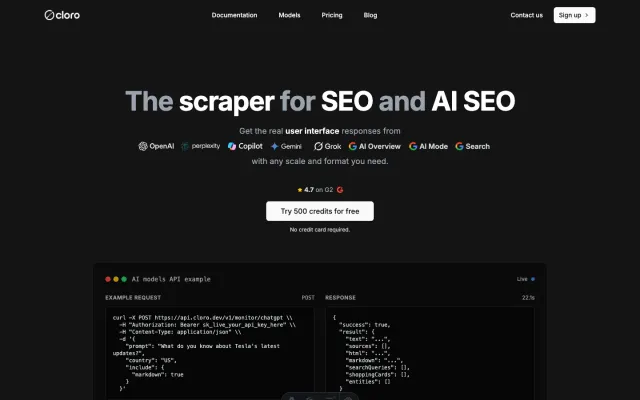
1. cloro: best for the live Google page and AI answers
cloro’s SERP API does a different job from the Semrush API. Semrush sells metrics about keywords, domains and links. cloro sells the search page itself: what Google shows a searcher right now, as structured JSON, with organic results, ads, People Also Ask, related searches and, for 2 more credits, the AI Overview with the sources it cites. Each request runs in a logged-out session, so the result is what an unauthenticated visitor sees in the country you set.
That fits rank tracking from the live page, tracking which sources the AI Overview cites, and monitoring what ChatGPT, Gemini, Copilot, Perplexity and Google AI Mode say about a brand, all on one key and one credit balance. It does not replace the metrics. cloro sells no keyword volume, keyword difficulty or backlink data, so a team that needs both pairs it with a metrics API below, or keeps Semrush for that part.
The trade is speed: about 7 seconds per Google request on average, in our own measurement over the 7 days to 2026-10-10. For batch rank checks, the async route returns results to a webhook, so the wait stops mattering. Agents can use the MCP server at https://mcp.cloro.dev/mcp, and code can use the Python and TypeScript SDKs.
Pricing: A Google search is 3 credits at 10 results, plus 2 for AI Overview and 2 per extra page, on the async route. A synchronous /v1/monitor/google call adds 2 credits. AI Mode, Gemini and Perplexity are 4 credits, Copilot 5, and ChatGPT 5 with web search or 7 for the full response. Lite is $30/month for 37,500 credits ($0.80 per 1,000 credits), Hobby $100 for 250,000 ($0.40), Growth $500 for 1,350,000 ($0.37), and self-serve plans go down to $0.305 per 1,000 credits on Enterprise 5,000, with $0.25 on a custom contract. The Free plan carries 500 credits a month with no card. See the pricing page.
Pros
- Returns Google's live results page as JSON, by country.
- AI Overview with its cited sources, and People Also Ask, parsed.
- ChatGPT, Gemini, Copilot, Perplexity and Google AI Mode under the same key.
- Every rate is public: $1.20 per 1,000 Google searches on Hobby.
Cons
- Does not sell keyword volume, keyword difficulty or backlink data.
- Each request is a live read, so you store results to see trends over time.
- About 7 seconds per Google request, by our own measurement.
02
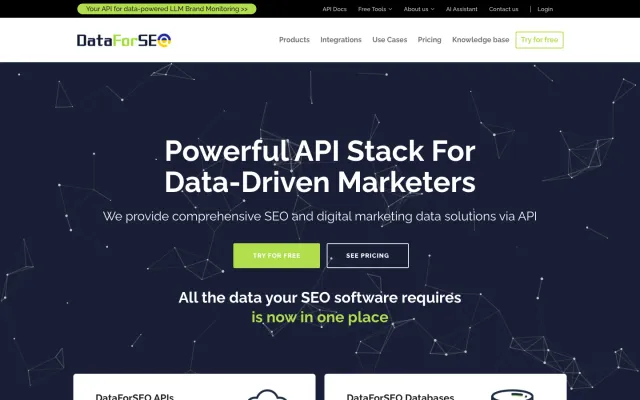
2. DataForSEO: best for pay-as-you-go keyword, SERP and backlink data
DataForSEO is the closest match to Semrush’s breadth on a pay-as-you-go model, and every Live price is on its site, so you can cost a job before you sign up. A Google Ads keyword task takes up to 1,000 keywords for $0.09, which DataForSEO prices at $90 per million keywords (Keywords Data pricing). Its Labs endpoints, which cover keyword and domain research, run Live only at $0.012 per task plus $0.00012 per item, so a call that returns 1,000 items costs $0.132 by our sum (Labs pricing). Backlinks are $0.024 per task plus $0.000036 per row, or $0.060 for 1,000 rows by our sum (Backlinks pricing).
It also sells the live page. A Live Google SERP of up to 10 results is $2.00 per 1,000, and each extra 10 results adds one base price, so a top-100 pull is $20 per 1,000 queries by our sum. Our DataForSEO alternatives page compares its SERP API with cloro’s on depth and AI Overview cost.
Pricing: Google Organic SERP Live $2.00 per 1,000 SERPs; Keywords Data (Google Ads) $0.09 per task; Labs $0.012 per task plus $0.00012 per item; Backlinks $0.024 per task plus $0.000036 per row. The minimum top-up is $50, and new accounts get a $1 trial credit (DataForSEO pricing).
Pros
- Every Live rate is public, per SERP, task, item or row.
- Live SERPs and keyword and backlink data in one account.
- No subscription: a $50 minimum top-up and a $1 trial credit.
- Up to 1,000 keywords in one Google Ads task for $0.09.
Cons
- Each API bills in its own unit, so every job needs its own sum.
- Each extra 10 results bills as another SERP.
03
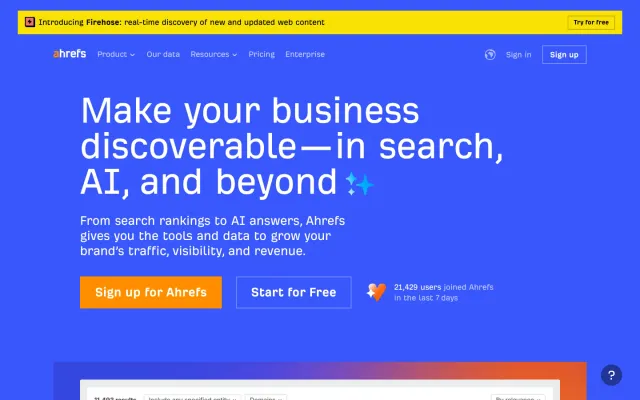
3. Ahrefs API: best for an SEO suite API with public plan limits
The Ahrefs API is the nearest like-for-like swap: another SEO suite’s keyword, site and backlink data, with its limits on a public page. Ahrefs’ API changelog for May 13, 2026 reads “Direct API access opened up for Lite+ plans!”, and its help center says new applications need Lite or higher. At least one explainer that ranks for Ahrefs API pricing still says the API needs Enterprise.
| Plan | Price | API units a month | Rows per request |
|---|---|---|---|
| Lite | $129 | 200,000 | 100 |
| Standard | $249 | 800,000 | 250 |
| Advanced | $449 | 2,000,000 | 500 |
| Enterprise | $1,499 | “4M, Custom” on the SEO API page, “Custom” in the help center | Unlimited |
The SEO API page does not say whether these prices assume monthly or annual billing.
Units work differently from Semrush’s lines. Per the limits docs, a request costs max(base_cost, per_row_cost * num_rows). The base cost is 50 units, and each field you request adds 1 unit per row by default, or 5 or 10 for some fields. Ahrefs’ own example: a backlinks request with title, traffic and refdomains_source costs 12 units a row, so 500 rows cost 6,000 units. On Lite, 200,000 units cover at most 4,000 minimum-cost requests a month (our arithmetic). Requests served from cache cost nothing, and the default rate limit is 60 requests a minute.
cloro’s own team runs on the Ahrefs Lite plan and logs the cost of every call. On 2026-10-24, a Keywords Explorer overview of 16 keywords with volume, global volume and difficulty cost 496 units, or 31 a keyword, and domain ratings for 77 domains cost 77 units. Our Ahrefs API pricing page has the full unit log and what 200,000 units buys.
Pricing: Lite $129/month, Standard $249, Advanced $449, Enterprise $1,499, with API units and MCP access from Lite. On plans that support pay as you go, Ahrefs charges extra units automatically once the allowance runs out (Ahrefs API introduction).
Pros
- API access on every plan from Lite, $129 a month.
- Units and rows per request published for each plan.
- Rank Tracker, Management and Public endpoints use no units.
- Remote MCP server from Lite.
Cons
- Not on Ahrefs Free; Starter ($29 a month) has free test queries only.
- Rows per request capped by plan: 100 on Lite, 500 on Advanced.
- Some endpoints are Enterprise-only.
04
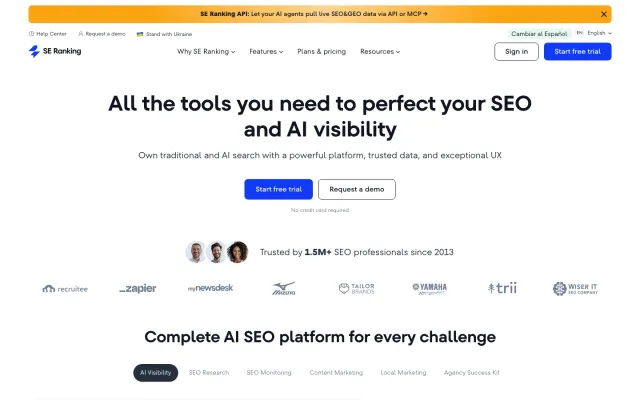
4. SE Ranking: best for API credits without a web app subscription
SE Ranking sells the same family of data as Semrush (keyword research, domain research and backlinks) plus website audit and an AI Search API, and it lets you buy credits without the SEO platform. Its API pricing page lists a Wallet at $50 for 250,000 credits, “Pay only for what you use without recurring fees”, with credits that never expire: $200 per million credits by our sum. A Standalone plan at $179 a month, billed annually, covers the Data API with “No web app subscription required.” Enterprise is custom, “as low as at $30/1M credits” by SE Ranking’s own figures.
Credits per call vary by endpoint. SE Ranking’s getting-started docs price a domain overview at 100 credits per request, a keyword export at 10 credits per record, and an AI search aggregated overview at 1,800 credits per request. On Wallet credits, exporting 1,000 keywords costs about $2 (our arithmetic).
The add-on for existing SE Ranking subscribers is priced differently on two of its pages. The API pricing page shows +$45 a month, billed annually, while the API overview page says “the API Add-On starts at $149/month”. Check the price at checkout before you budget.
Pricing: Free trial (14 days, 100,000 credits), Wallet $50 (250,000 credits), Standalone $179/month billed annually, add-on +$45/month on the API pricing page or from $149/month on the API overview page, Enterprise custom.
Pros
- Wallet credits never expire, per SE Ranking's pricing page.
- The Standalone plan sells the Data API with no web app subscription.
- 14-day free trial with 100,000 credits.
- MCP included on every plan, and failed requests are not charged.
Cons
- Its own pages disagree on the API add-on price.
- Standalone and the add-on are billed annually only.
05
5. Moz API: best for link and authority metrics on a small budget
Moz sells link and authority metrics, with keyword data, on a monthly row allowance. Every plan includes the same calls, from URL Metrics, Links and Brand Authority to Keyword Metrics, Search Intent and Ranking Keywords (Moz API pricing). “Rows are how we measure the cost of API requests,” Moz says, and the endpoint and parameters decide how many rows a call uses.
Per 1,000 rows, the plans work out at $6.67 on Starter medium, $5 on Starter large, $2.50 on Growth small, $2.08 on Growth medium and $1 on Growth large (our arithmetic). Overage is $5 per 1,000 extra rows on Starter large and $10 to $25 per 10,000 on the Growth plans. If you already pay for Moz Pro, note Moz’s line: “There is no paid access included in the Moz Pro subscription.”
Pricing: Free $0 (50 rows a month), Starter medium $20 (3,000 rows), Starter large $75 (15,000), Growth small $125 (50,000), Growth medium $250 (120,000), Growth large $500 (500,000), Enterprise custom.
Pros
- Plans from $20 a month for 3,000 rows.
- Free tier: 50 rows a month, one request every ten seconds.
- Every plan includes the same calls, from URL Metrics to Ranking Keywords.
Cons
- Billed apart from Moz Pro, which includes no paid API access.
- Small allowances at the low end: 3,000 rows on the $20 plan.
- MCP access is in beta.
Which Semrush API alternative to pick
Need Semrush's keyword, domain and backlink reports, and your plan already includes the API?
Stay on the Semrush API
Price the job in lines first: most reports cost 10 units per line.
Need the live Google page, AI Overview and People Also Ask included, or ChatGPT, Gemini and Copilot answers by country?
Need keyword, SERP and backlink data on published pay-as-you-go rates?
DataForSEO
Want another SEO suite's API, with the plan and unit allowance on a public page?
Ahrefs API
Want API credits without a web app subscription?
SE Ranking
Need link and authority metrics for $20 a month?
Moz API
Background
What the Semrush API sells today
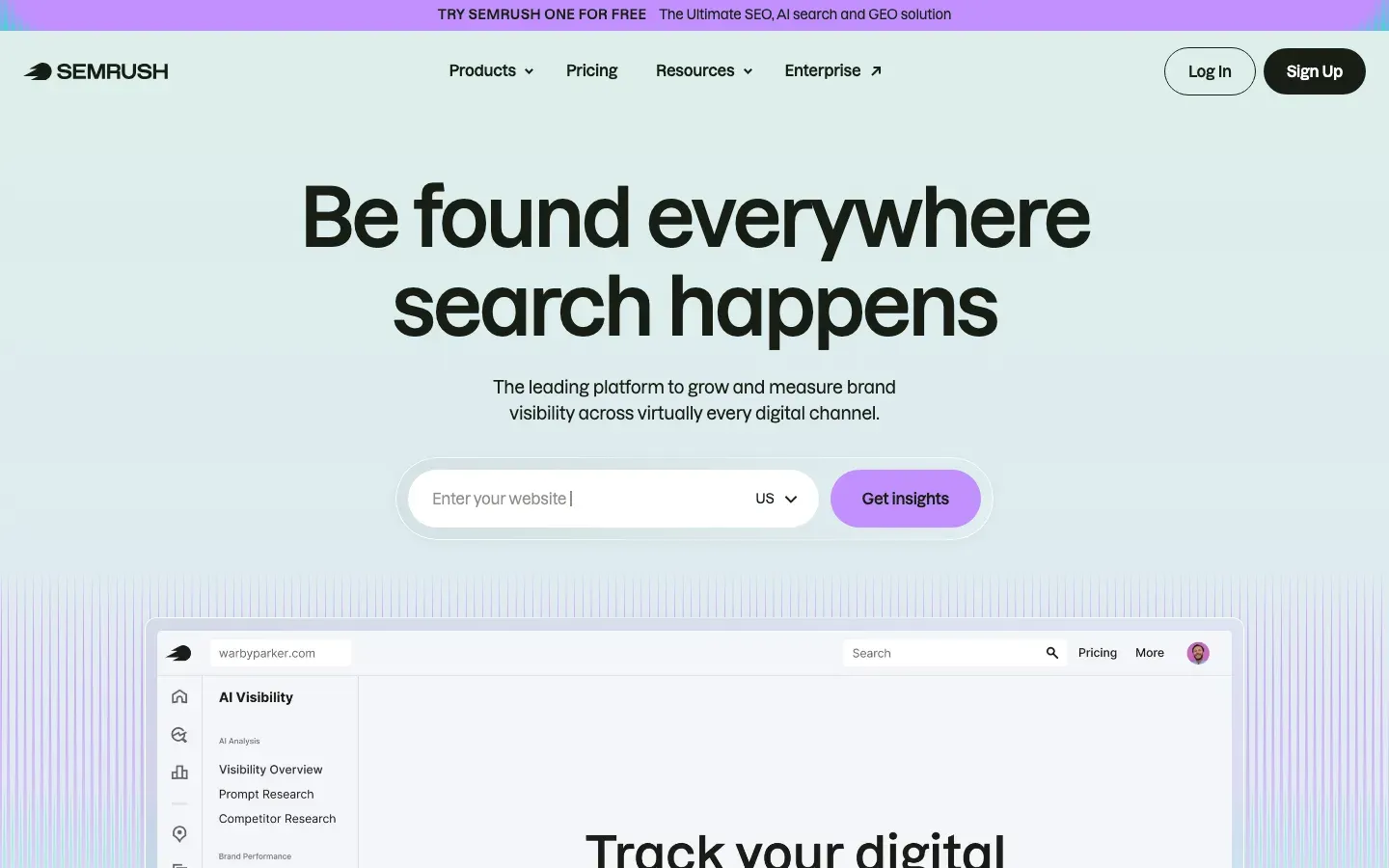
The pieces that matter to an API buyer, from Semrush’s API overview and knowledge base, read on 2026-10-24:
- Standard API, the domain, keyword and backlink reports, priced per line in units. v3 bills today, and v4 is in Early Access at v3 rates.
- Trends API, traffic and market data on a quarterly subscription, with its own request limit and units.
- MCP server, the same data for AI agents, drawing on the same units as the API.
Where the Semrush API earns its price
Each report page states its unit price for current and historical data, and the units guide works through an example. Empty results and the balance check are free. Historical data is available on most reports, which a live-only API cannot give you. If your product reports on keyword demand, a competitor’s rankings over time or link profiles, those are the reasons to stay.
Check the plan, the API version and the unit price before you buy
The plan gate differs between the docs and the pricing page, the v3 keyword endpoints are deprecated, and v4 pricing may change until General Availability. Some explainers that rank for “semrush api pricing” still print a dollar price for Advanced and a price per million units. Neither figure appears on the Semrush pages we read on 2026-10-24.
How we compared, and what these numbers rest on
The prices are the vendors’ own. Each rate comes from the vendor’s pricing page or docs, linked inline and read on 2026-10-24. Some of these sites show euro prices to visitors in Europe; every figure here is in US dollars. Prices change, so open the linked page before you commit.
Live rates only. DataForSEO also sells queued SERP modes. This page leaves their prices out, because every other rate here is real time.
Where a vendor’s pages disagree, we quote both. We left out two figures that do not fit the vendor’s own page: SE Ranking’s Standalone credit label, which does not square with its “Up to 57% off Wallet rates” line, and DataForSEO’s backlinks calculator total, which does not match its own per-task and per-row rates. Arithmetic marked “ours” is our sum from the vendor’s figures.
The 7-second figure is measured by us, for cloro, over the 7 days to 2026-10-10. We did not benchmark the other APIs’ speed or data quality. We read the live Google results for “semrush api pricing” and “semrush api alternatives” through cloro’s own API on 2026-10-24. None of the explainers ranking there treated live SERP, AI Overview or AI answer data as a separate need, which is why this page splits the question in two.
We make one of the products on this page. Ours is listed first because this is our site. The vendor links go to primary sources, so you can check our framing against them.
The bottom line
The Semrush API is priced in units by the line: most reports cost 10 units per line, units come in packages of 2 million to 20 million and expire at renewal, and the unit price is Custom (contact required). If you need Semrush’s keyword, domain and backlink reports and hold the plan that includes them, it remains a well-documented source. For the same data on published rates, DataForSEO is pay as you go, the Ahrefs API starts at $129 on Lite, SE Ranking sells credits without the platform and Moz starts at $20. If your job is the live Google page, AI Overview and People Also Ask included, or ChatGPT, Gemini and Copilot answers by country, cloro does it at $1.20 per 1,000 Google searches on Hobby, with 500 free credits a month to test on your own queries.
Keep the Semrush API if you need its keyword, domain and backlink reports and your plan already includes it. Price the job in lines first: most reports cost 10 units per line, and Semrush publishes no unit price. For the same family of data on public rates, DataForSEO is pay as you go and the Ahrefs API starts at $129 on Lite. If the job is the live Google page, AI Overview and People Also Ask included, or ChatGPT and Gemini answers by country, cloro does it at $1.20 per 1,000 Google searches on Hobby.
Try cloro freeFrequently asked questions
How much does the Semrush API cost?
Semrush publishes no price per API unit: Custom (contact required). Its knowledge base says units come in packages of 2,000,000, 5,000,000, 10,000,000 or 20,000,000, renewing with your plan, and you buy them on the logged-in Subscription Info page. Usage is priced per line: most domain and keyword reports cost 10 units per line, so 1,000 lines cost 10,000 units. You also need a plan that includes the API. Source: Semrush's API knowledge base and developer docs, read on 2026-10-24.
Which Semrush plan includes API access?
Semrush's pages disagree. The developer docs and knowledge base say the Standard API is an add-on to the Business tier of the SEO Toolkit, and that your unit balance is still zero after you upgrade. The pricing page lists SEO ($139 a month), Starter ($199) and Pro+ ($299), shows no Business plan, and puts API access on Advanced, priced as Custom. Starter lists MCP access. Check which plan your account is on before you budget.
Do unused Semrush API units roll over?
No. Semrush's knowledge base says purchased units renew on the same day as your plan, and 'Unused units will expire instead of being added to the renewed amount.' Requests that return no data do not consume units, and checking your balance is a free request.
Is the Semrush MCP server free?
No. Semrush's MCP page says 'No, Semrush MCP isn't free.' Semrush One Starter, Semrush One Pro+, SEO Classic Pro and SEO Classic Guru include 50,000 API units for it, refreshed at renewal. SEO Classic Business and Semrush One Advanced need an API units package. The server runs at `https://mcp.semrush.com/v2/mcp` and uses OAuth by default.
What is the best Semrush API alternative?
It depends on the data. For keyword, SERP and backlink data on published pay-as-you-go rates, DataForSEO: a Live Google SERP is $2.00 per 1,000 and a Google Ads keyword task of up to 1,000 keywords is $0.09. For another SEO suite's API with public limits, the Ahrefs API from $129 a month on Lite. For the live Google page with AI Overview and People Also Ask, or ChatGPT, Gemini and Copilot answers, cloro at $1.20 per 1,000 Google searches on Hobby. For link and authority metrics on a small budget, Moz from $20 a month.
Does the Ahrefs API still need an Enterprise plan?
No. Ahrefs' API changelog says direct API access opened to Lite and higher plans on May 13, 2026, and its help center says new applications need Lite or higher. Lite is $129 a month with 200,000 API units and 100 rows per request. Ahrefs Free has no API access, and Starter ($29 a month) includes free test queries only.
How much does the Semrush Trends API cost?
Semrush shows no public price for it: Custom (contact required). The Trends API comes in Basic and Premium plans, is sold as a quarterly subscription, has a default limit of 10,000 requests a month at up to 10 requests per second, and uses its own units rather than the Standard API balance. Semrush says it offers no free Trends API trial.
Related comparisons
Each page maps cloro's SERP API against one alternative on pricing, AI Overview coverage, and developer experience.
- Ahrefs API alternatives
- Apify alternatives
- Brave Search API alternatives
- Bright Data alternatives
- DataForSEO alternatives
- Exa alternatives
- Firecrawl alternatives
- Oxylabs alternatives
- Perplexity API alternatives
- ScrapeDO alternatives
- ScraperAPI alternatives
- ScrapingBee alternatives
- SearchApi alternatives
- SerpAPI alternatives
- Serper alternatives
- Tavily alternatives
- All comparisons