
Exa alternatives
Exa Pricing and 6 Exa Alternatives Compared (2026)
Exa pricing runs $4 to $15 per 1,000 searches, plus $1 per result past 10. We compare 6 Exa alternatives on live price, free allowance and output.
4.7 · 66 reviews
- cloro price
- $1.20 per 1,000 Google searches (Hobby, async)
- Exa price
- $4 (Lite) to $7 (Auto) per 1,000 searches, up to 10 results
On this page
cloro vs Exa
A check marks the stronger side of a row. A row with no check is a difference, not a win.
| cloro | Exa | |
|---|---|---|
| Starting price | $1.20 per 1,000 Google searches (Hobby, async) | $4 (Lite) to $7 (Auto) per 1,000 searches, up to 10 results |
| Key advantage | The live Google page as JSON, plus AI answer engines | Its own index, searched by meaning, with page contents |
| Price per 1,000 searches (10 results) | $1.20 on Hobby, about $0.92 on the largest self-serve tier | $4 on Lite, $7 on Auto, $12 on Deep |
| Going past 10 results | 2 credits per extra results page ($0.80 per 1,000 pages on Hobby) | $1 per 1,000 for each result past 10 |
| Monthly free allowance | 500 credits, about 166 Google searches | $10 credit, up to 2,500 Lite searches |
| Index | Google's live results page | Exa's own index, searched by meaning |
| AI Overview and People Also Ask | Parsed, with cited sources | None returned in our 500-query test |
| Page text in the response | Snippets and AI Overview text, not the pages behind the results | Full text, highlights or a summary per result |
| Response time | About 7 seconds per Google request (measured) | About 1 second on Auto, by Exa's own figures |
| AI answer engines | ChatGPT, Gemini, Copilot, Perplexity, Google AI Mode | Exa's own Answer endpoint, $5 per 1,000 |
| Rate limit | 1 to 255 concurrent requests, by plan | 10 QPS on search, 25 QPS after $1,000 of credits in 30 days |
Why teams switch from Exa
- 01
The $7 rate covers 10 results
Exa's Auto search is $7 per 1,000 requests for up to 10 results, and each result past 10 adds $1 per 1,000. A 25-result search therefore costs $22 per 1,000, before any AI page summaries. cloro prices a Google search at 3 credits, $1.20 per 1,000 on Hobby, and each extra results page adds 2 credits, so a three-page search is 7 credits, or $2.80 per 1,000.
- 02
Exa returns a different web from Google
Exa retrieves by meaning from its own index, which is the point of the product. In our 500-query test only 32.3% of Exa's top-10 URLs were in Google's top 10, and Exa returned none of Google's AI Overview (on 64% of queries) or People Also Ask (77%). cloro returns Google's live results page as JSON, so a rank tracker or AI Overview monitor measures the page searchers see.
- 03
AI answers are a second data source
Exa's Answer endpoint writes Exa's own cited answer, at $5 per 1,000 requests. If your product reports what ChatGPT, Gemini, Copilot or Perplexity tell a visitor, you need those engines' answers instead. cloro returns them, plus Google AI Mode, under the same key and credit balance as Google Search, so a new surface does not mean a new contract.
Exa AI pricing is pay as you go. Search costs $4 per 1,000 requests on lite, $7 on auto (the default) and $12 on deep, each with up to 10 results, and every result past 10 adds $1 per 1,000. Answer, Contents, Agent and Websets have prices of their own. Those are the rates on Exa’s pricing page, read on 2026-10-24, and the free tier is $10 of credit a month.
The six Exa alternatives on this page are cloro, Tavily, Parallel, the Perplexity Search API, Linkup and Brave. Parallel and Perplexity go as low as $1 per 1,000 in their fast modes. Tavily returned the most Google-like sources in our 500-query test. cloro is the one that returns Google’s live results page and the answers of ChatGPT, Gemini, Copilot and Perplexity, at $1.20 per 1,000 Google searches on Hobby.
Exa is a strong product: it retrieves pages by meaning and can return their text in the same call. The alternatives win on price, on closeness to Google, or on data from Google and the AI answer engines.
The 6 best Exa alternatives at a glance
The best Exa alternative for an AI agent’s search tool is Tavily, which returned the most Google-like sources in our test, and the best for Google’s live page and AI answer engines is cloro. Parallel and the Perplexity Search API are the cheapest at $1 per 1,000 in their fast modes, Linkup prices sourced answers per call, and Brave sells an independent index at a flat $5.
| Tool | What it returns | Live price per 1,000 searches | Free allowance | Google page features |
|---|---|---|---|---|
| cloro | Google’s live results page, plus AI answer engines | $1.20 (Hobby), about $0.92 at the top self-serve tier | 500 credits a month | Yes, parsed |
| Tavily | Search results plus a generated answer | $8 pay as you go, $5 on Growth | 1,000 credits a month | None in our test |
| Parallel | Ranked URLs with compressed excerpts | $1 (Turbo, Fast) to $5 (Basic, Advanced) | 5,000 requests a month | Not tested |
| Perplexity Search API | Ranked web results, each one dated | $5, or $1 on Fast Search | Not checked | None in our test |
| Linkup | Search results or a sourced answer | $5 (standard), $50 (deep) | $20 credit a month (work email) | Not tested |
| Brave Search API | Brave’s own web index | $5 | $5 credit a month | None in our test |
| Exa (incumbent) | Its own index, searched by meaning | $4 (Lite) to $7 (Auto) | $10 credit a month | None in our test |
The first question is whether you need search built for AI or Google’s page. Five of the six sit beside Exa as AI search APIs, and cloro returns what Google ranks and what AI answer engines say.
Exa pricing: $4 to $15 per 1,000 searches, before extras
Exa search costs $4 per 1,000 requests on lite, $7 on auto, $12 on deep-lite and deep, and $15 on the legacy deep-reasoning type. Every type includes up to 10 results in its base price, and Exa bills per request from prepaid credits, with no subscription for the API. These are the live rates on Exa’s pricing page and its pricing docs, read on 2026-10-24:
| Search type | Price per 1,000 requests (up to 10 results) | Latency, by Exa’s own figures | Status |
|---|---|---|---|
lite | $4 | About 450 ms | Added 2026-10-19 |
auto | $7 | About 1 second | Default |
deep-lite | $12 | About 4 seconds | Current |
deep | $12 | 4 to 15 seconds | Current |
instant | $4 | Not stated | Legacy, use lite |
fast | $7 | Not stated | Legacy, use lite |
deep-reasoning | $15 | 12 to 40 seconds | Legacy, use deep |
So in everyday use, Exa AI pricing comes to $7 per 1,000 on auto, or $0.007 a call, and lite cuts that to $4. Legacy types keep their prices, so an integration still on fast pays $7.
lite has one trade worth knowing before you switch. By Exa’s changelog, it “serves page content from Exa’s cache and never fetches a page live.” The other types accept maxAgeHours, where 0 always fetches fresh content. If your agent needs pages fetched live, for news or prices, that is a reason to pay $7 rather than $4.
Each result past 10 adds $1 per 1,000
The base price covers 10 results. Every result above that costs $1 per 1,000 results, and numResults goes up to 100 on the public API. Here is what that does to a 25-result auto search, per 1,000 searches:
- Base price: $7.00
- 15 extra results x 1,000 searches x $1 per 1,000 results: $15.00
- Total: $22.00 per 1,000 searches, more than three times the headline rate
At 100 results the same arithmetic gives $7 + $90 = $97 per 1,000, so set numResults to what the model actually reads.
Contents, Answer and Agent have their own prices
Exa sells more than search, and each endpoint bills separately (pricing docs):
- Contents (
/contents): $1 per 1,000 pages, per content type. Exa’s price list says “one page withtextandhighlightscounts as two.” AI page summaries are another $1 per 1,000 pages. - Contents on search results: Exa’s price list charges
/searchfor results past 10 and for AI page summaries. It lists no separate line for text or highlights on/search. Check thecostDollarsfield in a few real responses to see what your calls cost. - Answer (
/answer): $5 per 1,000 requests. It runs a search and returns Exa’s own answer with citations. - Agent: $0.012 to $1.00 per run at a fixed effort level, or metered at $0.10 per Agent Compute Unit.
- Websets: a separate subscription with its own credits. Starter is $49 a month for 8,000 credits and Pro is $449 for 100,000 (Websets billing).
The Research endpoint was retired in April 2026
Older Exa pricing guides still list a Research API. It is gone. Exa’s changelog records that on 2026-04-01 the /research endpoint was “replaced by /search with type: "deep-reasoning",” which costs $15 per 1,000. Exa now marks deep-reasoning as legacy too, and points multi-step research to the Agent API.
The free tier is $10 a month, and search runs at 10 QPS
Exa’s free tier is $10 of credit that “resets to $10 on the first of every month,” which Exa says covers up to 2,500 lite searches. On auto the same $10 buys about 1,428 searches. The first team also gets a one-time $10 bonus, and you do not need a payment method to start.
The default rate limits are shared across a team’s keys: 10 QPS on /search and /answer, 5 QPS for the deep types, 100 QPS on /contents, and 20 QPS on Websets. Pay-as-you-go accounts can reach 25 QPS: “Add $1,000 in credits within any 30-day window and your team’s rate limit rises to 25 QPS for 90 days, automatically.” Above that, Exa asks you to talk to sales. Enterprise adds custom QPS, up to 1,000 results per search, volume discounts and postpaid billing, on a quote.
The takeaway: Exa’s per-search price is predictable on lite and auto at 10 results. The bill grows with result depth, summaries and deep types, and the 10 QPS default is the limit a production agent meets first.
How Exa pricing compares with the alternatives
Every figure below is the real-time rate from the vendor’s own pricing page, read on 2026-10-24. None is a queued or batch rate.
| Vendor | Unit | Entry rate per 1,000 | Lowest listed rate per 1,000 | Notes |
|---|---|---|---|---|
| Exa | Search, up to 10 results | $7.00 (Auto) | $4.00 (Lite) | $1 per 1,000 for each result past 10 |
| cloro | Google search (3 credits) | $2.40 (Lite) | $0.92 (Enterprise 5,000), $0.75 custom | AI Overview adds 2 credits |
| Tavily | Basic search (1 credit) | $8.00 | $5.00 (Growth, $500/month) | Advanced search is 2 credits |
| Parallel | Request with 10 results | $5.00 (Basic, Advanced) | $1.00 (Turbo, Fast) | $1 per 1,000 extra results |
| Perplexity Search API | Successful request | $5.00 | $1.00 (Fast Search) | Billed per successful request |
| Linkup | Call, search results output | $5.00 (standard) | $5.00 (fast or standard) | Deep search is $50 |
| Brave Search API | Request | $5.00 | $5.00 | Enterprise on request |
What the table says:
- Exa’s
autorate of $7 sits above Brave, Linkup, Perplexity and Parallel Basic at $5, and below only Tavily’s pay-as-you-go $8. Exaliteat $4 undercuts the $5 group, but Parallel’s Turbo and Fast modes and Perplexity’s Fast Search are $1. - Result depth changes the order. Exa and Parallel both charge $1 per 1,000 for each result past 10, so a 25-result search costs $22 on Exa
autoand $20 on Parallel Basic. - cloro is the only option here that returns the Google page, at $1.20 per 1,000 on Hobby, below every rate in the table except the $1 fast modes.
For the price view across Google SERP APIs, see the cheapest SERP API in 2026.
The 6 Exa alternatives, compared
The best Exa alternatives are cloro for the live Google page and AI answer engines, Tavily for agent search close to Google’s sources, Parallel for the lowest per-request rate, the Perplexity Search API for dated results, Linkup for sourced answers at a flat price per call, and Brave for an independent index at $5 per 1,000.
01
1. cloro: best for the live Google page and AI answer engines
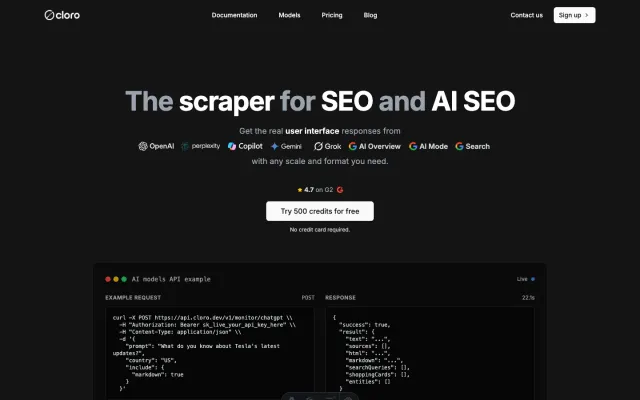
cloro’s SERP API answers a different question from Exa. Exa tells you which pages in its own index match the meaning of a query. cloro tells you what Google shows a searcher right now, as structured JSON: organic results, ads, People Also Ask, related searches and, for 2 more credits, the AI Overview with the sources it cites. Each request runs in logged-out sessions, so the result is what an unauthenticated visitor sees, by country.
That matters when the product reports on Google. In our 500-query test, only 32.3% of Exa’s top-10 URLs were also in Google’s top 10, and Exa surfaced 2,396 distinct domains against Google’s 1,691. For rank tracking, SEO reporting or AI Overview monitoring, an Exa feed measures a different web from the one your users search.
The same key reaches ChatGPT, Gemini, Copilot, Perplexity, Google AI Mode and Google News, so a team that tracks brand visibility in AI answers gets those engines and Google under one credit balance. cloro also runs an MCP server at https://mcp.cloro.dev/mcp, with Python and TypeScript SDKs, so an agent that called Exa through MCP can call cloro the same way (MCP setup).
The trade is speed and page text. A Google request averaged about 7 seconds in our measurement over the 7 days to 2026-10-10, against about 1 second for Exa auto by Exa’s figures. For batch work, send queries to POST /v1/async/task with a webhook and the wait stops mattering. And cloro does not fetch the pages behind the results, so a RAG pipeline that needs full page text still needs an extraction step.
Pricing: A Google search is 3 credits at 10 results, plus 2 credits for AI Overview and 2 per extra results page, on the async route. AI Mode and Gemini are 4 credits, Perplexity 4, Copilot 5, and ChatGPT 5 (web search) or 7 (full response). A synchronous /v1/monitor/* call adds 2 credits. Lite is $30/month for 37,500 credits ($0.80 per 1,000 credits), Hobby is $100/month for 250,000 ($0.40), and self-serve plans go down to $0.305 per 1,000 credits on Enterprise 5,000 (16,391,783 credits), with $0.25 on a custom contract. Free carries 500 credits a month. See the pricing page.
Pros
- Returns Google's actual results page as JSON.
- AI Overview and People Also Ask parsed, with cited sources.
- ChatGPT, Gemini, Copilot, Perplexity and Google AI Mode under the same key.
- $1.20 per 1,000 Google searches on Hobby, less at volume.
Cons
- Slower than Exa: about 7 seconds per Google request.
- Returns the results page, not the text of the pages behind it.
- Smaller free allowance than Exa's $10 credit.
02
2. Tavily: best for agent search close to Google's sources
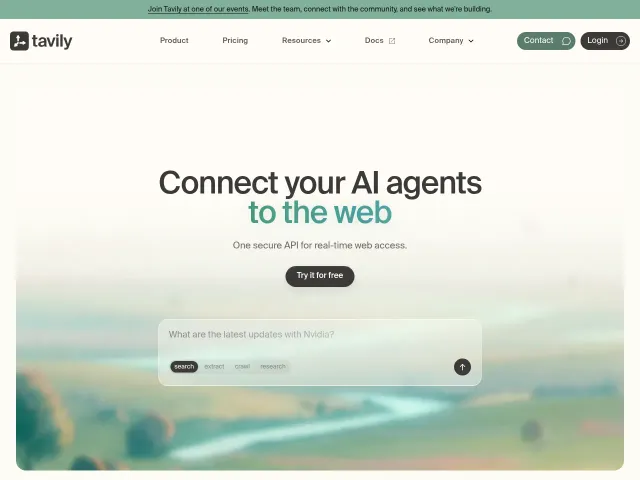
Tavily is the closest swap for an Exa agent tool when you want results nearer the mainstream web. In our 500-query study, Tavily’s top 10 shared about 80% of Google’s top-10 domains and about 60% of the exact URLs, the most of any independent API we measured. Exa shared about 44% of the domains. Tavily’s rank correlation with Google was near zero (0.03), though, so it returns Google’s sources in its own order. It was also the only API in that test to return a generated answer by default, on 99.6% of queries. Tavily vs Google Search covers that reordering in full.
So the choice is mostly about the results you want: Exa finds pages by meaning, including ones Google ranks low, and Tavily returns the well-known sources for a query. On price, a basic search is $8 per 1,000 on pay as you go, against Exa auto at $7, and $5 on the $500 Growth plan, still above Exa lite.
Pricing: Researcher free (1,000 credits a month), Project $30/month (4,000 credits), Bootstrap $100 (15,000), Startup $220 (38,000), Growth $500 (100,000), pay as you go $0.008 per credit; basic search 1 credit, advanced 2 (Tavily credits and pricing).
Pros
- About 80% of Google's top-10 domains in our 500-query test.
- 1,000 free credits a month, no credit card.
- Extract, map, crawl and research endpoints beside search.
Cons
- $8 per 1,000 basic searches on pay as you go, above Exa's $7.
- Advanced search costs 2 credits per request.
- Returns Google's sources in its own order, with no Google page features.
03
3. Parallel: best for the lowest per-request rate
Parallel prices its Search API by mode, each with 10 results in the base rate. Turbo and Fast are $1 per 1,000 requests, and Basic and Advanced are $5. By Parallel’s own figures, Turbo answers in about 200 ms, Fast in about 700 ms, Basic in about 1 second and Advanced in about 3 seconds.
The pricing has the same shape as Exa’s: a per-request rate for 10 results, plus $1 per 1,000 for each extra result. At 10 results, Parallel Fast is a quarter of Exa lite. At 25 results, Parallel Basic is $20 per 1,000 against $22 for Exa auto.
Parallel also sells an Extract API at $1 per 1,000 results. We have not run Parallel through our overlap test, so we cannot say how close its results sit to Google’s.
Pricing: Search $1 (Turbo, Fast) or $5 (Basic, Advanced) per 1,000 requests with 10 results; $1 per 1,000 extra results; up to 5,000 free requests a month; 600 requests a minute (Parallel pricing).
Pros
- Turbo and Fast modes at $1 per 1,000 requests with 10 results.
- Up to 5,000 free requests a month.
- 600 search requests a minute.
Cons
- Basic and Advanced modes are $5 per 1,000.
- Each result past 10 adds $1 per 1,000, as on Exa.
- Not in our 500-query overlap test.
04
4. Perplexity Search API: best for dated results and a $1 fast mode
The Perplexity Search API is a ranked-results endpoint, not the Perplexity answer engine people use in the app. It costs $5 per 1,000 requests, and Fast Search (search_type: "fast") costs $1. Perplexity bills “each successful POST /search request, not for each query in the request,” so failed and rate-limited calls cost nothing.
In our 500-query study it sat in the middle on Google overlap: it recalled about half of Google’s top-10 domains (49%) and kept Google’s order moderately well (rank correlation 0.43). It also dated essentially every result, which helps an agent filter by freshness, so it is a fair Exa alternative when dates matter more than discovery. Perplexity Search API vs Google has the full comparison.
If what you need is the answer Perplexity gives a visitor, with its citations, that is a different product. cloro’s Perplexity endpoint returns that answer for 4 credits a request.
Pricing: Search API $5.00 per 1,000 requests, Fast Search $1.00; failed requests are not billed (Perplexity pricing).
Pros
- $5 per 1,000 requests, or $1 on Fast Search.
- Billed per successful request, not per query in it.
- A date on every result in our test.
Cons
- Ranked results only, not the Perplexity answer engine.
- Results skewed older in our test, median age about 277 days.
05
5. Linkup: best for sourced answers at a flat price per call
Linkup prices per call, by search depth and output type. A fast or standard search that returns searchResults is $0.005, or $5 per 1,000. Asking for a sourcedAnswer or a structured output instead is $0.006. The deep depth is $0.05 a call for results and $0.055 for an answer, so $50 to $55 per 1,000.
Against Exa, Linkup costs less for plain results and more for answers. Its standard search is $5 per 1,000 against $7 for Exa auto, and its sourced answer is $6 per 1,000 against $5 for Exa’s Answer endpoint.
Linkup’s docs say a new account on a professional email gets $20 of credit, topped back up to $20 each month, which the pricing page puts at 4,000 queries. We have not measured Linkup’s overlap with Google.
Pricing: Search $0.005 to $0.006 per call (fast or standard), $0.05 to $0.055 (deep); Fetch $0.001 to $0.011; $20 a month free for eligible accounts; Enterprise custom (Linkup pricing).
Pros
- $5 per 1,000 for search results, $6 with a sourced answer.
- $20 of free credit a month for accounts on a work email.
- A Fetch endpoint from $0.001 per call.
Cons
- Deep search is $50 per 1,000.
- Not in our 500-query overlap test.
06
6. Brave Search API: best for an independent index at a flat $5
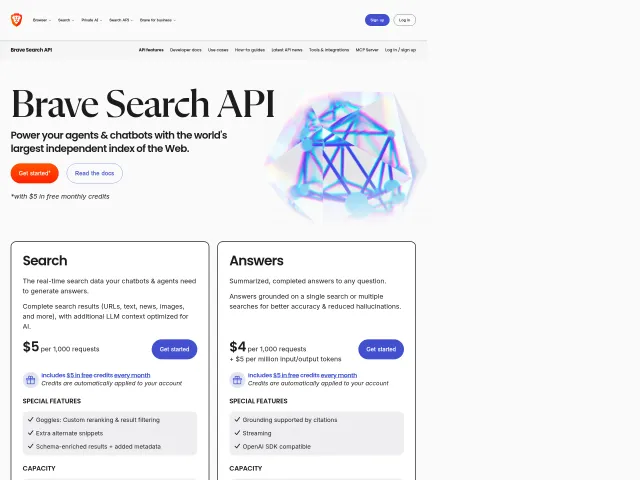
The Brave Search API searches Brave’s own index and is the simplest to price on this page: $5 per 1,000 requests, with $5 of credit applied every month.
Where Exa searches by meaning, Brave ranks more like Google does. In our 500-query study, Brave kept Google’s order best of the independent APIs (rank correlation 0.55), and its first result came from a domain Google also ranked 89% of the time. That makes it the safer swap when an agent should see roughly what a search engine ranks. Our Brave Search API alternatives page covers Brave’s plans and limits in detail.
Pricing: Search $5 per 1,000 requests with $5 of free credit a month; Answers $4 per 1,000 plus $5 per million tokens; up to 50 queries per second; Enterprise on request (Brave Search API).
Pros
- $5 per 1,000 requests at every volume.
- $5 of free credit every month.
- 50 queries per second on Search.
Cons
- Costs more than Exa lite at $4.
- No Google page features in our test.
Which Exa alternative to pick
Need retrieval by meaning, with page text in the same call?
Stay on Exa
Use lite at $4 per 1,000 when cached content is fresh enough.
Need what Google shows, AI Overview and People Also Ask included, or answers from ChatGPT, Gemini, Copilot and Perplexity?
Want agent search that returns the mainstream sources for a query?
Tavily
Want the lowest rate per request on an AI search index?
Parallel
Need a date on every result, or a $1 fast mode?
Perplexity Search API
Want a sourced answer and its search in one call at a flat price?
Linkup
Want an independent index that ranks close to Google, at a flat $5?
Brave Search API
Background
What Exa sells today
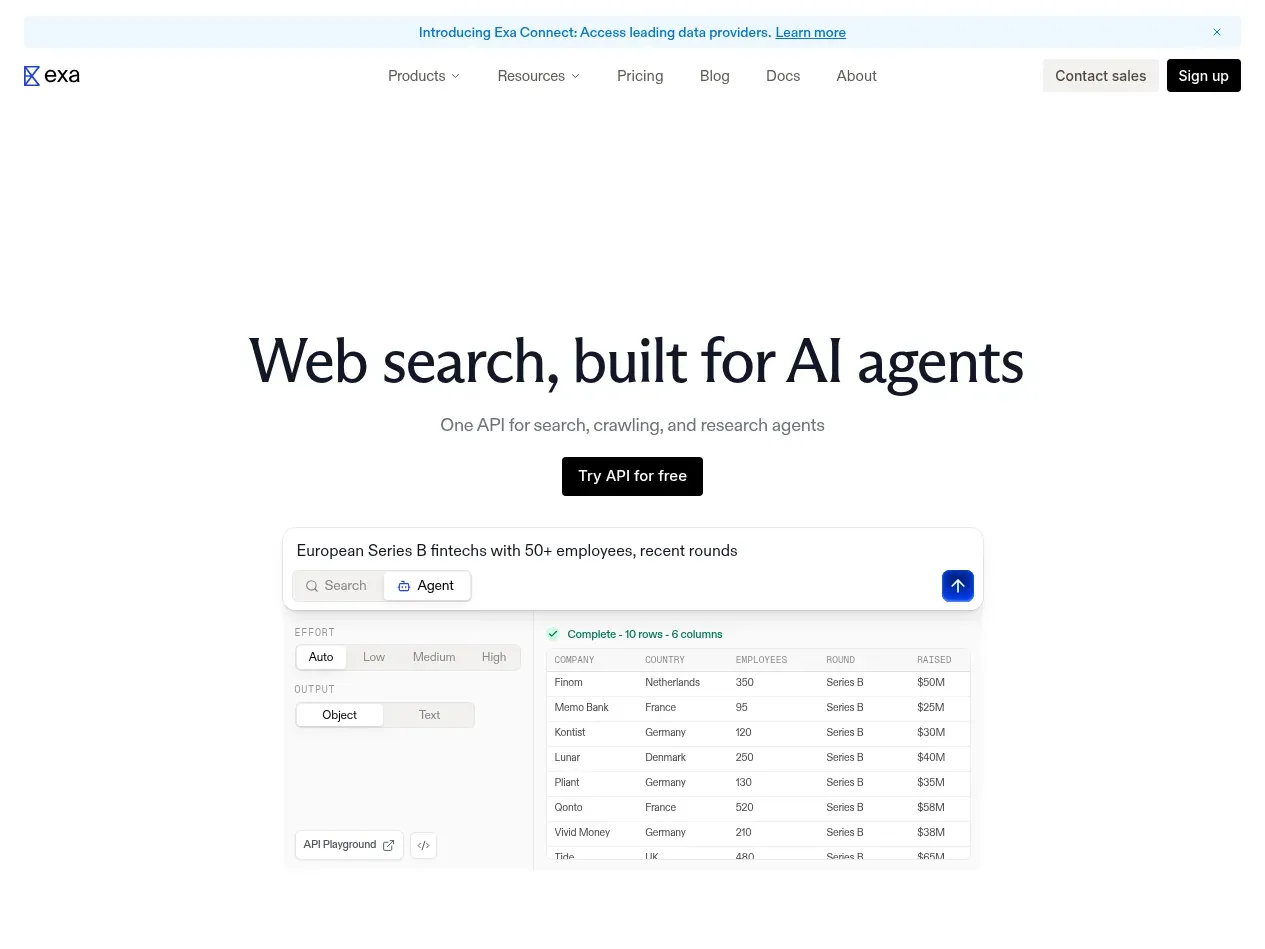
Exa sells search over its own index, plus Contents, Answer, Monitors, Agent and Websets endpoints built on it. Its FAQ puts the pitch in one line: “Exa Search is built for programmatic retrieval rather than ad-driven browsing.” Exa’s About page says the search is “designed specifically to handle non-keyword natural-language queries.”
A search returns 10 results by default and up to 100, with no pagination. Every result carries title, url and publishedDate, and you can ask for text, highlights or a summary per result, or narrow the search to a category such as company, people or news.
For developers, Exa ships official SDKs for Python (exa-py) and JavaScript (exa-js), and an MCP server at https://mcp.exa.ai/mcp. The MCP server needs no API key to start, and its default tools are web_search_exa and web_fetch_exa. Its integrations include LangChain, LlamaIndex and n8n.
Where Exa earns its price
Exa retrieves by meaning. Ask it for “companies like X” or “papers that argue Y” and it can match pages that share few of the query’s words. The result can carry the page text, so an agent gets sources and content in one call instead of a search and then a scrape. The maxAgeHours setting controls how old the cached copy may be. Category filters cover company and people search, and Websets turns a query into a verified, enriched list.
Exa also publishes benchmark results on its homepage, against Perplexity, Brave and Parallel, under the heading “Exa leads across benchmarks.” Those are Exa’s own figures, and we have not re-run them.
Where Exa’s index stops
Exa is not reading Google, so it cannot return Google’s page. In Exa vs Google Search, our 500-query comparison, Exa’s top result came from a domain Google also ranked 67.8% of the time, so the very top is close. Below that the lists diverge, and 62% of the domains Exa surfaced never appeared in Google’s top 10. Exa returned none of Google’s AI Overview (on 64% of queries), People Also Ask (77%) or shopping units (14%).
For discovery and research, that divergence is why you pay for Exa. For rank tracking or AI Overview monitoring, the missing blocks are the data the product sells.
How we compared, and what these numbers rest on
The prices are the vendors’ own. Each rate comes from the vendor’s pricing page or pricing docs, linked inline and read on 2026-10-24. Every rate is the real-time one. Prices change, so open the linked page before you commit.
The overlap figures are measured by us. The Google-overlap figures for Exa, Tavily, the Perplexity Search API and Brave come from one 500-query run through each API and through cloro’s live Google SERP on the same day, written up in the 500-query search API study. Parallel and Linkup were not part of that run, so this page makes no overlap claim for them.
Speed figures are the vendors’ own, except cloro’s. We did not benchmark Exa’s or Parallel’s latency. The 7-second figure for cloro is our measurement over the 7 days to 2026-10-10.
Why these six. We picked APIs an Exa user would swap in for search: four AI search APIs priced per request, Brave as the independent index, and cloro for the Google page. We also priced options the other Exa roundups name. Firecrawl charges 2 credits per 10 search results, which is $7.60 per 1,000 searches on its $19 Hobby plan and $1.98 on its $99 Standard plan. Valyu bills per result, about $0.63 per 1,000 web results, so $3.15 per 1,000 searches at its default of 5 results. You.com’s Web Search API is $5 per 1,000 calls. Google SERP APIs such as Serper ($1.00 per 1,000 on its smallest pack) and SerpApi ($25 for 1,000 on Starter) have their own pages: Serper alternatives and SerpApi alternatives.
We make one of the products on this page. Ours is listed first because this is our site. The measurements are reproducible and the vendor links go to primary sources, so you can check our framing against both.
The bottom line
Exa pricing is simple at the headline: $4 per 1,000 searches on lite and $7 on auto, with $10 of free credit a month, and the bill grows by $1 per 1,000 for every result past 10. For retrieval by meaning with page text in one call, Exa is still a sound choice, and the AI search alternatives cost $1 to $8 per 1,000. If what you need is Google’s page, AI Overview and People Also Ask included, or the answers ChatGPT, Gemini, Copilot and Perplexity give, cloro returns them through one key at $1.20 per 1,000 Google searches on Hobby, with 500 free credits a month to test it on your own queries.
Keep Exa if your agent needs retrieval by meaning with page text in the same call, and $4 to $7 per 1,000 searches fits the budget. Move to cloro if you need what Google actually shows, AI Overview and People Also Ask included, or the answers ChatGPT, Gemini, Copilot and Perplexity give. A Google search on cloro is $1.20 per 1,000 on Hobby, and a deeper result set costs 2 credits per extra page rather than $1 per 1,000 for every result past 10.
Try cloro freeFrequently asked questions
How much does Exa cost?
Exa pricing is pay as you go. Search is $4 per 1,000 requests on lite, $7 on auto (the default), and $12 on deep-lite and deep, each with up to 10 results. Each result past 10 adds $1 per 1,000. Answer is $5 per 1,000 requests, the Contents endpoint is $1 per 1,000 pages per content type, and AI page summaries are $1 per 1,000 pages. Websets is a separate subscription from $49 a month. Source: Exa's pricing page, read on 2026-10-24.
Is Exa free?
Exa has a free tier, not a free plan. Every account gets $10 of credit, which resets to $10 on the first of each month and covers up to 2,500 lite searches or about 1,428 auto searches. Exa's pricing page says the first team also earns a one-time $10 bonus and that no payment method is needed. Exa's MCP server also works without an API key, under free rate limits; the MCP docs give no figures.
Why is my Exa bill higher than $7 per 1,000?
Usually because of the parts the headline rate does not cover. Results past 10 cost $1 per 1,000 each, so 25 results on auto is $22 per 1,000. AI page summaries are $1 per 1,000 pages, the deep types are $12 to $15 per 1,000, and the Contents endpoint bills every content type separately. Each Exa response carries a `costDollars` field with the estimated cost of that call, so price a sample of your real requests before you budget.
What happened to the Exa Research API?
Exa retired the `/research` endpoint on 2026-04-01 and replaced it with the `deep-reasoning` search type, at $15 per 1,000 requests. Exa's docs now list `deep-reasoning` as a legacy type and point to `deep` instead, and for multi-step research they point to the Agent API, which costs $0.012 to $1.00 per run at a fixed effort level. Explainers that still price a Research endpoint are out of date.
What is the cheapest Exa alternative?
On an AI search index, Parallel's Turbo and Fast modes and Perplexity's Fast Search are each $1 per 1,000 requests, against $4 for Exa's cheapest type. For Google results, cloro is $1.20 per 1,000 searches on Hobby and about $0.92 on the largest self-serve tier, with AI Overview parsed for 2 more credits.
Is Tavily better than Exa?
They are built for different results. In our 500-query study, Tavily's top 10 shared about 80% of Google's top-10 domains and Exa's about 44%, so Tavily stays close to the mainstream web and Exa finds more pages Google ranks low. On price, Exa's auto search is $7 per 1,000, and a Tavily basic search is $8 per 1,000 on pay as you go or $5 on the $500 Growth plan.
How much does Exa Websets cost?
Websets runs on its own credits, separate from Search API credits. Starter is $49 a month for 8,000 credits, 100 results per Webset and 2 seats. Pro is $449 a month for 100,000 credits, 1,000 results per Webset and 10 seats. Enterprise is custom, up to 5,000 results per Webset. Exa's docs say the Websets API needs a paid plan and the Free plan caps a webset at 25 verified results. Source: Websets billing, read on 2026-10-24.
Related comparisons
Each page maps cloro's SERP API against one alternative on pricing, AI Overview coverage, and developer experience.
- Ahrefs API alternatives
- Apify alternatives
- Brave Search API alternatives
- Bright Data alternatives
- DataForSEO alternatives
- Firecrawl alternatives
- Oxylabs alternatives
- ScrapeDO alternatives
- ScraperAPI alternatives
- ScrapingBee alternatives
- SearchApi alternatives
- Semrush API alternatives
- SerpAPI alternatives
- Serper alternatives
- Tavily alternatives
- All comparisons