
Tavily alternatives
Tavily Pricing and 6 Tavily Alternatives Compared (2026)
Tavily pricing is $8 per 1,000 basic searches on pay as you go and $5 on the $500 Growth plan. We compare 6 Tavily alternatives on live rates and output.
4.7 · 66 reviews
- cloro price
- $1.20 per 1,000 Google searches (Hobby, async)
- Tavily price
- $8 per 1,000 basic searches (pay as you go)
On this page
cloro vs Tavily
A check marks the stronger side of a row. A row with no check is a difference, not a win.
| cloro | Tavily | |
|---|---|---|
| Starting price | $1.20 per 1,000 Google searches (Hobby, async) | $8 per 1,000 basic searches (pay as you go) |
| Key advantage | The live Google page as JSON, plus AI answer engines | Agent search with extract, map, crawl and research |
| Price per 1,000 web searches | $1.20 on Hobby, about $0.92 on the largest self-serve tier | $8 pay as you go, $5 on Growth ($500/month) |
| Monthly free allowance | 500 credits, about 166 Google searches | 1,000 credits, 1,000 basic searches |
| Results | Google's live results page, in Google's order | Tavily's own relevance ranking, up to 20 results |
| AI Overview and People Also Ask | Parsed, with cited sources | None returned in our 500-query test |
| Page content for an LLM | Google's snippets and AI Overview text | Snippets by default, full page with include_raw_content |
| Extract, map and crawl | Not offered | Extract, Map and Crawl endpoints on the same credits |
| AI answer engines | ChatGPT, Gemini, Copilot, Perplexity, Google AI Mode | An optional LLM-generated answer |
| Rate limit | 1 to 255 concurrent requests, by plan | 100 requests a minute (development key), 1,000 (production key) |
| Agent tooling | MCP server, Python and TypeScript SDKs, langchain-cloro | MCP server, Python and JavaScript SDKs, 45 integrations in its docs |
Why teams switch from Tavily
- 01
Advanced search costs double
Tavily bills per credit. A basic search is 1 credit and an advanced search is 2, so on pay as you go 1,000 advanced searches cost $16. The lowest basic rate, $5 per 1,000, needs the $500 Growth plan. cloro's Google endpoint costs $1.20 per 1,000 searches on the $100 Hobby plan, about a quarter of Tavily's lowest basic rate, so the same budget buys about four times the searches.
- 02
Google's sources, not Google's page
In our 500-query test, Tavily returned about 80% of Google's top-10 domains, but in its own order, and none of the AI Overview (on 64% of queries), People Also Ask (77%) or shopping units (14%). cloro returns the live Google page as JSON with those blocks parsed, so you can measure or reproduce what a searcher actually sees.
- 03
Tavily's answer is not ChatGPT's
Tavily's optional answer field is a short answer generated by an LLM, per Tavily's docs. It does not show what ChatGPT, Gemini, Copilot, Perplexity or Google AI Mode tell your users, and tracking those means a second vendor. cloro returns those answers, with the sources each one cites, under the same key and credit balance as Google Search.
Tavily pricing is per credit. A basic search costs 1 credit, an advanced search costs 2, and pay-as-you-go credits are $0.008, so 1,000 basic searches cost $8.00 and 1,000 advanced searches cost $16.00. Monthly plans lower the rate: Project is $30 for 4,000 credits, and Growth is $500 for 100,000 credits, which brings a basic search to $5.00 per 1,000. The free Researcher plan gives 1,000 credits a month with no card. Every Tavily price here comes from Tavily’s credits page, read on 2026-10-24.
The six Tavily alternatives on this page are cloro, Exa, the Perplexity Search API, Parallel, the Brave Search API and Firecrawl. Each one sells a search call for less than Tavily’s $8 pay-as-you-go rate, and the cheapest modes cost $1 per 1,000. They split by what they return. cloro returns Google’s live results page, plus the answers that ChatGPT, Gemini, Copilot, Perplexity and Google AI Mode give. Exa, Perplexity, Parallel and Brave return ranked web results for a model to read, as Tavily does. Firecrawl adds the scraping and crawling that Tavily sells beside search.
The 6 best Tavily alternatives at a glance
The best Tavily alternative for Google’s live results page, AI Overview included, and for AI engine answers is cloro. The closest swaps for an agent’s search tool are Exa, the Perplexity Search API, Parallel and Brave, and Firecrawl is the pick when you also use Tavily for extract and crawl.
| Tool | What it returns | Live price per 1,000 searches | Free allowance | Google page features |
|---|---|---|---|---|
| cloro | Google’s live results page, plus AI engine answers | $1.20 (Hobby), about $0.92 at the top self-serve tier | 500 credits a month | Yes, parsed |
| Exa | Results found by meaning, with page contents | $4 (Lite) to $7 (Auto) | $10 credit a month | None in our test |
| Perplexity Search API | Ranked results, almost all dated | $5, or $1 with Fast Search | None on its pricing page | None in our test |
| Parallel | Ranked results with excerpts for LLMs | $5 (Basic, Advanced), $1 (Turbo, Fast) | Up to 5,000 requests a month | Not tested |
| Brave Search API | Brave’s own independent index | $5 | $5 credit a month | None in our test |
| Firecrawl | Search results, with optional page scraping | $7.60 (Hobby) down to $1.50 (Scale) | 1,000 credits a month | Not tested |
| Tavily (incumbent) | Its own ranked results, with optional page content and answer | $8 pay as you go, $5 on Growth | 1,000 credits a month | None in our test |
The first question is whether you need Google’s page, which cloro returns, or a search tool for a model. Among the other five, price, response shape and the extra endpoints decide.
Tavily pricing: $8 per 1,000 basic searches on pay as you go, $5 on Growth
Tavily’s plans are Researcher (free, 1,000 credits a month), Project at $30, Bootstrap at $100, Startup at $220 and Growth at $500 a month, plus pay as you go at $0.008 a credit. A basic search is 1 credit and an advanced search is 2, so 1,000 basic searches cost $8.00 on pay as you go and $5.00 on Growth. The figures come from Tavily’s credits page and its pricing page, read on 2026-10-24.
| Plan | Price a month | Credits a month | Price per credit | Per 1,000 basic searches | Per 1,000 advanced searches |
|---|---|---|---|---|---|
| Researcher | Free | 1,000 | n/a | Free, up to 1,000 | Free, up to 500 |
| Project | $30 | 4,000 | $0.0075 | $7.50 | $15.00 |
| Bootstrap | $100 | 15,000 | $0.0067 | $6.67 | $13.33 |
| Startup | $220 | 38,000 | $0.0058 | $5.79 | $11.58 |
| Growth | $500 | 100,000 | $0.005 | $5.00 | $10.00 |
| Pay as you go | Per use | n/a | $0.008 | $8.00 | $16.00 |
| Enterprise | Custom | Custom | Custom | Custom | Custom |
The arithmetic is the plan price over its credits: Project is $30 / 4,000 = $0.0075 a credit, so $7.50 per 1,000 basic searches, and Growth is $500 / 100,000 = $0.005, so $5.00. Pay as you go also bills past a plan’s credit limit.
The takeaway: search depth moves the bill more than the plan does. Growth cuts the basic rate from $8.00 to $5.00, but advanced search doubles whatever rate you are on, and below 100,000 searches a month you pay $5.79 to $8.00 per 1,000.
Tavily’s other endpoints: extract costs a fifth of a search per URL
Tavily’s other endpoints draw on the same credits as search. The last column applies the pay-as-you-go rate of $0.008 a credit.
| Endpoint | Credits | Per | Pay-as-you-go cost |
|---|---|---|---|
| Search (basic, fast, ultra-fast) | 1 | Request | $8.00 per 1,000 searches |
| Search (advanced) | 2 | Request | $16.00 per 1,000 searches |
| Extract (basic) | 1 | 5 successful URLs | $1.60 per 1,000 URLs |
| Extract (advanced) | 2 | 5 successful URLs | $3.20 per 1,000 URLs |
| Map | 1 | 10 pages returned | $0.80 per 1,000 pages |
| Map with instructions | 2 | 10 pages returned | $1.60 per 1,000 pages |
| Crawl (basic extraction) | 3 | 10 pages (map plus extract) | $2.40 per 1,000 pages |
| Crawl (advanced extraction) | 5 | 10 pages (map plus extract) | $4.00 per 1,000 pages |
Research (mini model) | 4 to 110 | Request | $0.032 to $0.88 per request |
Research (pro model) | 15 to 250 | Request | $0.12 to $2.00 per request |
Basic Extract costs 200 credits per 1,000 URLs, and failed extractions cost nothing. Research is the one endpoint with a moving price, set between a minimum and a maximum by model, so budget for the maximum: a pro task can cost as much as 250 basic searches.
Rate limits follow the key type, and free credits reset monthly
Tavily sets rate limits by key type, not by plan. A development key gets 100 requests a minute. A production key gets 1,000 and needs a paid plan or pay as you go. Crawl is capped at 100 requests a minute and new research tasks at 20.
The free plan’s 1,000 credits reset on the first day of each month, and requests stop when they run out. Students can get free access (Tavily’s support team answers eligibility questions), and a startup program gives up to 100,000 credits for 6 months to VC-backed startups from pre-seed to Series A. That program is separate from the $220 Startup plan.
Every alternative searches for less than Tavily’s $8 pay-as-you-go rate
Every rate below is the real-time rate on the vendor’s own pricing page, linked in the table above and read on 2026-10-24.
| Vendor | Unit | Entry rate per 1,000 | Volume rate per 1,000 | Other modes |
|---|---|---|---|---|
| Tavily | Basic search (1 credit) | $8.00 (pay as you go) | $5.00 (Growth, $500/month) | Advanced search is 2 credits |
| cloro | Google search (3 credits, 10 results) | $2.40 (Lite) | $0.92 (Enterprise 5,000), $0.75 custom | AI Overview adds 2 credits |
| Exa | Auto search, up to 10 results | $7.00 | Enterprise is custom | Lite and Instant $4, Deep $12, Deep-reasoning $15 |
| Perplexity Search API | Request | $5.00 | No volume rate listed | Fast Search $1 |
| Parallel | Request, 10 results | $5.00 (Basic, Advanced) | No volume rate listed | Turbo and Fast $1 |
| Brave Search API | Request | $5.00 | Enterprise on request | Answers $4 plus tokens |
| Firecrawl | Search, 10 results (2 credits) | $7.60 (Hobby, $19/month) | $1.50 (Scale, $749/month) | Standard $1.98, Growth $1.60 |
What the table says:
- Exa Auto ($7) and Firecrawl Hobby ($7.60) come closest to $8. Brave, Perplexity and Parallel’s default modes sit at $5, the rate Tavily reaches only on its $500 Growth plan.
- The $1 modes, Perplexity’s Fast Search and Parallel’s Turbo and Fast, are the cheapest search calls here. Both vendors sell them as their lower-latency modes.
- For the same $100, Tavily’s Bootstrap plan buys 15,000 basic searches and cloro’s Hobby plan buys 83,333 Google searches (250,000 credits / 3), with the AI Overview at $2.00 per 1,000.
- Result counts differ. Tavily returns up to 20 results per search, Exa and Parallel add $1 per 1,000 for each result past 10, and cloro adds 2 credits per extra page of 10.
For the price view across the Google SERP API category, see the cheapest SERP API in 2026.
The 6 Tavily alternatives, compared
The best Tavily alternatives are cloro for Google’s live page and AI engine answers, Exa for search by meaning with page contents, the Perplexity Search API for dated results at $1 to $5 per 1,000, Parallel for LLM-ready excerpts and a free MCP with no key, Brave for an independent index at a flat $5, and Firecrawl for search plus the scraping and crawling Tavily sells as Extract and Crawl.
01
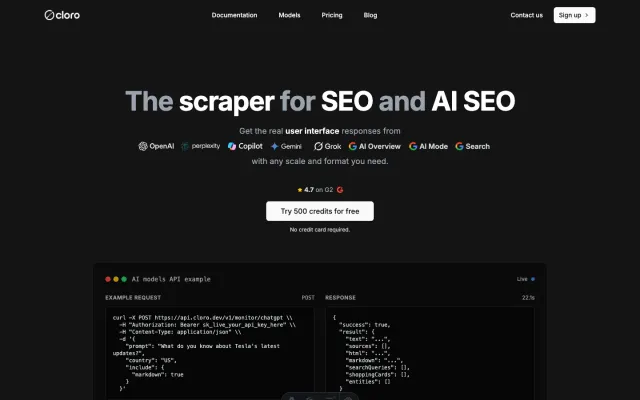
1. cloro: best for Google's live page and AI engine answers
cloro’s SERP API answers a different question from Tavily. Tavily ranks the web by its own relevance score for a model to read. cloro returns what Google shows a searcher right now, as structured JSON: organic results, ads, People Also Ask, related searches and, for 2 more credits, the AI Overview with the sources it cites. Each request runs in a logged-out session in the country you choose, so the result is what an unauthenticated visitor there sees.
If you track rankings or AI Overview visibility, Tavily’s order is not Google’s, so a Tavily feed measures a different list from the one your users see. If your product reports what AI engines say, the same key returns the answers of ChatGPT, Gemini, Copilot, Perplexity and Google AI Mode, with the sources each one cites. Tavily’s answer field is a short LLM-generated answer and cannot stand in for them. Google News costs the same 3 credits as a search.
cloro plugs in where Tavily does: a hosted MCP server at https://mcp.cloro.dev/mcp (setup), Python and TypeScript SDKs, and a LangChain package, langchain-cloro.
The trade is speed and page text. A Google request averaged about 7 seconds in our own measurement over the 7 days to 2026-10-10. For batch work, send queries to POST /v1/async/task with a webhook and the wait stops mattering. cloro also does not fetch the pages behind the results, so an agent that needs full page text pairs it with a scraper such as Firecrawl.
Pricing: On the async route, a Google search is 3 credits at 10 results, plus 2 for AI Overview and 2 per extra page. Google News is 3 credits, AI Mode, Gemini and Perplexity 4, Copilot 5, and ChatGPT 5 (web search) or 7 (full response). A synchronous /v1/monitor/* call adds 2 credits. Lite is $30/month for 37,500 credits ($0.80 per 1,000 credits), Hobby $100 for 250,000 ($0.40), and self-serve plans go down to $0.305 per 1,000 credits on Enterprise 5,000 (16,391,783 credits), with $0.25 on a custom contract. The Free plan has 500 credits a month. See the pricing page.
Pros
- Returns Google's actual results page as JSON.
- AI Overview and People Also Ask parsed, with cited sources.
- ChatGPT, Gemini, Copilot, Perplexity and Google AI Mode under the same key.
- $1.20 per 1,000 Google searches on Hobby, less at volume.
Cons
- About 7 seconds per Google request, slow for an interactive agent loop.
- No extract, crawl or map endpoint, and it does not fetch arbitrary URLs.
- Returns Google's snippets, not the full text of each page.
02
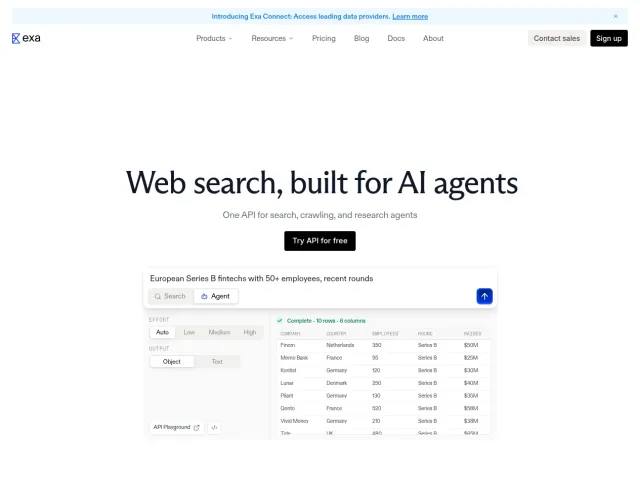
2. Exa: best for search by meaning, with page contents
Exa retrieves by meaning, with embeddings, where a keyword index matches words. Its pricing page describes Search as “real-time search with token-efficient page contents”, so, like Tavily, it hands the model text and not only links.
Retrieval by meaning also takes Exa far from Google, by design. In our 500-query test, only 32.3% of Exa’s top-10 URLs also ranked in Google’s top 10, the lowest overlap of any search API we measured (Tavily had the highest). Exa surfaced 2,396 distinct domains against Google’s 1,691, and 62% of them never appeared in Google’s top 10. So a move from Tavily to Exa changes which web your agent reads, not just the price, which suits research agents that want sources Google ranks low.
Pricing: Lite and Instant search $4 per 1,000 requests, Auto and Fast $7, Deep $12, Deep-reasoning $15, each with up to 10 results; each extra result $1 per 1,000; Contents $1 per 1,000 pages; $10 of free credit at signup, reset monthly (Exa pricing).
Pros
- Lite and Instant search at $4 per 1,000.
- Search returns page contents, by Exa's own description.
- $10 of free credit, reset every month.
Cons
- Auto search is $7 per 1,000.
- Each result past 10 adds $1 per 1,000.
- The least Google-like results of the APIs we measured.
03
3. Perplexity Search API: best for cheap, dated search results
The Perplexity Search API sells Perplexity’s search results without an answer on top. Its pricing page lists it as “raw web search results with advanced filtering”, priced per request with no token charges. Set search_type: "fast" and it costs $1 per 1,000, tied with Parallel’s Turbo and Fast modes as the cheapest search call on this page.
Two things stood out in our 500-query test. Nearly every result, 99.8%, carried a machine-readable date, which helps an agent that must prefer fresh sources. And the Search API returned a generated answer on 0 of 500 queries. That is by design, since Perplexity’s answers come from its Sonar models, but it means this API does not show what Perplexity users are told. cloro’s Perplexity endpoint returns that answer instead.
Pricing: Search API $5.00 per 1,000 requests; with Fast Search $1.00 per 1,000; “no additional token-based charges” (Perplexity pricing).
Pros
- $5 per 1,000 requests, or $1 with Fast Search.
- No token charges on top of the request price.
- 99.8% of results carried a date in our test.
Cons
- Returns ranked results, not an answer: 0 of our 500 queries came back with one.
- No free tier on its pricing page.
- Exact top-10 URL overlap with Google was 32.9% in our test.
04
4. Parallel: best for LLM-ready excerpts and a free MCP with no key
Parallel sells a search API built for agents, with four modes at two prices. Each result carries a URL, title, publish date and what Parallel calls “relevant excerpts optimized for LLMs”, a shape close to Tavily’s snippets. By Parallel’s own figures, Turbo runs at a 200 ms median and Fast at around 700 ms, against about 3 seconds for Advanced, its highest-quality mode.
The low-friction part is the Search MCP. It is free with no API key, offers web_search and web_fetch tools, and runs at lower rate limits until you add a key. Tavily’s keyless mode needs a custom header, which a client that only accepts a URL cannot send.
Pricing: Turbo $1, Fast $1, Basic $5 and Advanced $5 per 1,000 requests with 10 results; additional results $1 per 1,000; up to 5,000 free requests a month (Parallel pricing).
Pros
- $1 per 1,000 requests in Turbo and Fast modes.
- Each result carries excerpts picked for LLMs and a publish date.
- Up to 5,000 free requests a month.
- Free Search MCP that needs no API key.
Cons
- Basic and Advanced modes are $5 per 1,000, the same as Tavily's Growth rate.
- Each result past 10 adds $1 per 1,000.
- Not in our overlap tests, so we have no Google comparison for it.
05
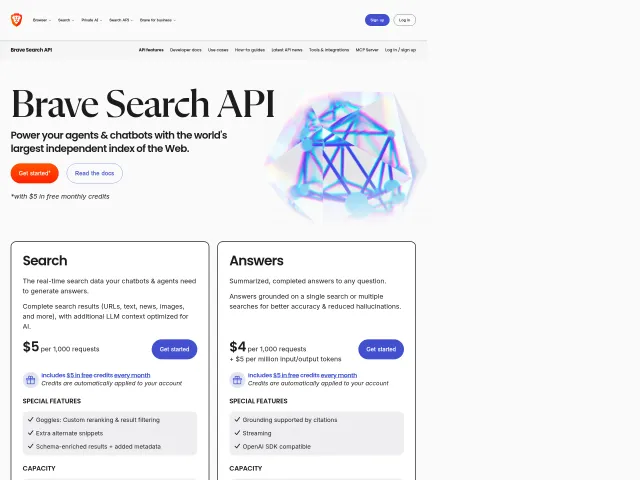
5. Brave Search API: best for an independent index at a flat rate
The Brave Search API says outright where its results come from: “Every result comes from Brave’s own independent index, crawled and ranked by Brave.” The Search plan returns web results, news and images, plus LLM Context, which Brave describes as “the best passages from the best pages, ranked in a single call”. Brave puts its latency at under 500 ms at P90.
In our 500-query comparison, Brave’s top result came from a domain Google also ranked 89% of the time, and Brave kept Google’s order better than any other independent API we measured (rank correlation 0.55). But only 46.6% of its exact top-10 URLs matched Google’s, and it returned none of Google’s AI Overview, People Also Ask or shopping units. Our Brave Search API alternatives page covers Brave in more depth.
Pricing: Search $5 per 1,000 requests at up to 50 requests per second; Answers $4 per 1,000 requests plus $5 per million tokens, at 2 requests per second; $5 of free credit every month (Brave pricing).
Pros
- Results from Brave's own independent index.
- $5 per 1,000 requests at up to 50 requests per second.
- LLM Context returns ranked passages in one call.
Cons
- One $5 rate; larger deals go through Enterprise sales.
- Asks for a credit card, which its FAQ says is to prevent abuse.
- None of Google's page features in our test.
06
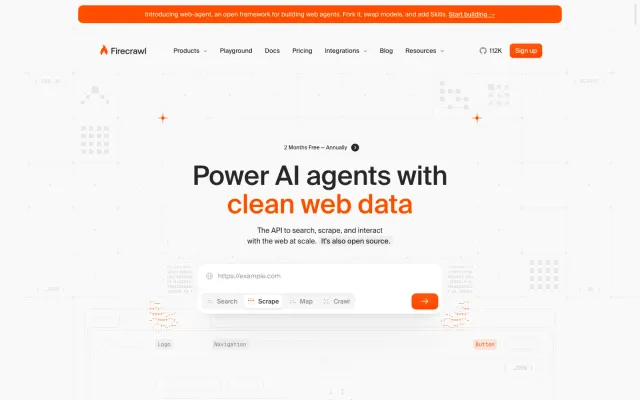
6. Firecrawl: best for search plus scraping and crawling
Firecrawl is the alternative for teams that use Tavily for more than search. Tavily sells Extract, Map and Crawl beside its search endpoint, and Firecrawl’s Scrape, Map and Crawl cover similar jobs. Scrape and Crawl cost 1 credit per page and Map 1 credit per call.
On page work, Tavily’s basic Extract is $1.60 per 1,000 URLs on pay as you go. Firecrawl Scrape is $3.80 per 1,000 pages on Hobby ($19 for 5,000 credits) and $0.99 on Standard ($99 for 100,000), so Tavily is cheaper for small jobs and Firecrawl from Standard up. For search alone, Firecrawl’s Hobby rate of $7.60 per 1,000 sits between Tavily’s Project ($7.50) and pay-as-you-go ($8.00) rates, and Standard drops it to $1.98.
Pricing: Free 1,000 credits a month; Hobby $19/month for 5,000 credits; Standard $99 for 100,000; Growth $399 for 500,000; Scale $749 for 1,000,000; search 2 credits per 10 results, Scrape and Crawl 1 credit per page (Firecrawl pricing).
Pros
- Search, Scrape, Crawl and Map on one credit balance.
- Scrape and Crawl at 1 credit per page.
- Search falls to $1.50 per 1,000 on Scale.
Cons
- Hobby search costs $7.60 per 1,000, close to Tavily's pay-as-you-go rate.
- Search counts 2 credits per 10 results, and scraping the results costs extra.
- Concurrency starts at 2 requests on Free and 5 on Hobby.
Which Tavily alternative to pick
Need agent search, extract and crawl from one credit balance, and $5 to $8 per 1,000 searches is fine?
Stay on Tavily
Its docs list 45 integrations, LangChain and LlamaIndex among them.
Need what Google shows, AI Overview and People Also Ask included, or answers from ChatGPT, Gemini, Copilot and Perplexity?
Need search by meaning, for research agents that want sources Google ranks low?
Exa
Want the cheapest search call, with a date on almost every result?
Perplexity Search API
Want LLM-ready excerpts, a $1 mode and a free MCP with no key?
Parallel
Need an independent index at a flat $5, at up to 50 requests per second?
Brave Search API
Need scraping and crawling as well as search?
Firecrawl
Background
What Tavily sells today
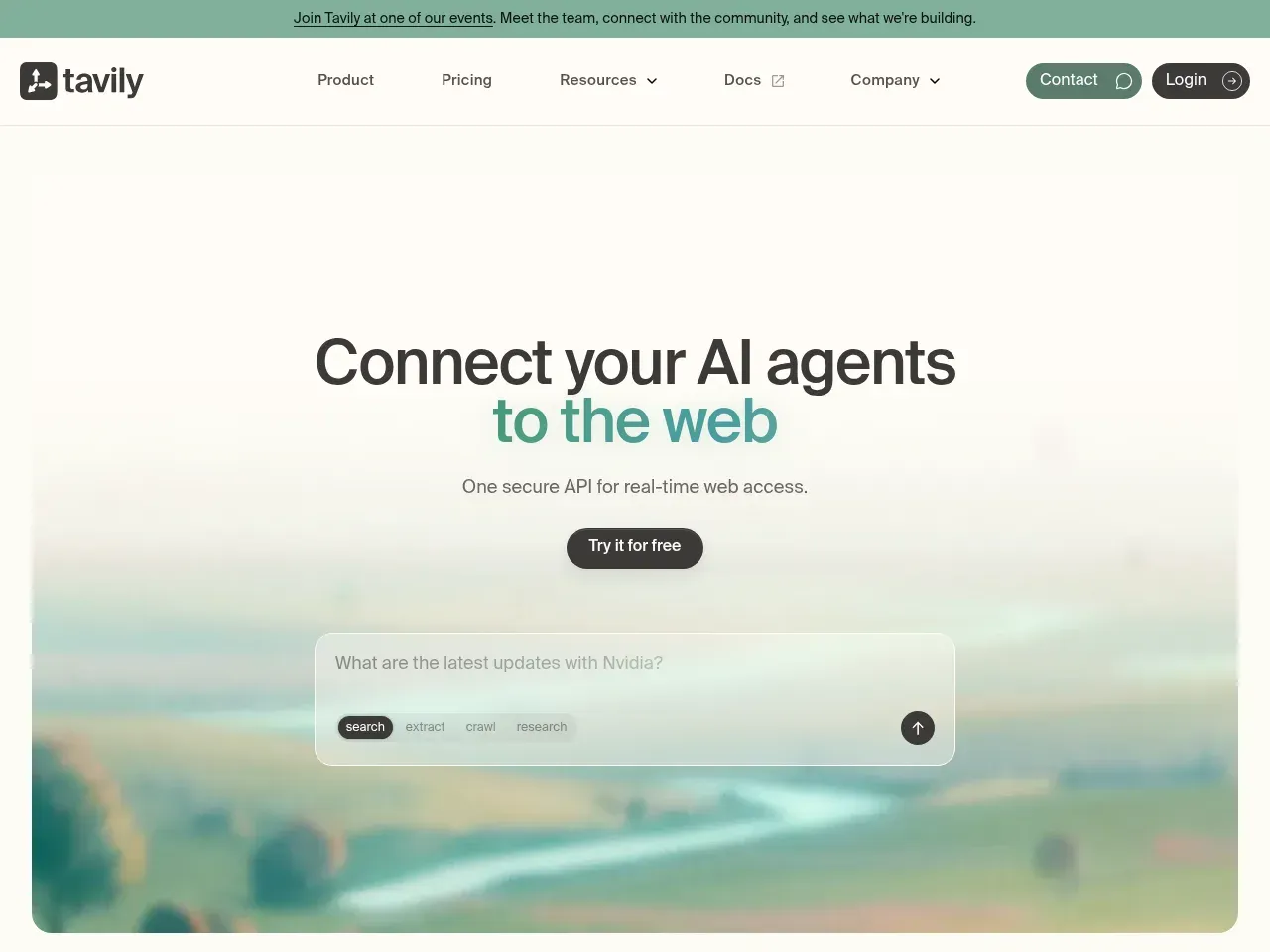
Tavily sells five endpoints on one credit balance: Search, with general, news and finance topics and a country boost; Extract, up to 20 URLs a request; Map; Crawl; and Research.
Nebius announced an agreement to acquire Tavily on 2026-02-10, and its 2026-05-20 post says “Nebius has acquired Tavily”. Tavily keeps its brand, and its site header now reads “Tavily by Nebius”.
Where Tavily earns its price
One search call returns what a model needs to ground an answer. Each result has a title, URL, a short content snippet and a relevance score, and three switches add more: include_raw_content adds the cleaned page, include_answer an answer written by an LLM, and include_images images. Tavily’s docs list 45 integrations, LangChain, LlamaIndex, CrewAI and the Vercel AI SDK among them, plus Python and JavaScript SDKs and a remote MCP server at https://mcp.tavily.com/mcp/. Search and Extract also run with no key when the client sends X-Tavily-Access-Mode: keyless.
Where Tavily’s results come from
Tavily does not name the index behind its results. Its FAQ says that, unlike Bing, Google or SerpAPI, Tavily “dynamically searches the web, reviews multiple sources, and extracts the most relevant content.” In our 500-query test, Google’s #1 domain landed in Tavily’s top 10 on 92% of queries, and about 80% of Google’s top-10 domains appeared, in Tavily’s own order. Tavily vs Google Search has the full numbers. For grounding a model, those are close to Google’s sources. For rank tracking or AI Overview monitoring, Google’s order and page blocks are the data, and Tavily does not carry them.
How we compared, and what these numbers rest on
The prices are the vendors’ own. Each rate comes from the vendor’s pricing page, linked inline and read on 2026-10-24, and each is the real-time rate. For plans, the per-1,000 figure is the plan price divided by the searches it includes. Prices change, so check the linked page before you commit.
The overlap figures are measured by us. The Tavily, Exa, Perplexity and Brave figures come from 500-query runs through each API and through cloro’s live Google SERP on the same day, summarized in the 500-query search API study and in one post per vendor. Parallel and Firecrawl were not in those runs.
We did not benchmark the alternatives’ speed. The latency figures for Brave and Parallel are the vendors’ own claims. The 7-second figure for cloro is our own measurement of cloro over the 7 days to 2026-10-10. We have no latency figure for Tavily.
We make one of the products on this page. Ours is listed first because this is our site. The vendor links go to primary sources, so you can check our framing against them.
The bottom line
Tavily pricing comes down to two numbers: $8 per 1,000 basic searches on pay as you go and $5 on the $500 Growth plan, with advanced search at double either rate. For ranked results, page content and crawling from one credit balance, Tavily is a sound default. Exa, Perplexity, Parallel and Brave sell the same shape for $1 to $7 per 1,000, and Firecrawl fits when Extract and Crawl are a large part of the bill. If you need Google’s own page, AI Overview and People Also Ask included, or the answers ChatGPT, Gemini, Copilot and Perplexity give, cloro returns them at $1.20 per 1,000 Google searches on Hobby, with 500 free credits a month to test on your own queries.
Keep Tavily if your agent needs ranked web results with page content, plus extract and crawl, from one credit balance, and $5 to $8 per 1,000 basic searches fits the budget. Move to cloro if you need what Google actually shows, AI Overview and People Also Ask included, or what ChatGPT, Gemini, Copilot and Perplexity answer. At $1.20 per 1,000 Google searches on Hobby, the switch also cuts the per-search rate.
Try cloro freeFrequently asked questions
How much does Tavily cost?
Tavily bills in credits. The free Researcher plan has 1,000 credits a month. Paid plans are Project at $30 for 4,000 credits, Bootstrap at $100 for 15,000, Startup at $220 for 38,000 and Growth at $500 for 100,000, and pay as you go is $0.008 a credit. A basic search is 1 credit, so 1,000 basic searches cost $8.00 on pay as you go and $5.00 on Growth. Enterprise is custom. Source: Tavily's credits page, read on 2026-10-24.
How many credits does each Tavily endpoint use?
Search costs 1 credit at basic, fast or ultra-fast depth and 2 at advanced depth. Extract costs 1 credit per 5 successful URLs (2 at advanced depth). Map costs 1 credit per 10 pages returned (2 with instructions). Crawl is the map cost plus the extract cost, so 10 pages cost 3 credits at basic depth and 5 at advanced. Research costs 4 to 110 credits a request with the mini model and 15 to 250 with pro. Failed extractions and failed map requests are not charged.
Is Tavily free?
Tavily gives 1,000 free credits every month with no credit card, which covers 1,000 basic searches. Credits reset on the first day of each month, and requests stop when they run out until the reset or an upgrade to a paid plan. Tavily also offers free access to students, and a startup program with up to 100,000 credits for 6 months for VC-backed startups from pre-seed to Series A.
What is the cheapest Tavily alternative?
Per search call, the Perplexity Search API with Fast Search and Parallel in its Turbo and Fast modes cost $1 per 1,000 requests. cloro costs $1.20 per 1,000 Google searches on Hobby and about $0.92 on the largest self-serve tier, and it returns Google's own results page. Firecrawl search falls to $1.50 per 1,000 on its $749 Scale plan. Tavily's lowest basic rate is $5 per 1,000, on the $500 Growth plan.
Does Tavily use Google search results?
Tavily does not say which index it uses. Its FAQ says that, unlike Bing, Google or SerpAPI, Tavily 'dynamically searches the web, reviews multiple sources, and extracts the most relevant content.' In our 500-query study, Tavily's results shared about 80% of Google's top-10 domains, the most of the independent APIs we measured, but in its own order and with none of Google's AI Overview, People Also Ask or shopping units.
Which Tavily alternative replaces Extract and Crawl?
Firecrawl is the closest fit. Its Scrape and Crawl endpoints cost 1 credit per page and Map costs 1 credit per call, so 1,000 scraped pages cost $3.80 on the $19 Hobby plan and $0.99 on the $99 Standard plan. Tavily Extract costs $1.60 per 1,000 URLs on pay as you go. cloro does not scrape arbitrary URLs or crawl sites, so pair it with a scraper if your agent reads full pages.
Does Tavily have an MCP server?
Yes. Tavily's remote MCP server at https://mcp.tavily.com/mcp/ exposes search, extract, crawl, map and research tools, with OAuth or an API key. Search and Extract also run without a key when the client sends the X-Tavily-Access-Mode: keyless header. Among the alternatives, Parallel's Search MCP is free and needs no key, and cloro's MCP server is at https://mcp.cloro.dev/mcp.
Related comparisons
Each page maps cloro's SERP API against one alternative on pricing, AI Overview coverage, and developer experience.
- Ahrefs API alternatives
- Apify alternatives
- Brave Search API alternatives
- Bright Data alternatives
- DataForSEO alternatives
- Exa alternatives
- Firecrawl alternatives
- Oxylabs alternatives
- ScrapeDO alternatives
- ScraperAPI alternatives
- ScrapingBee alternatives
- SearchApi alternatives
- Semrush API alternatives
- SerpAPI alternatives
- Serper alternatives
- All comparisons