
Firecrawl alternatives
Firecrawl Pricing and 6 Firecrawl Alternatives Compared (2026)
Firecrawl pricing runs $0 to $749 a month: $3.80 per 1,000 pages and $7.60 per 1,000 searches on Hobby. Plus 6 Firecrawl alternatives for scraping and search.
4.7 · 66 reviews
- cloro price
- $1.20 per 1,000 Google searches (Hobby, async)
- Firecrawl price
- $7.60 per 1,000 searches or $3.80 per 1,000 pages (Hobby)
On this page
cloro vs Firecrawl
A check marks the stronger side of a row. A row with no check is a difference, not a win.
| cloro | Firecrawl | |
|---|---|---|
| Starting price | $1.20 per 1,000 Google searches (Hobby, async) | $7.60 per 1,000 searches or $3.80 per 1,000 pages (Hobby) |
| Key advantage | The live Google page as JSON, plus AI answer engines. No URL scraping | Scrape, crawl, map and search on one credit balance |
| Price per 1,000 searches (10 results) | $1.20 on Hobby, about $0.92 on the largest self-serve tier | $7.60 on Hobby, $1.98 on Standard, $1.20 on Scale billed annually |
| Entry plan | Lite, $30 a month for 37,500 credits | Hobby, $19 a month ($16 billed annually) for 5,000 credits |
| Monthly free allowance | 500 credits, about 166 Google searches | 1,000 credits, about 500 searches or 1,000 pages |
| AI Overview and People Also Ask | Parsed, with cited sources | Not among the search response fields Firecrawl documents |
| Search engine behind the results | Google's live results page | Not named; the docs say 'our upstream search provider' |
| Scrape or crawl any URL | No | Yes, 1 credit per page |
| AI answer engines | ChatGPT, Gemini, Copilot, Perplexity, Google AI Mode | Search covers web, news and image results |
| Open source | No | AGPL-3.0, self-hostable |
Why teams switch from Firecrawl
- 01
Search results without Google's page
Firecrawl's search docs describe each result as a title, description, URL and position, and they do not name the engine behind them. In our 500-query test, Google showed an AI Overview on 64% of queries and People Also Ask on 77%. cloro returns Google's live results page as JSON with those blocks parsed, so a rank tracker or an AI Overview monitor reports what a searcher actually sees.
- 02
Reading every result multiplies the bill
A Firecrawl search is 2 credits for 10 results, but scraping those 10 pages adds 10 more credits. That is $45.60 per 1,000 searches on Hobby. If your job is the ranking Google shows, not the full text of each page, cloro returns it in one 3-credit request, $1.20 per 1,000 on Hobby, and the AI Overview for 2 credits more.
- 03
One web, one surface
Firecrawl searches and scrapes the open web. If your product also needs to know what ChatGPT, Gemini, Copilot, Perplexity or Google AI Mode say about a query, that is a second vendor. cloro covers Google Search and those AI answer engines under one key and one credit balance.
Firecrawl pricing starts with a free plan of 1,000 credits a month, then runs $19, $99, $399 and $749 a month for Hobby, Standard, Growth and Scale, or $16 to $599 a month billed annually (Firecrawl pricing, read on 2026-10-24). A credit buys one scraped page, and a search costs 2 credits per 10 results. On Hobby that is $3.80 per 1,000 pages or $7.60 per 1,000 searches. On Scale it falls to $0.75 and $1.50.
The right Firecrawl alternative depends on which job you bought Firecrawl for. To crawl and scrape pages, the alternatives are Apify, Crawl4AI, ScrapingBee and Bright Data. To replace the search endpoint, they are cloro, which returns Google’s live results page with AI Overview and People Also Ask, and Tavily. cloro does not scrape URLs or crawl sites, so it replaces only the search half.
Firecrawl is a good product, with scraping, crawling and search on one credit balance and an open-source core. This page shows what each call costs, where the bill outgrows the plan price, and which alternative fits each job.
The 6 best Firecrawl alternatives at a glance
For crawling and scraping, the best Firecrawl alternatives are Apify for ready-made crawlers, Crawl4AI for an open-source crawler you run yourself, ScrapingBee for cheap JavaScript rendering and Bright Data for heavily protected sites. For Firecrawl’s search endpoint, the best alternatives are cloro for Google’s full results page and Tavily for agent-ready search on its own index.
| Tool | Firecrawl job it replaces | Live price per 1,000 | Free allowance | What sets it apart |
|---|---|---|---|---|
| cloro | Search | $1.20 Google searches (Hobby), $2.40 (Lite) | 500 credits a month | Google’s live page, AI Overview and People Also Ask parsed |
| Tavily | Search, plus page extraction | $8 searches pay as you go, $5 on Growth | 1,000 credits a month | Search built for agents, on its own index |
| Apify | Crawl and scrape | $0.50 to $5 pages with a browser, $0.20 raw HTTP (Apify’s estimate) | $5 of platform credit a month | Website Content Crawler plus a store of ready-made scrapers |
| Crawl4AI | Crawl and scrape | $0 for the software, you pay for hosting | Free to self-host | Open source under Apache 2.0 |
| ScrapingBee | Scrape | $1.27 JavaScript-rendered pages (Hobby) | 1,000 credits to try | Per-request credit costs set by proxy and rendering |
| Bright Data | Scrape protected pages | $1.50 requests pay as you go | 5,000 requests a month | Unblocking at scale, billed only for success |
| Firecrawl (incumbent) | All of the above | $3.80 pages, $7.60 searches (Hobby) | 1,000 credits a month | Scrape, crawl, map and search on one balance |
The split matters more than the price column. Four tools replace Firecrawl’s scrape and crawl endpoints. Two replace its search endpoint, and they answer different questions: cloro shows what Google shows, and Tavily hands an agent page content from its own index.
Firecrawl pricing: $19 to $749 a month, and what a page or a search really costs
Firecrawl’s paid plans cost $19, $99, $399 and $749 a month, or $16, $83, $333 and $599 a month billed annually. The per-1,000 rate falls from $3.80 per page and $7.60 per search on Hobby to $0.75 and $1.50 on Scale. Every figure below comes from Firecrawl’s own pricing page and billing docs, read on 2026-10-24. Firecrawl dates the current prices September 4, 2026.
The plans, monthly and annual
| Plan | Monthly | Billed annually | Credits a month | Concurrent requests | Firecrawl’s own conversion | Extra credits per $5 |
|---|---|---|---|---|---|---|
| Free | $0 | n/a | 1,000 | 2 | 500 searches or 1,000 pages | Not available |
| Hobby | $19 | $16 a month ($190 a year) | 5,000 | 5 | 2,500 searches or 5,000 pages | 1,000 |
| Standard | $99 | $83 a month ($990 a year) | 100,000 | 25 | 50,000 searches or 100,000 pages | 2,000 |
| Growth | $399 | $333 a month ($3,990 a year) | 500,000 | 50 | 250,000 searches or 500,000 pages | 2,500 |
| Scale | $749 | $599 a month ($7,190 a year) | 1,000,000 | 100 | 500,000 searches or 1,000,000 pages | 5,000 |
| Enterprise | Custom | Custom | Custom | Custom | n/a | Custom |
Annual billing saves 16.7% on Hobby, Standard and Growth and 20% on Scale, which checks out self-serve with no sales call. Rate limits rise with the plan: /search allows 10 requests a minute on Free, 100 on Hobby and 10,000 on Scale.
Per 1,000, that works out to:
| Plan | Pages, monthly | Pages, annual | Searches, monthly | Searches, annual |
|---|---|---|---|---|
| Hobby | $3.80 | $3.17 | $7.60 | $6.33 |
| Standard | $0.99 | $0.83 | $1.98 | $1.65 |
| Growth | $0.80 | $0.67 | $1.60 | $1.33 |
| Scale | $0.75 | $0.60 | $1.50 | $1.20 |
The arithmetic is the plan price divided by its credits. Hobby is $19 for 5,000 credits, $0.0038 a credit, so 1,000 one-credit pages cost $3.80 and 1,000 two-credit searches cost $7.60. The takeaway: the step from Hobby to Standard cuts the rate by about three quarters, and the steps after Standard save much less.
What each endpoint costs in credits
The billing docs list the credit costs, which “are the same on every plan”:
| Call | Credits | Notes |
|---|---|---|
| Scrape | 1 per page | Options below add to this |
| Crawl | 1 per page | Each crawled page pays the same scrape options |
| Search | 2 per 10 results | Rounded up, so 11 results cost 4 |
| Search with results scraped | 2 per 10 results, plus each page’s scrape cost | 12 credits for 10 basic pages |
| JSON format (LLM extraction) | +4 per page | A JSON page is 5 credits |
| Enhanced proxy | +0 | Billed as a basic request, and an escalated retry is not charged again |
| Zero data retention | +1 per page | Stacks with the other options |
| Agent | 5 free runs a day, then dynamic | In preview |
The options stack: a page with JSON format and zero data retention is 1 + 4 + 1 = 6 credits. The older /extract endpoint bills at 15 tokens a credit, and Firecrawl calls /agent its successor.
Failed pages have two rules. A scrape that returns no document is free. A page that answers with a 403 or 404 still comes back as a document and costs 1 credit, so a crawl that keeps hitting a blocked site keeps paying.
The search arithmetic: 2 credits, until you read the pages
A Firecrawl search returns titles, descriptions and URLs for 2 credits per 10 results. The limit parameter defaults to 10 results and goes up to 100 (Firecrawl search docs). Add scrapeOptions and Firecrawl also fetches each result as markdown or HTML, and every fetched page bills as a scrape.
| Plan | 10 results, no scrape | 10 results, all 10 scraped (12 credits) |
|---|---|---|
| Hobby | $7.60 per 1,000 | $45.60 per 1,000 |
| Standard | $1.98 per 1,000 | $11.88 per 1,000 |
| Growth | $1.60 per 1,000 | $9.58 per 1,000 |
| Scale | $1.50 per 1,000 | $8.99 per 1,000 |
So a search-then-read agent loop costs six times what the search alone costs. On Hobby, 1,000 such searches use 12,000 credits, more than twice the plan’s 5,000. With JSON format on the scraped pages, each result is 5 credits and a 10-result search becomes 52 credits. The cheaper patterns are to scrape only the results you need, a two-step pattern Firecrawl’s docs describe, or to skip the scrape when the ranking is what you need.
Extra credits cost more than plan credits
On paid plans, pay-as-you-go adds credits in $5 increments when the balance runs out, up to a monthly limit you set:
| Plan | Credits per $5 | Rate per 1,000 credits | Plan rate per 1,000 credits |
|---|---|---|---|
| Hobby | 1,000 | $5.00 | $3.80 |
| Standard | 2,000 | $2.50 | $0.99 |
| Growth | 2,500 | $2.00 | $0.80 |
| Scale | 5,000 | $1.00 | $0.75 |
Top-ups run 1.3 to 2.5 times the plan rate. A Hobby team that needs 20,000 credits in a month pays $19 plus 15 top-ups of $5, $94 in total, next to $99 for Standard’s 100,000 credits. If you top up every month, the next plan is cheaper. Bought credits stay until used, but expire if you cancel.
Firecrawl pricing against the alternatives
Every rate below is the real-time rate from the vendor’s own page, read on 2026-10-24.
| Vendor | Unit | Entry rate per 1,000 | Volume rate per 1,000 | Notes |
|---|---|---|---|---|
| Firecrawl | Basic page | $3.80 (Hobby) | $0.75 (Scale), $0.60 billed annually | JSON pages are 5 credits |
| ScrapingBee | JavaScript-rendered page (5 credits) | $1.27 (Hobby, $19) | $0.24 (Enterprise 120, $5,799) | Premium proxy with JavaScript is 25 credits |
| Bright Data Web Unlocker | Request | $1.50 (pay as you go) | $1.00 ($1,999 plan, 2,000,000 requests) | Billed only for success |
| Apify Website Content Crawler | Page | $0.50 to $5 with a browser, $0.20 raw HTTP | Compute drops to $0.13 per unit on Business | Apify’s own estimate, plus a $19 Starter plan |
| Firecrawl | Search, 10 results | $7.60 (Hobby) | $1.50 (Scale), $1.20 billed annually | Scraping the results adds 1 credit per page |
| cloro | Google search (3 credits) | $2.40 (Lite), $1.20 (Hobby) | About $0.92 (Enterprise 5,000), $0.75 custom | AI Overview adds 2 credits |
| Tavily | Basic search (1 credit) | $8.00 (pay as you go) | $5.00 (Growth, $500 a month) | Advanced search is 2 credits |
What the table says:
- For scraping, Firecrawl’s small plans are not the cheap end: ScrapingBee Hobby renders JavaScript for $1.27 per 1,000 pages, a third of Firecrawl Hobby’s $3.80. From Standard up, Firecrawl’s $0.99 is competitive.
- On protected pages the order flips. Firecrawl’s enhanced proxy costs no extra credits, while ScrapingBee’s stealth proxy with JavaScript is 75 credits, $19.00 per 1,000 pages on Hobby.
- For search, the entry tickets differ. $19 on Firecrawl Hobby buys 2,500 searches. $30 on cloro Lite buys 12,500 Google searches. Firecrawl catches up only at Scale billed annually, where its $1.20 per 1,000 equals cloro Hobby’s rate.
For Google results across the whole SERP API category, see the cheapest SERP API in 2026.
Firecrawl alternatives for search: cloro and Tavily
For Firecrawl’s /search endpoint, the best alternatives are cloro, for Google’s live results page with AI Overview and People Also Ask plus AI answer engines, and Tavily, for agent-ready search with page content on its own index.
01
1. cloro: best for search results, not crawling
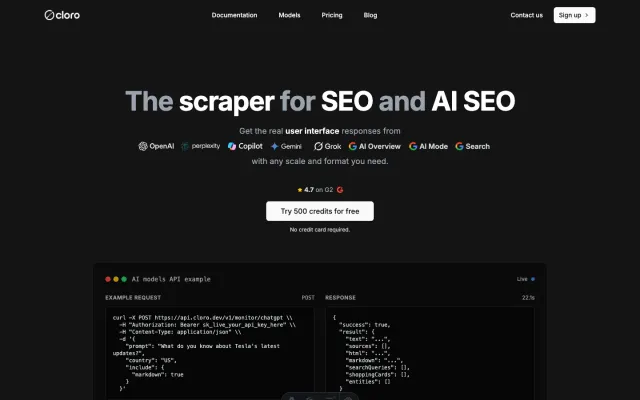
cloro’s SERP API replaces one Firecrawl endpoint, /search. You send a query and a country, and cloro returns Google’s live results page as JSON: organic results, ads, People Also Ask, related searches and, for 2 more credits, the AI Overview with the sources it cites. Requests run in logged-out sessions, so you get what an unauthenticated visitor sees.
That matters when your product reports on Google rather than reading the web. Firecrawl’s search docs describe a result as a title, description, URL and position, and do not say which engine supplies it. To track rankings, measure AI Overview citations or see what a buyer sees before they click, you need the Google page itself. In our 500-query study, Google rendered an AI Overview on 64% of queries and People Also Ask on 77%.
The same key reaches ChatGPT, Gemini, Copilot, Perplexity, Google AI Mode and Google News, so monitoring brand visibility in AI answers needs no second vendor. Agents connect through the MCP server at https://mcp.cloro.dev/mcp, or the Python and TypeScript SDKs.
The limits are plain. cloro does not scrape arbitrary URLs or crawl sites, so a pipeline that reads each result’s full text still needs a scraper for that step. It is also slower than an index lookup: Google requests averaged about 7 seconds in our own measurement over the 7 days to 2026-10-10. For batch work, send queries to POST /v1/async/task with a webhook and the wait stops mattering.
Pricing: A Google search is 3 credits for 10 results on the async route, plus 2 for AI Overview and 2 per extra page. A synchronous /v1/monitor/google call adds 2 credits. AI Mode, Gemini and Perplexity are 4 credits, Copilot 5, ChatGPT 5 or 7. Lite is $30 a month for 37,500 credits ($0.80 per 1,000 credits), Hobby $100 for 250,000 ($0.40), and self-serve plans go down to $0.305 per 1,000 credits on Enterprise 5,000 (16,391,783 credits), with $0.25 on a custom contract. The Free plan carries 500 credits a month. See the pricing page.
Pros
- Returns Google's actual results page, by country.
- AI Overview and People Also Ask parsed, with cited sources.
- ChatGPT, Gemini, Copilot, Perplexity and Google AI Mode under the same key.
Cons
- Does not scrape arbitrary URLs or crawl sites. You need a scraper for page text.
- About 7 seconds per Google request, measured.
- Smaller free allowance: 500 credits a month against Firecrawl's 1,000.
02
2. Tavily: best for agent-ready search with page content
Tavily is the closest swap for Firecrawl search inside an agent: a search API made for LLM tool calls, on its own index, with Extract and Crawl endpoints that fetch page content too.
In our 500-query study, Tavily returned the most Google-like sources of the independent search APIs we measured, about 80% of Google’s top-10 domains, in its own order, and none of Google’s page features. Tavily vs Google Search has the full comparison.
On price it sits beside Firecrawl’s small plans: a basic search is 1 credit at $0.008, so $8 per 1,000 against Firecrawl Hobby’s $7.60, falling to $5 on Growth. Basic Extract bills 1 credit for every 5 successful URLs.
Pricing: Researcher free (1,000 credits a month), Project $30 a month (4,000 credits), Bootstrap $100 (15,000), Startup $220 (38,000), Growth $500 (100,000), pay as you go $0.008 per credit. Advanced search is 2 credits (Tavily API credits).
Pros
- Built for LLM tool calls, with page content in the response.
- Extract and crawl endpoints beside search.
Cons
- $8 per 1,000 basic searches on pay as you go, about Firecrawl Hobby's rate.
- Advanced search costs 2 credits per request.
- Returned no AI Overview or People Also Ask in our 500-query test.
Firecrawl alternatives for crawling and scraping
For Firecrawl’s scrape and crawl endpoints, the best alternatives are Apify for ready-made crawlers on a managed platform, Crawl4AI for open-source crawling on your own servers, ScrapingBee for JavaScript rendering at a low per-page rate, and Bright Data for sites that block ordinary scrapers.
03
3. Apify: best for ready-made crawlers on a managed platform
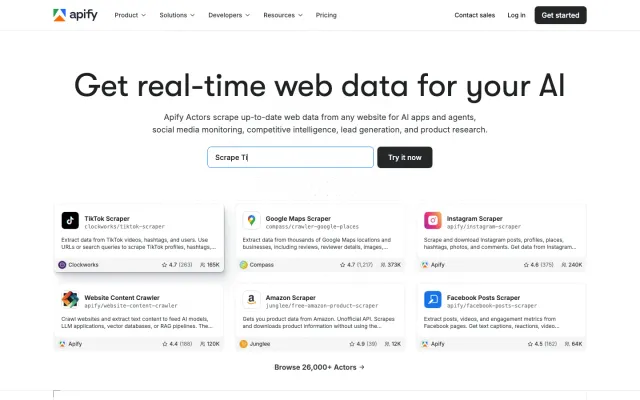
Apify runs scrapers, called Actors, on its own cloud. Its Website Content Crawler is the closest match to Firecrawl’s crawl endpoint: Apify built it to “crawl websites and extract text content to feed AI models, LLM applications, vector databases, or RAG pipelines”, with Markdown output. The Apify Store listed 97,349 Actors on 2026-10-24, so a site-specific scraper often exists already.
The trade is the price model. The Actor is free, and you pay for the compute it uses, in compute units (one unit is 1 GB of memory for one hour). Apify’s own test-based estimate is $0.50 to $5 per 1,000 pages with a headless browser, depending on the site, and $0.20 with the raw HTTP crawler, at $0.25 per compute unit. Starter bills $0.20, so the same work there should cost about a fifth less. That is harder to budget than Firecrawl’s flat 1 credit per page, but simple pages can cost far less. Our Apify alternatives page has the wider picture.
Pricing: Free $0 with $5 of monthly credit, Starter $19 a month plus pay as you go at $0.20 per compute unit, Scale $199 at $0.16, Business $999 at $0.13 (Apify pricing). Annual billing takes 10% off.
Pros
- Website Content Crawler outputs text and Markdown for LLMs and RAG.
- A store of ready-made scrapers for specific sites.
- $5 of free platform credit every month.
Cons
- No fixed per-page price: you pay for compute, and Apify gives only an estimate.
- The estimate spans 10x, $0.50 to $5 per 1,000 pages with a browser.
04
4. Crawl4AI: best for open-source crawling on your own servers
Crawl4AI turns websites into Markdown for RAG, agents and data pipelines, and its README calls the self-hosted route “free forever”. You run it as a Python library or as your own Docker server, so the crawler, the browser pool and the data stay inside your infrastructure.
The license is the practical difference from self-hosted Firecrawl, which is AGPL-3.0. Crawl4AI is Apache 2.0, with one addition at the end of its LICENSE file: “All distributions, publications, or public uses of this software, or derivative works based on this software, must include the following attribution”. If a legal team reviews your dependencies, give them both files.
Free software is not free to operate: on JavaScript-heavy pages and bot walls the proxies are yours, so the real cost is servers and engineering time. Crawl4AI also sells a hosted Cloud.
Pricing: Self-hosted, free. Crawl4AI Cloud gives 1,000 free credits a month at 10 requests a minute, and paid plans start at $10 a month, with 120 requests a minute and 10 at a time.
Pros
- Free software under Apache 2.0.
- Runs in your Python process or your own Docker server.
- A hosted option with 1,000 free credits a month.
Cons
- You run the browsers, proxies and scaling yourself.
- Its license file adds an attribution requirement on top of Apache 2.0.
05
5. ScrapingBee: best for JavaScript rendering at a low per-page rate
ScrapingBee runs the headless browser and rotates proxies for you, and prices each request by how it fetches the page. On the Hobby plan ($19 for 75,000 credits):
- Classic proxy, no JavaScript: 1 credit, $0.25 per 1,000 pages.
- Classic proxy with JavaScript, the default: 5 credits, $1.27.
- Premium proxy, no JavaScript: 10 credits, $2.53.
- Premium proxy with JavaScript: 25 credits, $6.33.
- Stealth proxy with JavaScript: 75 credits, $19.00.
On ordinary pages it is cheaper than Firecrawl’s small plans: the default JavaScript render is a third of Firecrawl Hobby’s $3.80. On protected pages the order flips, because Firecrawl bills its enhanced proxy at the base 1 credit. Auto mode climbs through those configurations and bills only the one that worked, or nothing if all fail. See our ScrapingBee alternatives for its plans.
Pricing: Hobby $19 a month (75,000 credits, 25 concurrent requests), Freelance $49 (250,000, 50), Startup $99 (1,000,000, 100), Business $249 (3,000,000, 200), up to Enterprise 120 at $5,799 (120,000,000, 900), with 1,000 free credits to try (ScrapingBee pricing, credit costs).
Pros
- $1.27 per 1,000 JavaScript-rendered pages on the $19 Hobby plan.
- 25 concurrent requests on Hobby, against Firecrawl Hobby's 5.
Cons
- Premium and stealth proxies cost 25 and 75 credits with JavaScript.
- AI extraction adds 5 credits per request.
06
6. Bright Data: best for heavily protected sites, billed per success
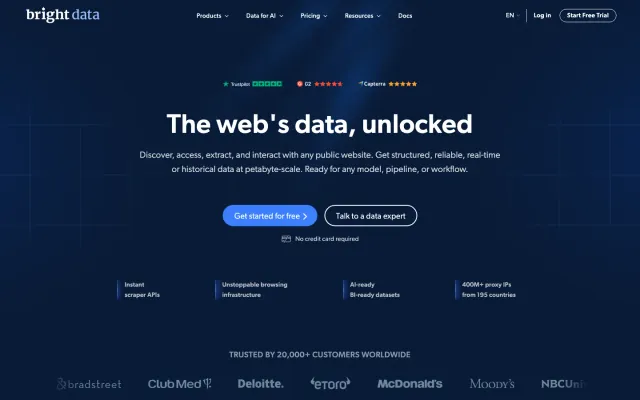
Bright Data’s Web Unlocker fetches pages that block ordinary scrapers, handling proxies, browser rendering and CAPTCHA solving behind one request. Its Crawl API is priced the same, $1.50 per 1,000 requests on pay as you go.
The biggest difference from Firecrawl is what it bills. Bright Data’s pay-as-you-go plan reads “Pay only for success”, while Firecrawl charges 1 credit for a page that answers with a 403 or 404. On hard targets, where many requests fail, that can matter more than the headline rate. On easy pages Firecrawl is cheaper from Standard up, $0.99 per 1,000 pages against $1.50. Our Bright Data alternatives page compares the other unblocking vendors.
Pricing: Free tier 5,000 requests a month. Pay as you go $1.50 per 1,000 requests. Scale $499 a month with 383,000 requests included ($1.30 per 1,000 after), $999 with 908,000 ($1.10), $1,999 with 2,000,000 ($1.00). Enterprise is custom.
Pros
- Pay only for successful requests.
- Unlimited concurrency on pay as you go.
- 5,000 free requests a month.
Cons
- $1.50 per 1,000 requests, above Firecrawl's rate from Standard up.
- Volume discounts start at a $499 monthly plan.
Which Firecrawl alternative to pick
Scrape and crawl pages into markdown for an LLM, with search on the same balance?
Stay on Firecrawl
From Standard up, $0.99 per 1,000 pages, with enhanced proxy at no extra credit.
Need what Google shows, AI Overview and People Also Ask included, or answers from ChatGPT, Gemini, Copilot and Perplexity?
Want search for an agent tool, with page content in the response?
Tavily
Need a ready-made scraper for a specific site, or a managed crawler for RAG?
Apify
Want to run the crawler on your own servers under a permissive license?
Crawl4AI
Need JavaScript rendering on ordinary pages at the lowest per-page rate?
ScrapingBee
Scraping hard targets where many requests fail, and want to pay only for success?
Bright Data
Background
What Firecrawl sells today
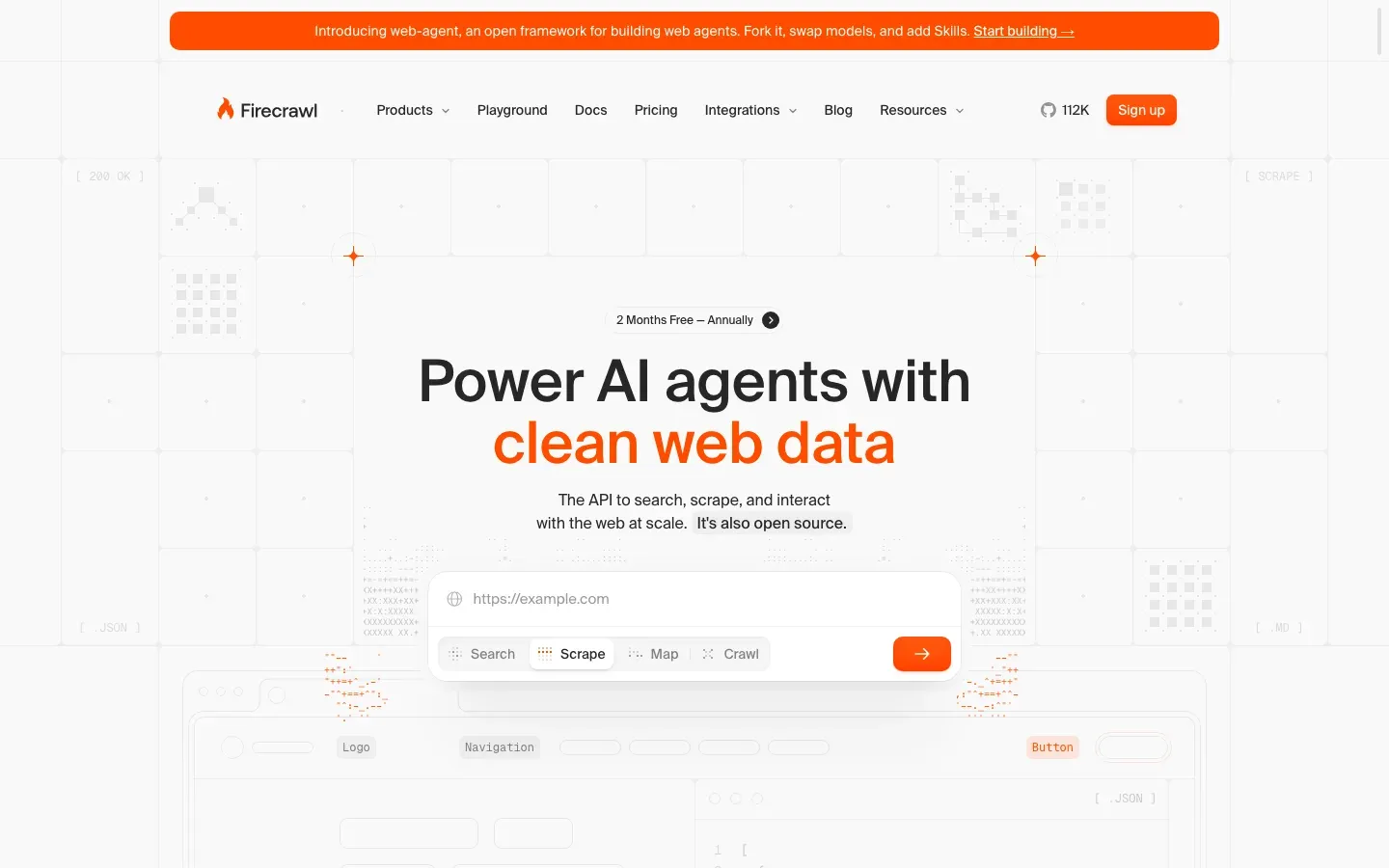
Firecrawl sells web data for AI applications through one API and one credit balance: scrape, crawl, map and search, plus Agent (in preview), a browser sandbox called Interact, and Monitor for rechecking pages (billing docs, read 2026-10-24). Scrape and search also work with no API key, through a keyless free tier capped per IP address per day, and agents can use Firecrawl’s keyless MCP server at https://mcp.firecrawl.dev/v2/mcp. Firecrawl does not publish the per-IP caps.
Where Firecrawl earns its price
One balance pays for scraping and searching, protected pages cost no extra credits, and a scrape that returns nothing is free. The core is open source under AGPL-3.0, and the self-hosting guide runs scrape, crawl, map and search in Docker Compose. It leaves out Fire-engine, the service behind the advanced anti-bot handling, so screenshots and page actions need Firecrawl Cloud or a Fire-engine you run separately. Agent, Browser and the enhanced proxy paths are Cloud only.
Where Firecrawl search stops
Firecrawl’s search docs describe each web result as a URL, title, description and position, with query-relevant highlights by default. The docs do not say which engine the web results come from; the only reference is to “our upstream search provider”. The response fields they document include no AI Overview, AI Mode or People Also Ask block. For grounding a model, that is often enough. For rank tracking or AI Overview monitoring, those blocks are the data.
How we compared, and what these numbers rest on
The prices are the vendors’ own. Each rate comes from the vendor’s pricing page or billing docs, linked inline and read on 2026-10-24, and each is the real-time rate. Firecrawl’s annual totals ($190, $990, $3,990, $7,190) are twelve monthly prices less the saving Firecrawl prints on each plan.
The per-1,000 rates are our arithmetic: the plan price divided by its credits, times the credits a call uses. Apify’s per-page range is Apify’s own estimate, because Apify bills compute, not pages.
The Google and Tavily figures are measured by us. The 64% AI Overview and 77% People Also Ask rates and Tavily’s 80% domain overlap come from one 500-query run, written up in the search API study. Firecrawl’s search was not in that run, so this page makes no overlap claim about it. The 7-second figure is our own measurement of cloro over the 7 days to 2026-10-10.
We did not benchmark scraping. Success rate, speed and output quality for the scraping tools are not measured here. Their order reflects price model and job, not a test.
We make one of the products on this page. Ours is listed first because this is our site. cloro replaces only Firecrawl’s search endpoint, and the vendor links go to primary sources, so you can check our framing against them.
The bottom line
Firecrawl pricing is simple on the card and less simple on the bill. Plans run $19 to $749 a month and a basic page is 1 credit, but JSON format makes a page 5 credits and scraping the results makes a search 12. From Standard up, it is a fair price for scraping and search on one balance. For scraping, Apify, Crawl4AI, ScrapingBee and Bright Data each beat it on one axis: ready-made crawlers, self-hosting, cheap rendering or paying only for success. For search, Tavily is the agent-shaped swap at about Firecrawl Hobby’s price. If you need Google’s own page, AI Overview and People Also Ask included, or answers from ChatGPT, Gemini, Copilot and Perplexity, cloro returns it at $1.20 per 1,000 Google searches on Hobby, with 500 free credits a month to test it.
Keep Firecrawl if you scrape and crawl pages for an LLM and like having search on the same credit balance. For crawling, Apify, Crawl4AI, ScrapingBee and Bright Data are the alternatives. Move your search calls to cloro if you need Google's live page, AI Overview and People Also Ask included, or answers from ChatGPT, Gemini, Copilot and Perplexity. At $1.20 per 1,000 Google searches on Hobby, cloro is also cheaper per search than every paid Firecrawl plan except Scale billed annually, which matches it.
Try cloro freeFrequently asked questions
How much does Firecrawl cost?
Firecrawl has a free plan with 1,000 credits a month, then Hobby at $19 a month (5,000 credits), Standard at $99 (100,000), Growth at $399 (500,000) and Scale at $749 (1,000,000). Billed annually, they are $16, $83, $333 and $599 a month. A basic scrape is 1 credit and a search is 2 credits per 10 results, so Hobby works out to $3.80 per 1,000 pages or $7.60 per 1,000 searches. Source: Firecrawl's pricing page, read on 2026-10-24.
Is Firecrawl free?
Yes, up to 1,000 credits a month with no card, which Firecrawl puts at 500 searches or 1,000 pages scraped, at 2 concurrent requests. The free plan has no pay-as-you-go, so requests return HTTP 402 once the allotment runs out. Scrape and search also work with no API key through a keyless tier, which Firecrawl caps per IP address per day without publishing the number.
How many credits does a Firecrawl search use?
2 credits per 10 results, rounded up, so 11 results cost 4 credits. If you ask Firecrawl to scrape the results too, each scraped page adds its own scrape cost, 1 credit for a basic page and 5 with JSON format. A 10-result search with every result scraped is 12 credits, $45.60 per 1,000 searches on Hobby.
What is the cheapest Firecrawl alternative?
For scraping, Crawl4AI costs nothing as software, and you pay for the servers that run it. Among hosted APIs, ScrapingBee's Hobby plan is $0.25 per 1,000 pages without JavaScript rendering and $1.27 with it, and Apify estimates $0.20 per 1,000 pages for its raw HTTP crawler. For search, cloro is $1.20 per 1,000 Google searches on Hobby, against Firecrawl's $7.60 on its own Hobby plan.
Is Firecrawl open source?
Yes. The repository is licensed under AGPL-3.0, with the SDKs and some UI components under MIT. Firecrawl's self-hosting guide runs the core scrape, crawl, map and search APIs in Docker Compose, but it leaves out Fire-engine, the service behind its advanced anti-bot handling, screenshots and page actions. Agent, Browser and the enhanced proxy paths are Cloud only.
Does Firecrawl search use Google?
Firecrawl does not say. Its search docs refer only to 'our upstream search provider', and they describe results with a title, description, URL and position. If you need what Google ranks and shows, including the AI Overview and People Also Ask, use a Google SERP API such as cloro.
Can cloro replace Firecrawl?
Only the search endpoint. cloro returns Google Search, Google News, Google AI Mode and ChatGPT, Gemini, Copilot and Perplexity answers as JSON. It does not scrape arbitrary URLs or crawl sites. Teams that need both keep a scraper for page text and use cloro for the Google page.
Related comparisons
Each page maps cloro's SERP API against one alternative on pricing, AI Overview coverage, and developer experience.
- Ahrefs API alternatives
- Apify alternatives
- Brave Search API alternatives
- Bright Data alternatives
- DataForSEO alternatives
- Exa alternatives
- Oxylabs alternatives
- ScrapeDO alternatives
- ScraperAPI alternatives
- ScrapingBee alternatives
- SearchApi alternatives
- Semrush API alternatives
- SerpAPI alternatives
- Serper alternatives
- Tavily alternatives
- All comparisons