
Brave Search API alternatives
Brave Search API Alternatives: 5 Search APIs Compared (2026)
The best Brave Search API alternatives are Tavily, Exa, cloro, Serper and SerpApi. Live rates run $0.30 to $25 per 1,000, against Brave's flat $5.
4.7 · 66 reviews
- cloro price
- $1.20 per 1,000 Google searches (Hobby, async)
- Brave Search API price
- $5 per 1,000 requests ($5 monthly credit)
On this page
cloro vs Brave Search API
A check marks the stronger side of a row. A row with no check is a difference, not a win.
| cloro | Brave Search API | |
|---|---|---|
| Starting price | $1.20 per 1,000 Google searches (Hobby, async) | $5 per 1,000 requests ($5 monthly credit) |
| Key advantage | The live Google page as JSON, plus AI answer engines | Independent web index with an LLM context endpoint |
| Price per 1,000 web searches | $1.20 on Hobby, about $0.92 on the largest self-serve tier | $5 flat |
| Monthly free allowance | 500 credits, about 166 Google searches | $5 credit, about 1,000 requests (attribution required) |
| Index | Google's live results page | Brave's own index, no Google or Bing dependency |
| AI Overview and People Also Ask | Parsed, with cited sources | Not returned |
| Context for LLMs | Organic results, snippets and AI Overview text | LLM Context endpoint with ranked page chunks |
| Response time | About 7 seconds per Google request (measured) | Under 1 second, by Brave's own figures |
| AI answer engines | ChatGPT, Gemini, Copilot, Google AI Mode | Brave's own Answers plan only |
| Rate limit | 1 to 255 concurrent requests, by plan | 50 requests per second on Search |
Why teams switch from Brave Search API
- 01
The free plan is gone
Brave's pricing page lists no free plan. Every plan now carries $5 of monthly credit, about 1,000 Search requests, and Brave asks you to attribute the API on your site to get it. After that, each 1,000 requests costs $5. cloro's Google endpoint costs $1.20 per 1,000 searches on Hobby, so an agent that outgrew the free allowance pays about a quarter of the rate.
- 02
Brave's index is not Google's page
Brave runs its own index, so it cannot return what Google shows a user. In our 500-query test, Google rendered an AI Overview on 64% of queries and People Also Ask on 77%, and Brave returned neither. cloro returns the live Google page as JSON, with those blocks parsed, so you can measure or reproduce what a searcher actually sees.
- 03
One index, one surface
Brave answers from Brave. If your product also needs to know what ChatGPT, Gemini, Copilot or Google AI Mode say about a query, that is a second vendor. cloro covers Google Search and those AI answer engines under one key and one credit balance, so you add a surface without adding a contract.
Many agent builders started on the free plan of the Brave Search API. That plan is gone. Brave’s current pricing has no free tier: Search costs $5 per 1,000 requests, and the only free part is a $5 monthly credit that covers about 1,000 requests. So teams that never paid for search now do, and the fair question is whether Brave is still the right index to pay for.
Brave is a good product. It runs one of the few independent web indexes, it answers in well under a second, and its LLM Context endpoint hands a model ranked page chunks instead of bare links. The question is whether you need those things at $5 per 1,000, or whether a different API fits your job better. This page compares five Brave Search API alternatives on the live price, the free allowance, and what each one returns.
The 5 best Brave Search API alternatives at a glance
The best Brave Search API alternative as a search tool inside an AI agent or a RAG pipeline is Tavily, the closest swap, and the best for Google’s full page, AI Overview included, is cloro. Exa, Serper and SerpApi cover meaning-based search, cheap basic Google results and many engines under one key.
| Tool | What it searches | Live price per 1,000 searches | Free allowance | Google page features |
|---|---|---|---|---|
| cloro | Google’s live results page, plus AI answer engines | $1.20 (Hobby), about $0.92 at the top self-serve tier | 500 credits a month | Yes, parsed |
| Tavily | Its own index, built for agents | $8 pay as you go, $5 on Growth | 1,000 credits a month | No |
| Exa | Its own index, searched by meaning | $4 (Lite) to $7 (Auto) | $10 credit a month | No |
| Serper | Google results, basic fields | $1.00 down to $0.30 | 2,500 queries once | Partial |
| SerpApi | Google and many other engines | $25 (Starter) down to $3.75 (Cloud 1M) | 250 searches a month | Yes, parsed |
| Brave Search API (incumbent) | Brave’s own index | $5 | $5 credit a month | No |
The five split on one question first: do you want an independent index or Google’s? Tavily and Exa sit beside Brave as indexes built for AI. cloro, Serper and SerpApi return what Google ranks. Inside each group, price and response depth decide the rest.
Brave Search API pricing against the alternatives
Every figure below is the real-time rate from the vendor’s own pricing page, read on 2026-10-22. None is a queued or batch rate.
| Vendor | Unit | Entry rate per 1,000 | Volume rate per 1,000 | Notes |
|---|---|---|---|---|
| Brave Search API | Request | $5.00 | $5.00 | Flat. Enterprise on request |
| cloro | Google search (3 credits) | $2.40 (Lite) | $0.92 (Enterprise 5,000), $0.75 custom | AI Overview adds 2 credits |
| Tavily | Basic search (1 credit) | $8.00 | $5.00 (Growth, $500/month) | Advanced search is 2 credits |
| Exa | Lite search, up to 10 results | $4.00 | $4.00 (no volume rate listed) | Auto search is $7; each extra result adds $1 |
| Serper | Query | $1.00 ($50 top-up) | $0.30 ($3,750 top-up) | Credits expire after 6 months |
| SerpApi | Search | $25.00 (Starter) | $3.75 (Cloud 1M) | Monthly plans |
What the table says:
- Brave sits in the middle on price. At $5 per 1,000 it costs more than any Google SERP API on this list except SerpApi’s small plans, and less than Tavily’s pay-as-you-go rate.
- For Google results, cloro and Serper are the low-cost options. Serper is cheaper per query at volume, and cloro costs a little more but returns the full page, with AI Overview and People Also Ask parsed.
- For an independent index, Exa Lite at $4 is the one rate below Brave’s. Tavily reaches $5 only on a $500 monthly plan.
- Free allowances are small everywhere. Brave’s $5 credit is about 1,000 requests, Tavily’s is 1,000 basic searches, cloro’s 500 credits are about 166 Google searches. None of them carries a production agent.
For the price view across the whole SERP API category, see the cheapest SERP API in 2026.
The 5 Brave Search API alternatives, compared
The best Brave Search API alternatives are cloro for the live Google page and AI answer engines, Tavily for agent-ready search with page content, Exa for meaning-based retrieval, Serper for the cheapest basic Google results, and SerpApi for the widest engine catalog.
01
1. cloro: best for the live Google page and AI answer engines
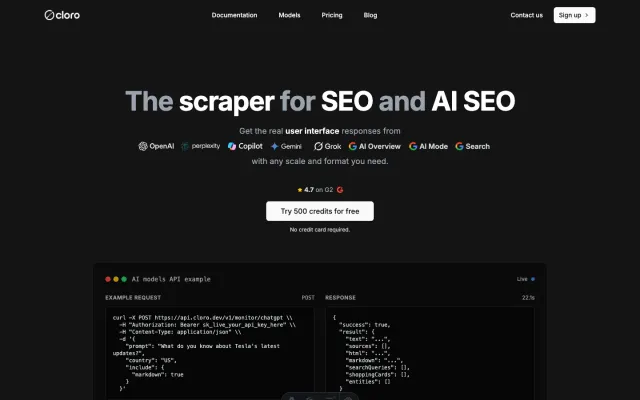
cloro’s SERP API answers a different question from Brave. Brave tells you what its own index thinks is relevant. cloro tells you what Google shows a searcher right now, as structured JSON: organic results, ads, People Also Ask, related searches and, for 2 more credits, the AI Overview with the sources it cites. Each request runs in a logged-out session, so the result is what an unauthenticated visitor sees.
That difference matters most in two cases. If you track rankings or AI Overview visibility, a Brave feed measures a different web from the one your users see. If your agent must answer the way Google would, grounding it on Google’s own ranking removes a gap that our 500-query test measured: only 46.6% of Brave’s top-10 URLs matched Google’s. The same key also reaches ChatGPT, Gemini, Copilot and Google AI Mode, so a product that monitors AI answers does not need a second vendor.
The trade is speed. It averaged about 7 seconds for a Google request in our own benchmark over the 7 days to 2026-10-10, against Brave’s sub-second answers. For batch work, send queries to POST /v1/async/task with a webhook and the wait stops mattering. For an interactive agent loop, it is a real cost to weigh.
Pricing: A Google search is 3 credits at 10 results, plus 2 credits for AI Overview and 2 per extra page, on the async route. A synchronous /v1/monitor/google call adds 2 credits, so 5 credits for a plain search. Lite is $30/month for 37,500 credits ($0.80 per 1,000 credits), Hobby is $100/month for 250,000 credits ($0.40), and self-serve plans go down to $0.305 per 1,000 credits on Enterprise 5,000, with $0.25 on a custom contract. The Free plan carries 500 credits a month. See the pricing page.
Pros
- Returns Google's actual results page.
- AI Overview and People Also Ask parsed, with cited sources.
- ChatGPT, Gemini, Copilot and Google AI Mode under the same key.
- $1.20 per 1,000 Google searches on Hobby, less at volume.
Cons
- Slower than Brave: about 7 seconds per Google request.
- No ready-made LLM context chunks; you get the whole page and pick the parts.
- Smaller free allowance than Brave's $5 credit.
02
2. Tavily: best for agent-ready search with page content
Tavily is the closest like-for-like swap for a Brave agent integration. It is a search API designed for LLM tool calls, and its response carries page content the model can read, which covers much of what Brave’s LLM Context endpoint does. In our 500-query study, Tavily returned the most Google-like sources of the independent APIs we measured, about 80% of Google’s top-10 domains, though in its own order. Read Tavily vs Google Search for that comparison in full.
The catch is price. A basic search is 1 credit and pay-as-you-go credits are $0.008, so $8 per 1,000, more than Brave. The rate reaches Brave’s $5 only on the $500/month Growth plan.
Pricing: Researcher free (1,000 credits a month), Project $30/month (4,000 credits), Bootstrap $100 (15,000), Startup $220 (38,000), Growth $500 (100,000), pay as you go $0.008 per credit (Tavily credits and pricing).
Pros
- Built for agents: one call returns ranked results with page content.
- 1,000 free credits a month, no credit card.
- Extract, map and crawl endpoints beside search.
Cons
- $8 per 1,000 basic searches on pay as you go, above Brave's $5.
- Advanced search costs 2 credits per request.
- Its own index, so no Google page features.
03
3. Exa: best for meaning-based retrieval
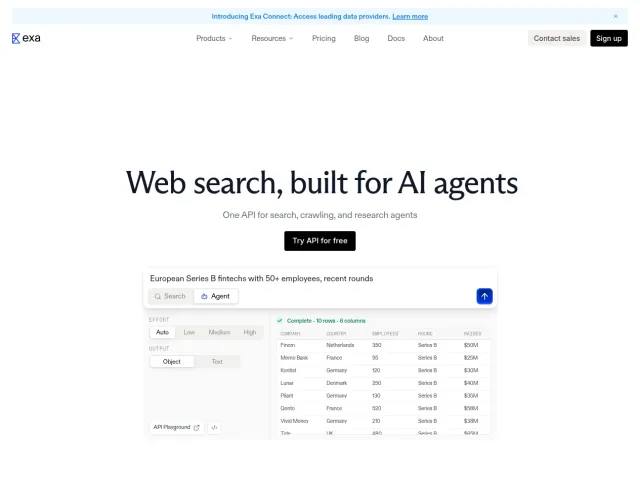
Exa retrieves by meaning, where a keyword index matches words. Ask it for “companies like X” or “papers that argue Y” and it finds pages a keyword index ranks low. That makes it strong for research agents and enrichment. It also means its results look least like Google’s: in our 500-query study Exa had the lowest overlap with Google of the four independent APIs. That is the design of the product. See Exa vs Google Search for the detail.
Pricing: Lite search $4 per 1,000, Auto search $7, Deep search $12, each with up to 10 results; Contents $1 per 1,000 pages; $10 free credit a month (Exa pricing).
Pros
- Lite search at $4 per 1,000, below Brave's rate.
- $10 of free credit every month.
- Searches by meaning, which finds pages keyword search misses.
Cons
- Auto search, the default mode, is $7 per 1,000.
- Each result past 10 adds $1 per 1,000 requests.
- The least Google-like results of the APIs we measured.
04
4. Serper: best for the cheapest basic Google results
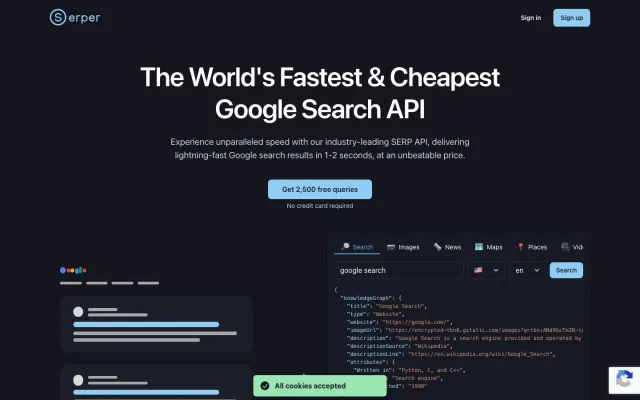
Serper is the budget way to swap Brave’s index for Google’s. It returns Google’s organic results, answer box and related searches in 1 to 2 seconds, which keeps it close to Brave’s speed, at a fifth of Brave’s price on the smallest top-up. It is the right pick when an agent needs Google’s ranking and nothing else. When you need the AI Overview or the fuller page, see our Serper alternatives page.
Pricing: $50 for 50,000 credits ($1.00 per 1,000), $375 for 500,000 ($0.75), $1,250 for 2,500,000 ($0.50), $3,750 for 12,500,000 ($0.30); credits valid for 6 months (Serper pricing).
Pros
- $1.00 per 1,000 queries, falling to $0.30 at volume.
- 1 to 2 seconds per query.
- 2,500 free queries to start.
Cons
- Top-up credits expire after 6 months.
- Returns Google's basic fields, without a parsed AI Overview.
- Google only.
05
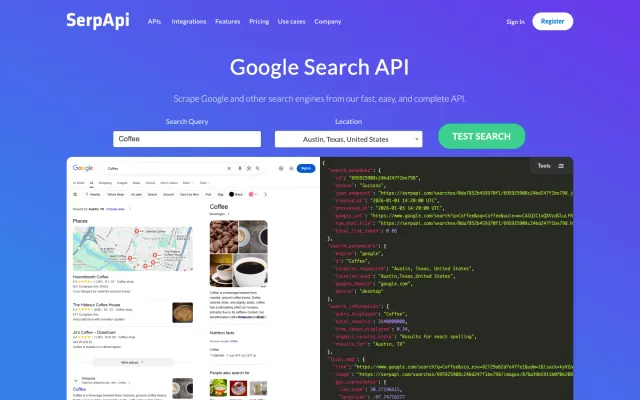
5. SerpApi: best for the widest engine catalog
SerpApi is the long-running multi-engine SERP API. If your agent needs Google today and YouTube, eBay or Google Scholar next quarter, one SerpApi integration covers all of them with parsed JSON. It is the most expensive option here at small volume: Starter is $25 for 1,000 searches, and the per-1,000 rate falls below Brave’s $5 only at the Cloud 1M plan ($3,750 a month for 1,000,000 searches). Our SerpApi alternatives page has the full tier math.
Pricing: Free (250 searches a month), Starter $25 (1,000), Developer $75 (5,000), Production $150 (15,000), Big Data $275 (30,000), up to Cloud plans from $3,750 for 1,000,000 (SerpApi pricing).
Pros
- Google, Bing, Baidu, YouTube, eBay and dozens more under one key.
- Parsed AI Overview on Google.
- Only successful searches are counted.
Cons
- $25 per 1,000 on the Starter plan.
- The rate drops below Brave's only on plans of 1,000,000 searches a month.
Which Brave Search API alternative to pick
Need fast, private grounding on the open web, and $5 per 1,000 is fine?
Stay on Brave
Its index, speed and zero data retention option are the reasons to pay.
Need what Google shows, AI Overview and People Also Ask included, or AI answers from ChatGPT, Gemini and Copilot?
Want the closest swap for a Brave agent tool, with page content in the response?
Tavily
Need research-style retrieval by meaning, or a rate below $5 on an independent index?
Exa
Need Google's basic results at the lowest price per query?
Serper
Need many engines beyond Google under one integration?
SerpApi
Background
What the Brave Search API sells today
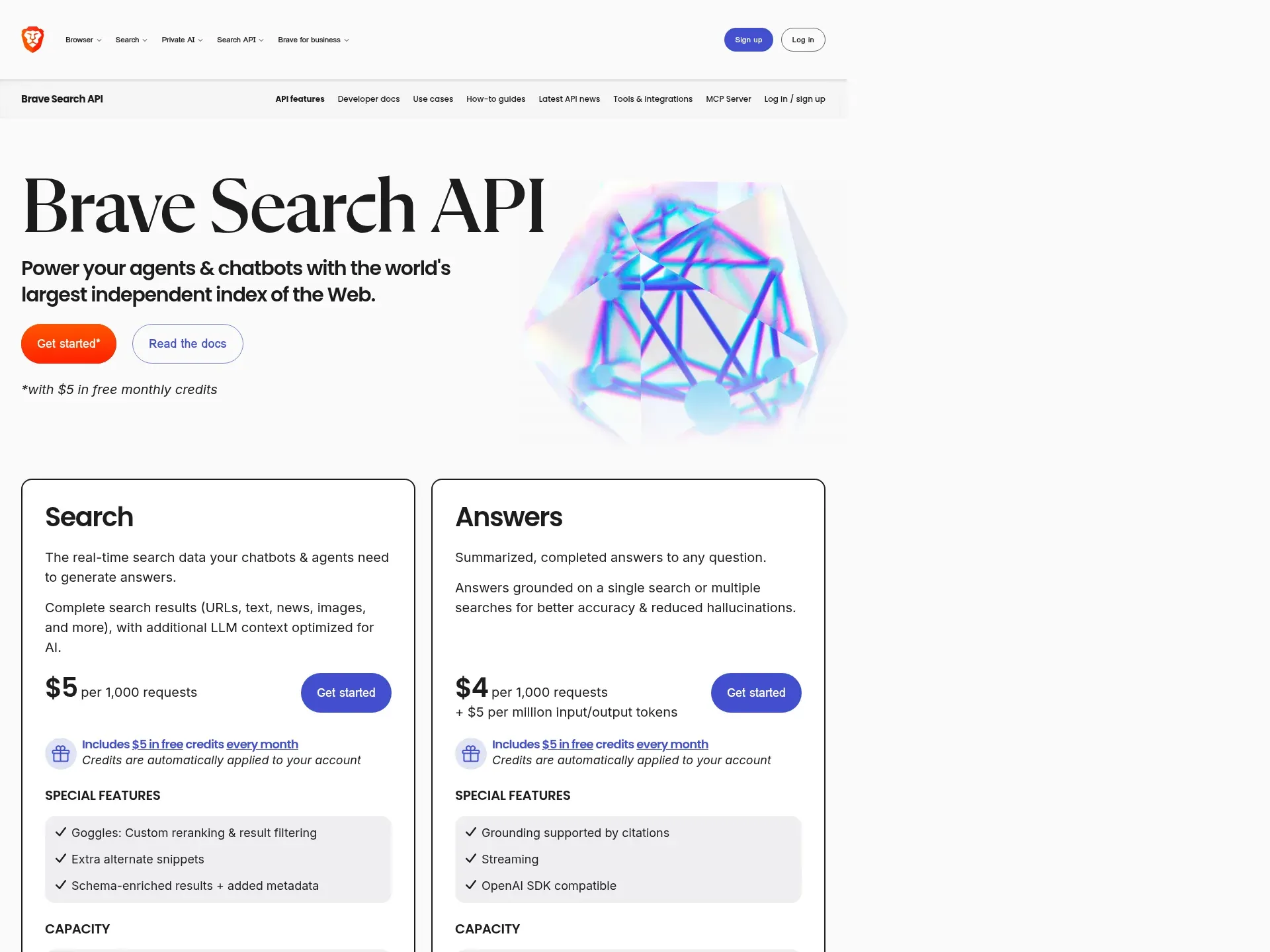
Brave sells four public plans (pricing, read 2026-10-22):
- Search, $5 per 1,000 requests at up to 50 requests per second. It covers web, news, images, videos and the LLM Context endpoint.
- Answers, $4 per 1,000 queries plus $5 per million input tokens and $5 per million output tokens, at 2 requests per second.
- Spellcheck and Autocomplete, $5 per 10,000 requests each.
- Enterprise, priced on request, with zero data retention and custom terms.
Each plan includes $5 of credit every month. Brave’s launch post for these plans says that to receive the credit you attribute the Brave Search API on your project’s website or about page.
Where Brave earns its price
Brave runs its own index and says it has no dependency on Google or Bing. That independence is why Anthropic appears to use it behind Claude’s web search, as TechCrunch reported. The LLM Context endpoint returns ranked chunks of page text, tables and code, sized to a token budget you set, which saves an extraction step. Brave reports under 500 ms at p90 for that endpoint, and offers SOC 2 Type II and zero data retention. If those are the properties your agent needs, the alternatives above do not replace them one for one.
Where the independent index stops
Brave cannot return Google’s page because it is not reading Google. In our 500-query comparison, Brave’s top result came from a domain Google also ranked 89% of the time, so the sources are close. But the exact top-10 URLs matched only 46.6% of the time, and Brave returned none of Google’s AI Overview (present on 64% of queries), People Also Ask (77%) or shopping units (14%). For grounding a model, that gap is often fine. For rank tracking, AI Overview monitoring, or any product that reports what Google shows, the missing blocks are the data the product sells.
Google Custom Search is not the fallback
Teams leaving Brave sometimes look at Google’s own API. Google’s documentation says the Custom Search JSON API is closed to new customers and shuts down on January 1, 2027. Our shutdown guide covers what to move to.
How we compared, and what these numbers rest on
The prices are the vendors’ own. Each rate comes from the vendor’s pricing page, linked inline and read on 2026-10-22. Every rate is the real-time one. Prices change, so open the linked page before you commit.
The overlap figures are measured by us. The 89%, 46.6%, 64%, 77% and 14% figures come from one 500-query run through the Brave Search API and through cloro’s live Google SERP on the same day, written up in Brave Search API vs SERP API. The Tavily and Exa overlap findings come from the 500-query search API study.
We did not benchmark Brave’s speed or uptime. The sub-second figure for Brave is Brave’s own claim. The 7-second figure for cloro is our own measurement of cloro over the 7 days to 2026-10-10.
We make one of the products on this page. Ours is listed first because this is our site. The measurements are reproducible and the vendor links go to primary sources, so you can check our framing against both.
The bottom line
The Brave Search API is now a paid product at $5 per 1,000 requests, with a $5 monthly credit in place of the old free plan. For fast, private grounding on an independent index, it is still a sound choice, and Tavily or Exa are the alternatives in the same shape. If what you need is Google’s ranking, Serper is the cheapest basic option and SerpApi the widest. If you need the full Google page, AI Overview and People Also Ask included, or answers from ChatGPT, Gemini and Copilot through the same key, cloro does that at $1.20 per 1,000 Google searches on Hobby, with 500 free credits a month to test it on your own queries.
Keep Brave if your agent needs fast, private grounding on the open web and $5 per 1,000 requests fits the budget. Move to cloro if you need what Google actually shows, AI Overview and People Also Ask included, or if you also track ChatGPT, Gemini and Copilot answers. At $1.20 per 1,000 Google searches on Hobby, the switch also cuts the per-search rate.
Try cloro freeFrequently asked questions
Is the Brave Search API still free?
Not as a plan. Brave's pricing page lists Search at $5 per 1,000 requests and Answers at $4 per 1,000 plus $5 per million tokens, with no free tier. Each plan does include $5 of credit every month, which covers about 1,000 Search requests, and Brave asks you to attribute the API on your website to receive it. Past that credit, you pay the per-request rate.
How much does the Brave Search API cost?
The Search plan is $5 per 1,000 requests and covers web, news, images, videos and the LLM Context endpoint, at up to 50 requests per second. The Answers plan is $4 per 1,000 queries plus $5 per million input tokens and $5 per million output tokens, at 2 requests per second. Enterprise plans with zero data retention are priced on request. Source: Brave's pricing page, read on 2026-10-22.
What is the cheapest alternative to the Brave Search API?
For Google results, Serper starts at $1.00 per 1,000 queries on a $50 top-up and falls to $0.30 at $3,750, with credits that expire after 6 months. cloro is $1.20 per 1,000 Google searches on Hobby and about $0.92 on the largest self-serve tier, and it adds a parsed AI Overview for 2 more credits. Among independent indexes, Exa Lite search is $4 per 1,000 and Tavily drops to $5 per 1,000 on its $500 Growth plan.
Does the Brave Search API return Google results?
No. Brave crawls and ranks the web itself. In our 500-query comparison, Brave's top result was a domain Google also ranked 89% of the time, but only 46.6% of the exact URLs matched Google's top 10, and Brave returned none of Google's page features. If you need the Google page itself, use a Google SERP API.
Which Brave alternative is best for LLM grounding?
It depends on what the model needs. Tavily and Exa are built for agents and return page content ready for a prompt. A Google SERP API like cloro is the better fit when the agent must answer from what Google ranks, or when you also need Google's AI Overview. In our 500-query study, Tavily returned the most Google-like sources and Exa the least, by design.
Is Google Custom Search a Brave alternative?
Not for new projects. Google's own documentation says the Custom Search JSON API is not available to new customers and shuts down on January 1, 2027. Existing users pay $5 per 1,000 queries after 100 free queries a day. Our shutdown guide covers the migration options.
Related comparisons
Each page maps cloro's SERP API against one alternative on pricing, AI Overview coverage, and developer experience.
- Ahrefs API alternatives
- Apify alternatives
- Bright Data alternatives
- DataForSEO alternatives
- Exa alternatives
- Firecrawl alternatives
- Oxylabs alternatives
- ScrapeDO alternatives
- ScraperAPI alternatives
- ScrapingBee alternatives
- SearchApi alternatives
- Semrush API alternatives
- SerpAPI alternatives
- Serper alternatives
- Tavily alternatives
- All comparisons