Google "Verifying Your Request": What It Means and How to Fix It
Google's 'Verifying your request' page comes back as HTTP 200 with no search results, so scrapers log it as a success. What sets it off and how to get through it.
Notes on SEO monitoring, AI SEO performance, and how to keep tabs on your brand.

Google's 'Verifying your request' page comes back as HTTP 200 with no search results, so scrapers log it as a success. What sets it off and how to get through it.
Competitor SEO tracking is share-of-voice measurement for classic Google search: which domains own the top 10 across your keyword set, computed from scraped SERPs. Here's how to build it, a 30-day war in one niche, and how to alert on entries and exits.

There's no single 'ask Copilot' API. Here's what the official Microsoft 365 Copilot APIs actually return, who can use them, and when you have to scrape instead.

We compared 11 AEO tools on engine coverage, citation intelligence, API access, and price. See which answer engine optimization tool fits your team.

Log-based threat hunting sees what touched your network. It can't see your credentials pasted to a public gist, a phishing domain registered against your brand, or a staging box Google indexed last week. This is the open-web hunting layer: four repeatable, own-scope hunts you can schedule and diff.

Anthropic's Claude searches the web with the Brave Search API, not Google. So how close is Brave to Google? We ran 500 identical queries through both indexes. The answer is "closer than the headline number suggests," with one real exception.

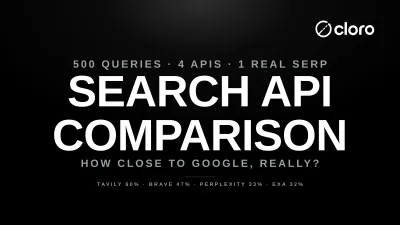
Every AI app picks a search API assuming it's basically Google. We ran the same 500 queries through Brave, Tavily, Exa, and the Perplexity Search API against cloro's live Google SERP. The result is a spectrum that runs from "Google's sources reordered" to "a different web by design", plus one thing every vendor shares.

Grounding is when an AI engine answers from live web results instead of training memory. We measured it across six engines on ~2,500 prompts each. Five ground 91–98% of the time, and one, Gemini, grounds just 41%.
The same keyword ranks differently in every city. Here is how much local rankings vary by geography, why the map pack changes week to week, and how to check Google Maps rankings programmatically across a city grid.