What is AI citation tracking?
AI citation tracking is recording which pages and brands an AI answer cites as sources, for each engine and each prompt, over time. LLM citation tracking is the same thing under another name. The output is a table: prompt, engine, date, and the cited URLs in the order the answer shows them. The rest of this guide is how to fill that table and how to read it.
How do I find which pages AI engines cite for my topic?
Run the questions your buyers ask on each AI engine, save the full source list of every answer, and count which pages and domains come back most often. The pages at the top of that count are the pages AI engines cite for your topic.
- Write 30 to 100 buyer prompts in the words buyers type, for example “best invoicing software for freelancers”. Group them by intent: one question asked ten ways is one intent.
- Run each prompt on every engine you care about. cloro returns ChatGPT, Gemini, Google AI Overview, Google AI Mode and Bing AI Mode (Copilot Search in Bing). Each engine draws on a different part of the web, so a list from one engine does not stand in for the others.
- Keep the whole source list with positions. The answer text names brands. The source list names pages, and pages are what you are counting.
- Count per engine: the number of distinct answers that cite each URL. Then roll the URLs up to domains.
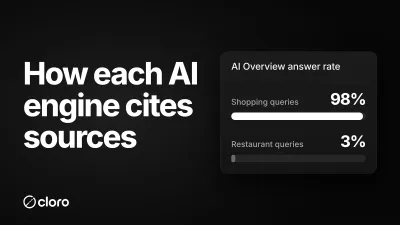
The length of the list depends on the engine. In our July 2026 reading of about 2,500 prompts per engine, a ChatGPT answer with live sources carried 14.1 of them on average, Google AI Mode 9.9, Google AI Overview 9.1 and Gemini 3.2 (grounding by engine). These averages move: in the August re-measurement Gemini’s rose to 10.1. The AI citation tracker publishes the current figures for each engine every week.
The Google results are not a shortcut to this list. On our 500-query baseline, the domains an AI Overview cited overlapped with Google’s own organic top 10 only 51% of the time (search API test). Two engines with the same product name also differ. On 96 US prompts, Bing AI Mode and Google AI Mode had a mean domain overlap per prompt (Jaccard) of 0.08, and 39 of the 91 prompts we could compare shared no domain at all (Bing AI Mode vs Google AI Mode).
To see a list before you run anything, the free AI visibility sources pages show the domains the engines cite in twelve software categories, from cloro’s weekly run.
How do you track AI citations for your brand?
To measure whether AI engines cite your brand, track citations as a rate: run a fixed prompt set on a schedule, count the answers that cite your pages, and divide by all the answers collected, one row per engine. Store the raw answers, so that you can compute the rate again when a definition changes.
- Freeze the prompt set and a competitor list for the measurement window. Write down the date of every change, because a new prompt changes the denominator.
- Run every prompt on every engine on a fixed schedule, daily or several times a week.
- For each answer, record whether your domain is in the source list, which URL it is, and its position.
- Each week, for each engine, compute the citations per page and the share of answers that cite you. Do the same for each competitor.
A mention and a citation are different measurements. A mention is your brand name in the answer text. A citation is your URL in the source list. A brand can be named with no link, and a page can be cited in an answer that never names the brand, so report both. GEO metrics defines mention rate, citation rate, position and share of voice.
Retrieved is not cited: why each engine needs its own row
An engine can read your page and still leave it out of the answer. Retrieval (the page was among the sources the engine pulled) and citation (the answer linked it) are two steps, and the engines convert one into the other at very different rates.
On our own domain and one prompt corpus, the citations per retrieval were 0.11 on ChatGPT, 1.25 on Google AI Overview and 2.58 on Gemini (GEO metrics). The ratio can go above 1.0 because one answer can cite the same URL twice. ChatGPT pulled many pages and linked few of them. Gemini linked what it pulled, often more than once.
Gemini also answers without live sources more often than the other engines. In July 2026 it carried a live source in 41.1% of answers, against 91% to 98% for ChatGPT, Google AI Mode and Google AI Overview. By October it was at 68.2% (grounding by engine). An answer with no source has no citation to win, so a low Gemini count can mean that the engine did not search at all.
So AI citation tracking needs one row per engine, with no blended score. “Cited often on Gemini, rarely on ChatGPT” points to two different fixes, and an average hides both. High retrieval with low citation means the engine finds the page but does not quote it, which is a problem with the shape of the content. Zero retrieval means the engine never finds the page, which is a discovery problem.
How many runs before a citation trend is real?
About 300 answers per engine in each period you compare. Citation is a probability for each answer: when we sent the same prompts to the same model twice, minutes apart, the second run repeated only about 40% of the cited domains of the first (AI visibility sample size). One screenshot of one answer proves neither that you are cited nor that you are not.
In the same study, 300 answers resolve a rate near 25% to about 5 percentage points either way. Fifty prompts run once a day give 350 answers per engine a week, so a weekly read is sound. One day gives 50 answers and about 12 points either way, which is noise. Set alerts on a weekly drop and ignore single days.
What are the best ways to integrate citation tracking into a data pipeline?
The best way to integrate real-time search citation tracking into a data pipeline is an API that returns each answer and its sources as JSON, because the data arrives structured and you keep the raw answers. The two other ways are a dashboard export and your own scraper. Compare the three here:
| Way | What you get | What you maintain |
|---|---|---|
| Dashboard export | The vendor’s computed metrics, on the vendor’s schedule | Little, but the definitions are the vendor’s |
| Your own scraper | Raw answers | Browsers, proxies and a parser for each engine, which break when an engine changes its page |
| Answer API | Answer text, sources and citations as JSON | A schedule, a table and the alerts |
cloro is an API that returns the answers of AI answer engines and search engines as structured data: the answer text, its sources and its citations. Each call gets the answer the engine gives at that moment, so “real time” means the live answer, and the trend comes from the schedule. The flow is: send the prompts as an async batch, get each result by webhook or by polling, write one row per cited URL (prompt_id, engine, run_at, url, domain, position) to a warehouse table, and alert on a weekly drop in citations.
The production version, with batch sizes, a warehouse schema and alert thresholds, is in programmatic AI visibility tracking. The product page is AI visibility tracking.
Dashboard or API: which AI citation trackers exist?
AI citation tracking tools come in two kinds: dashboards that run the prompts for you and show citation reports, and APIs that return the raw answers for your own reports. Each line below is what the vendor’s own page says, read on 2026-11-26. It is not a ranking, and we did not test these tools against each other.
- Similarweb tracks citations daily across ChatGPT, Google AI Mode, Gemini and Perplexity. Each URL shows an Influence Score, a source category, a topic and the number of prompts it appears in.
- OmniSEO monitors citations on more than 10 AI platforms, including ChatGPT with and without browsing, and compares your citation rate with competitors.
- Siftly maps each citation to a specific page on your site or a competitor’s site, and classifies it as your own content, media coverage, social platforms or competitor sites.
- Beamtrace lets you open a tracked answer to see the websites and pages the model referenced, one platform at a time.
- LLM Pulse extracts every URL from AI responses, records its position, and classifies it as your domain, a competitor or a general reference.
- LLMrefs lets you view and filter the full set of source URLs that generative search engines cite.
- Peec AI starts at $95 a month on its Starter plan, with 50 prompts and 3 models that you choose.
A dashboard suits a team that wants reports without building anything. An API suits a team whose citation data must go into its own warehouse with its own definitions. For a side-by-side comparison of 12 dashboards, see LLM visibility tracking tools, and for the prices and limits of two of them, OtterlyAI alternatives and Peec AI alternatives.
Can I track AI citations for free?
Yes, you can start AI citation tracking for free at a small scale. Ask your prompts by hand in each engine while logged out, and paste the cited links into a sheet. This works for a dozen prompts. It does not reach the 300 answers per engine that a trend needs. The guides from HubSpot and OtterlyAI both add a second free signal, AI referral traffic in Google Analytics. It shows the clicks that cited pages send, but not the citations that got no click.
Free tools that help:
- Rankscope’s AI citation tracker is free with no signup. It covers ChatGPT, Google AI Overviews, Google AI Mode and Perplexity, and lists each cited page with the engines and the questions that cite it.
- cloro’s AI visibility sources pages list the domains the engines cite in twelve software categories.
- cloro’s Free plan includes 500 credits a month for a first test of the API. The plans are on the pricing page.
Frequently asked questions
What does citation tracking mean?
In AI search, citation tracking means recording which pages an AI answer links as its sources, for each prompt and each engine, and how that list changes over time. In academic writing the same words mean checking the references in a paper, which is a different job.
How to track LLM mentions?
Run a fixed set of buyer prompts on each engine on a schedule, store the full answer text, and count the answers whose text names your brand. That count divided by all answers collected is your mention rate. A mention is in the answer text and a citation is in the source list, so store both and report them separately for each engine. The metric definitions are in GEO metrics.
Is AI citation tracking the same as an AI citation checker?
No. An AI citation checker tests whether the references in a paper or an essay exist and support the text. AI citation tracking records which web pages AI engines such as ChatGPT and Gemini cite in their answers, so that a brand can see where it is a source and where a competitor is.
How often should I run AI citation tracking?
Daily or several times a week, and read the result weekly. The same model on the same prompt minutes apart repeated only about 40% of its cited domains in cloro's paired runs, so one day of answers is noise. Fifty prompts a day give 350 answers per engine a week, which resolves a citation rate near 25% to about 5 percentage points (AI visibility sample size).